Guyana on Tuesday marked the 78th anniversary of the Enmore Martyrs, the five sugar workers whose deaths during a labour protest on June 16, 1948, became a defining moment in the country’s labour movement and political history.
The five men — Rambarran, Lallabagee Kissoon, Pooran, Surujballi and Harry — were fatally shot by colonial police at Plantation Enmore while protesting poor working conditions, low wages and the controversial “cut-and-load” system imposed on sugar workers. Their deaths sparked widespread outrage throughout British Guiana and intensified demands for social justice, workers’ rights and political reform.
The funeral procession from Enmore to Georgetown attracted thousands and remains one of the largest public demonstrations in the country’s history. The tragedy also profoundly influenced a young Dr. Cheddi Jagan, who later recalled making a commitment at the graveside of the slain workers to dedicate his life to ending exploitation and colonial rule.
Today, the five men are universally known as the Enmore Martyrs, but their recognition as martyrs did not occur immediately after their deaths. According to trade union records, the designation followed an international campaign led by the Guyana Trades Union Congress (GTUC), which fought for official recognition of the workers’ sacrifice as part of the broader struggle for labour rights and social justice.
That effort was ultimately accepted by the People’s National Congress (PNC) government of Forbes Burnham resulting in the Enmore Five being formally recognised as martyrs in 1976. Since then, they have occupied a prominent place in Guyana’s national history and are commemorated annually for their contribution to the workers’ struggle.
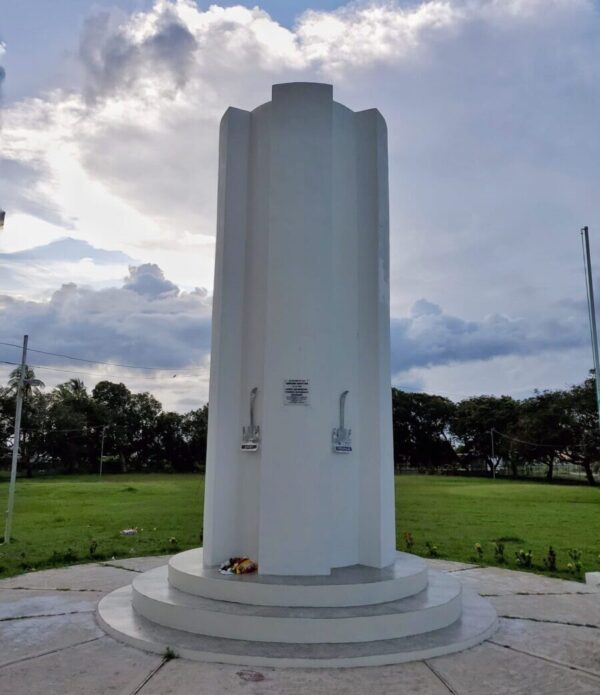
The following year, on June 16, 1977, the Enmore Martyrs Monument, designed by renowned Guyanese artist Dennis Williams, was unveiled at Enmore by Prime Minister Forbes Burnham. The monument remains the focal point of annual commemorative activities.
Notwithstanding their national status, debate over the use of the term “martyr” has persisted in some sections of society.
The late Allan Fenty, writing in his Frankly Speaking column on June 14, 2013, questioned whether the designation was historically justified.
“I often question the Enmore five’s status as ‘Martyrs’. I suppose we Guyanese are adept at stretching and manipulating definitions to suit our own interests. Whether it’s our ‘independence’ or our own ’cause’ we have that right. Right? Many sugar workers were shot dead protesting before Enmore 1948! Are they not ‘qualified’ to be martyrs too?”
Fenty’s comments reflected a longstanding argument that while the deaths of the Enmore Five were undoubtedly significant, other sugar workers who lost their lives in labour struggles before 1948 have not received comparable recognition.
The annual observance itself has also become a subject of political discussion.
Trade unionists have pointed out that the GTUC, which led the campaign that secured recognition for the Enmore Five, has not been invited to participate in some official commemorative activities in recent years.
For decades, the observance was regarded as a national event that transcended political affiliation. The tradition was maintained through successive administrations, including those of Forbes Burnham, Desmond Hoyte, Cheddi Jagan and Janet Jagan.
The commemorations took on a more partisan character during the administrations of Bharrat Jagdeo and Donald Ramotar of the People’s Progressive Party (PPP), before returning to a broader national format under the coalition government of A Partnership for National Unity and the Alliance For Change (APNU+AFC), led by President David Granger and Prime Minister Moses Nagamootoo.
Questions about the character of the observance have again surfaced under the current administration of President Irfaan Ali, with trade union and civil society voices contending that what was once a national commemoration has increasingly become associated with partisan political activity. Government supporters, however, maintain that the annual observance remains focused on honouring the sacrifices of the Enmore Five and their contribution to Guyana’s labour movement and political development.
Seventy-eight years after colonial bullets ended their lives, the legacy of the Enmore Martyrs continues to resonate beyond the sugar belt. Whether viewed as labour heroes, national martyrs, or symbols of resistance against colonial oppression, their deaths remain a pivotal chapter in Guyana’s journey toward political consciousness, workers’ rights and self-determination.