Guyana’s oil industry continues to generate unprecedented wealth, with production averaging approximately 903,000 barrels per day in April 2026 and revenues expected to climb further amid rising global oil prices. Yet despite the country’s transformation into one of the world’s fastest-growing economies and one of the richest nations on a per-capita basis, serious questions remain about whether the benefits of the oil boom are reaching ordinary citizens.
The latest surge in petroleum revenues comes against the backdrop of heightened geopolitical tensions in the Middle East. Concerns over disruptions to global oil supplies, particularly through the Strait of Hormuz, have driven crude prices upward, creating an additional financial windfall for oil-producing nations such as Guyana.
According to industry reports, Guyana is now South America’s third-largest oil producer, behind only Brazil and Venezuela, and is on track to become the world’s largest per-capita oil producer. ExxonMobil and its partners have discovered an estimated 11 billion barrels of recoverable resources in the offshore Stabroek Block, with production projected to climb to as much as 2.2 million barrels per day by 2030.
For policymakers, those figures represent a remarkable economic success story. Since first oil was produced in December 2019, Guyana has earned more than US$8 billion from profit oil and royalties. The country’s Natural Resource Fund (NRF), established to manage petroleum revenues, held approximately US$4.1 billion at the end of April 2026 and is projected to exceed US$13 billion by 2030.
The Government has repeatedly pointed to investments in roads, bridges, housing, healthcare, education and energy infrastructure as evidence that oil wealth is being converted into national development. Officials have also argued that the NRF Act of 2021 strengthened governance arrangements for managing petroleum revenues and protecting future generations from the volatility often associated with commodity-dependent economies.
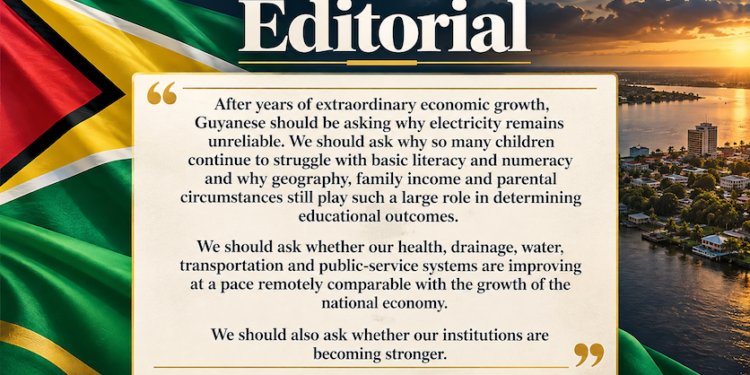
Yet beneath the impressive macroeconomic indicators lies a more troubling reality.
Despite Guyana’s emergence as a global oil powerhouse, poverty remains widespread. The 2025 poverty assessment conducted by the Inter-American Development Bank (IDB) found that approximately 58 per cent of Guyanese live below the poverty line and 32 per cent live in extreme poverty. Those findings challenged the narrative that rapid economic growth is automatically translating into broad-based prosperity.
Many local economists, social commentators and civil society organisations have argued that the situation may be even worse than official estimates suggest, particularly in hinterland communities and among vulnerable populations that continue to face limited access to healthcare, education, transportation and economic opportunities.
The persistence of poverty despite unprecedented petroleum revenues has intensified scrutiny of public policy and governance.
Analysts have long warned that Guyana possesses many of the characteristics that have historically made countries vulnerable to the so-called “resource curse”—a phenomenon in which resource wealth fuels corruption, inequality, institutional weakness and political instability rather than sustainable development.
Those concerns have been amplified by recurring findings in Auditor General reports, which have repeatedly highlighted overpayments on public contracts, weak procurement controls, missing supporting documents, inadequate inventory management, unreturned cheques, unreconciled transactions and billions of dollars in questionable expenditures across government agencies and regional administrations.
While the Government has maintained that corrective measures are being implemented, recurring findings year after year have raised questions about the effectiveness of accountability mechanisms and whether sufficient safeguards exist to protect public resources.
Equally concerning is the state of parliamentary oversight.
The Public Accounts Committee, one of Parliament’s most important oversight bodies, has often struggled to function at full capacity. Concerns have also been expressed by sections of civil society regarding infrequent sittings of the National Assembly and procedural obstacles that have limited the effectiveness of legislative scrutiny. In any democracy, robust parliamentary oversight serves as a critical check on executive power, particularly during periods of rapid public spending.
The challenge facing Guyana is not simply one of wealth generation but of wealth distribution.
The country’s oil sector has undoubtedly transformed the national economy. New highways, hospitals, schools and energy projects are under construction. Foreign investment continues to flow, and government revenues are increasing at a pace unprecedented in the country’s history.
However, for many Guyanese, particularly those living in rural, hinterland and low-income communities, daily realities remain largely unchanged. High living costs, inadequate public services, unemployment, underemployment and limited economic opportunities continue to affect significant segments of the population.
This disconnect has fueled a growing debate over whether Guyana’s development model is sufficiently inclusive.
Economic growth figures measure production and output. They do not necessarily measure whether citizens can afford food, access healthcare, secure quality education or improve their standard of living. Nor do they capture whether public institutions are strong enough to ensure that national wealth is managed transparently and equitably.
The Government has consistently argued that it is pursuing diversification through investments in agriculture, tourism, manufacturing, infrastructure and energy. Those efforts are intended to reduce dependence on petroleum revenues and avoid the pitfalls experienced by resource-rich nations elsewhere.
Nevertheless, the central question remains unresolved: can Guyana convert its extraordinary petroleum wealth into lasting human development before structural weaknesses undermine that opportunity?
With production expected to more than double by the end of the decade and billions more dollars set to flow into the Treasury, the stakes could not be higher. The country’s future may ultimately depend not on how much oil it produces, but on whether its institutions, governance systems and public policies are strong enough to ensure that the benefits of that wealth extend beyond balance sheets, government budgets and economic statistics to the lives of ordinary Guyanese.