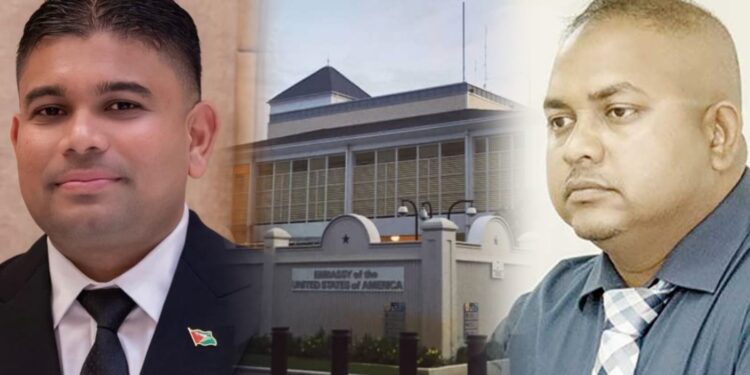
Opposition Member of Parliament Sharma Solomon is urging the government to ensure that Guyana’s proposed Development Bank is built on strong accountability, transparency and broad public representation, warning that without proper oversight the institution could become vulnerable to misuse.
In a detailed social media post, the A Partnership for National Unity parliamentarian said there is little disagreement over the need for a Development Bank in Guyana. Rather, he argued, the critical issue is whether the institution will be structured to serve the national interest and command public confidence.
“A Development Bank can either become one of the greatest instruments of national progress or one of the greatest risks to public resources. The difference lies in one thing: accountability,” Solomon stated.
The comments come amid government plans to establish a Development Bank to provide long-term financing for productive sectors of the economy. The initiative is being advanced at a time when Guyana, now one of the fastest-growing economies in the world due to its oil wealth, is seeking to diversify economic opportunities beyond the petroleum sector.
Solomon noted that Guyana is not unfamiliar with development financing institutions, pointing to the former Guyana Agricultural and Industrial Development Bank (GAIBANK), which supported agriculture, manufacturing and small industries.
“The issue is not whether Guyana should have a Development Bank, we had in the past. Initiatives such as GAIBANK helped to finance agriculture, manufacturing and small industry development. The issue is whether it will be structured in a way that earns public confidence and serves the widest possible national interest,” he said.
According to Solomon, expertise alone is insufficient to guarantee accountability. He argued that transparency, oversight and broad participation are essential safeguards when managing public resources.
“The proposed bank will be established by an Act of Parliament and funded with resources that ultimately belong to the people of Guyana. That reality makes oversight not an obstacle to development but a requirement for development,” he stated.
The opposition parliamentarian used the opportunity to criticize what he described as weaknesses in the country’s oversight framework, particularly the absence of a functioning Public Accounts Committee (PAC), one of Parliament’s principal watchdog bodies responsible for examining government spending and Auditor General reports.
“Annual reports, audits, and financial statements are important, but they only have meaning when they are actively examined. Parliament is expected to play that role. However, Guyanese should be concerned about the PPP’s abuse of oversight mechanisms including the Public Accounts Committee which have not been functioning, not only as it should but so far not at all, 10 months into the life of the 13th Parliament,” Solomon said.
He maintained that accountability depends not only on producing reports and audits, but on ensuring that institutions tasked with reviewing them are fully operational.
“Oversight works when institutions like Parliament and all its committees are active, not only because reports exist,” he added.
Solomon also called for a governance structure that extends beyond government-appointed financial experts, arguing that wider participation would strengthen public trust in the institution.
“The argument for wider representation in the governance structure should not be viewed as a call for political control. It is a call for public confidence,” he said.
He proposed that representatives from local government, agriculture, labour, cooperatives, business and other productive sectors be included in the governance framework, contending that such stakeholders possess firsthand knowledge of the challenges facing communities and entrepreneurs.
While much of the public discussion has centered on the bank’s potential role in financing small and medium-sized enterprises, Solomon argued that Guyana’s development needs are far broader.
“Agriculture, agro-processing, manufacturing, tourism, local government bodies, cooperatives, community enterprises, housing initiatives, renewable energy projects, and municipal authorities all require access to affordable development financing,” he stated.
Drawing on his experience as a former mayor, Solomon made a case for municipalities and local democratic organs to be eligible for financing through the institution. He noted that towns and municipalities are responsible for markets, roads, drainage systems, community infrastructure and local economic projects, and often struggle to access affordable capital for development initiatives.
He suggested that a Development Bank with multiple financing windows could help unlock growth not only in Georgetown, but also in communities such as Linden, New Amsterdam, Corriverton, Bartica, Lethem and Mabaruma.
“Development must not be concentrated. It must be distributed,” Solomon declared.
The APNU parliamentarian said the concept of a Development Bank has long been part of his party’s vision for economic transformation, arguing that its success should ultimately be measured by the opportunities it creates for ordinary Guyanese.
“The ultimate measure of a Development Bank will not be the composition of a board alone nor the passage of legislation alone. Its success will be measured by whether a young entrepreneur can access financing, whether a farmer can expand production, whether a municipality can invest to improve surroundings, whether a manufacturer can grow exports, whether a community can create jobs and whether ordinary Guyanese can participate meaningfully in the nation’s prosperity,” he said.
Solomon concluded by calling for a Development Bank that is independently audited, transparently governed and fully accountable to the public.
“Development without accountability creates suspicion. Accountability without development creates stagnation. Guyana needs both,” he said. “If we are to build an institution that will serve generations to come, then let us build one that reflects not only financial expertise but the democratic principle that the resources of this nation belong to all of its people.”