Book Review
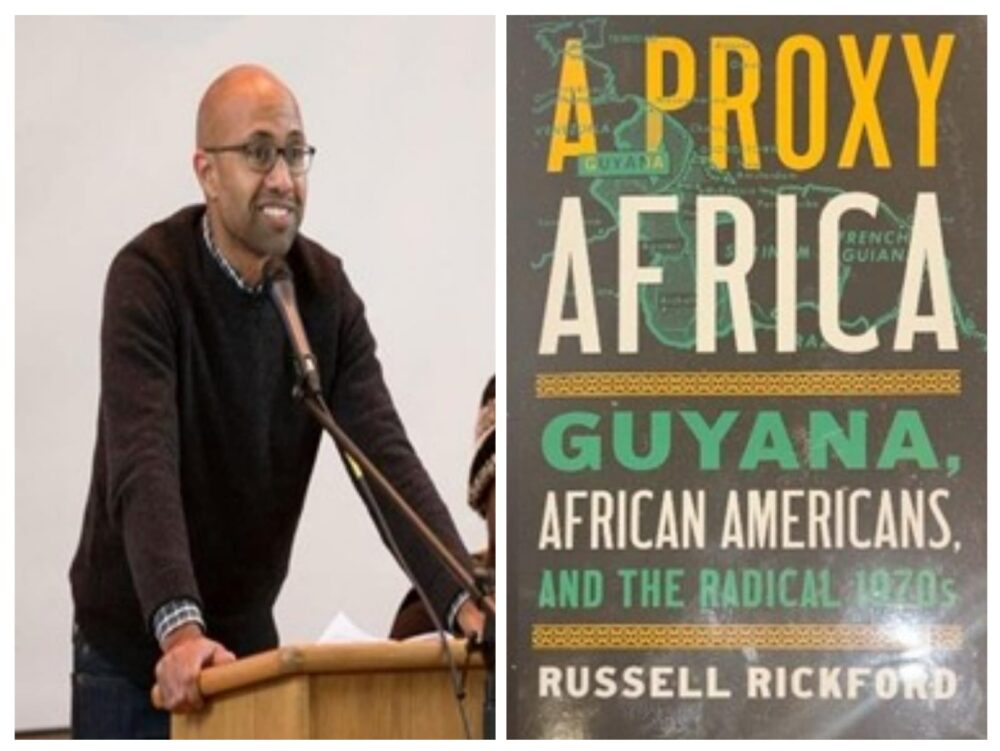
By Nigel Westmaas- Russell Rickford’s A Proxy Africa: Guyana, African Americans and the Radical 1970s is a sharp, honest, and discerning study of a remarkable understudied political moment in the history of Guyana and by extension, the United States. The result is a nuanced account of Guyana’s transformation into what he calls a proxy Africa, a symbolic and political nation unto which African Americans radicals, Pan- Africanists, black nationalists, exiles, and fugitives from the US projected their aspirations, anxieties and revolutionary hopes during the 1970s described by th author as a period in which Guyana’s “decolonial image had solidified.” .
One of the book’s major strengths is its refusal to romanticize either the Guyanese state or the various strands of African American radicalism that converged there in the 1970s. Rickford carefully reconstructs two overlapping yet often competing narratives. Rather than imposing his own subjective interpretation or framework on the material, Rickford allows the contradictions of the period to emerge organically.
On the one hand, Guyana appeared as a post-colonial experiment under Forbes Burnham, acting in de facto way as an imperialist nation aligned with the third world liberation movements. Burnham himself famously declared that under his watch, “the black American revolution would always find a home in Guyana”, a statement that captured both the symbolic ambitions and geopolitical calculations of the regime. On the other hand, Guyana became a shelter and political laboratory for African American activists disillusioned with the limitations of life under residual Jim Crow in the United States, and who were searching for racial solidarity, revolutionary purpose, or simple escape from repression at home.
The author provides a stark example of this in the case of a Marvin X who declared after his arrest for “evading military conscription” stated the following: “Since I…have no desire to be a US citizen, I demand that the USA deport me at the earliest possible date to the country of my choice, either to the Cooperative Republic of Guyana, the republic of the Sudan, the United Arab Republic, the Democratic Republic of North Vietnam, the Peoples Republic of North Korea, the Peoples Republic of China, or the Republic of Cuba,” Note Guyana’s prominence on the list.
The book likewise offers a well-constructed outline of the underpinnings of Guyana’s later radicalism. It contains a deep historical analysis of African American activism that sought out Guyana as a place of refuge or “imaginary” for Pan-Africanists and its subsequent development of what he evocatively deems the “brief golden age of Guyanese Pan-Africanism” in the 1970s.
He examines in historical detail the influence of Cheddi Jagan and his popularity in leftist US circles and among the black movements in the US in the two decades prior to independence. In this context he notes that Jagan was noted as the “dean of Guyanese anti colonialism over Forbes Burnham the democratic socialist.” But as Rickford points out “Jaganism and Burnhamism were never dichotomous” and some vestiges of Burnham’s erstwhile radicalism survived Guyana’s path to nationhood.”
While Rickford’s focus was on the important wave of African American arrivals in the 1970s, he notes several antecedents that prefaced Guyana’s radical posture of the 1970. These include Cheddi Jagan’s friendship with black Americans like WEB Du Bois and Paul Robeson and African American awareness of Guyana as an “anticolonial stronghold”.
It would have been useful for the author to also note that even prior to Guyana’s independence in 1966, the country’s two major political parties, despite being fierce rivals amid the ethnic unrest and ideological struggles of Guyana’s pre-independence period, were still able to find common cause in opposing Ian Smith’s Universal Declaration of Independence and the apartheid regime in Rhodesia (now Zimbabwe).
In fact, Cheddi Jagan’s PPP did appear on Burnham’s PNC platform at a Georgetown rally condemning the Ian Smith regime. The broader point here is that the developments of the 1970s were significant because they deepened and consolidated an already emerging consciousness of solidarity with the African continent in Guyana and elsewhere.
The book uncovers a substantial range of personalities and networks. Figures such as Lavinia Williams (famous dancer), Tom Feelings, Julian Mayfield and Herman Ferguson (aka Paul Adams who led the Guyana National Service at one point)) appear as part of a wider constellation of African American cultural and political actors who viewed Guyana as the site of diasporic possibility. More than fifty African Americans appeared throughout the text although the absence of a consolidated list of names, as in an appendix, is a missed opportunity for readers and researchers alike.
Still, Rickford succeeds in situating each figure in granular specificity within the wider Guyanese political landscape, whether aligned with the government, opposition movements or individuals, or independent radical circles. What emerges is a rich portrait of Guyana as a crossroads of black internationalism where activists, intellectuals. fugitives and dreamers move through a volatile and shifting political environment charged with both promise and disillusionment.
The structure of the chapters reflects the coated nature of the book. Chapters such as “Neo-Pan Africanism and Embodied Solidarity”, “African Americans and Guyana’s, Anti Colonial Struggle”, and “The Politics of Self Exile” trace the ideological, emotional and pragmatic investments that African Americans placed in Guyana. Rickford demonstrates how solidarity was not merely rhetorical, but deeply embodied tin migration, political work, teaching, organising, and everyday social interaction with the Guyanese state and society.
Yet the tensions surrounding race and belonging were never entirely resolved. In one revealing anecdote, while drawing attention to the relatively overlooked work of Ann Cook (later Tchaiko Kwayana) and Eusi Kwayana’s African Society for Cultural Relations with Independent Africa (ASCRIA) in organizing and laying the groundwork for the eventual wave of the black American migration to Guyana Tchaiko recounts that an employee at a Guyana mission in New York reportedly told her that “there were no Africans in Guyana.” The remark by the employee when Tchaiko was looking at the possibility of visiting Guyana exposed the contradictions between the rhetoric of Black internationalism and the realities of Guyanese racial politics.
The discussions of expatriation and “fugitivity” in the book are compelling. In chapters like “African American Expatriates in Guyana” and “Guyana and African American Fugitivity”, Rickford locates the tensions between political idealism and lived reality. Some African American arrivants found genuine purpose and community, while others encountered bureaucracy, authoritarianism, economic hardship and ideological conflict.
Rickford never loses sight of the fact that the Guyanese state was itself contradictory: anti colonial in rhetoric, yet increasingly authoritarian in practice. This contradiction was not lost on segments of the wider Pan-African world. The 1970 seminar of Pan Africanists and Black Revolutionary Nationalists held in Georgetown reflected both the optimism and ideological tensions of the moment as activists debated the meaning of Black Power, revolutionary nationalism and post-colonial sovereignty within the Guyanese context.
Similarly in 1971, the Pan African Conference in Guyana openly decried political repression in the country, highlighting the growing discomfort among black internationalists with Burnham’s increasingly coercive state apparatus. And the African Americans residing in Guyana took different sides in the local political dynamic.
Rickford also does not disappoint in his inclusion of the stellar political activist and historian Walter Rodney in the discussion. In the chapter “Walter Rodney and Black America”, Rickford highlights Rodney’s transnational influence and the reciprocal relationship between Caribbean radicalism and African American political thought. Rodney appears not simply as the Guyanese intellectual, but as a figure situated within a broader black Atlantic tradition of revolutionary struggle. Rickford effectively captures how Rodney’s ideas resonated with activists in the United States, while also revealing the local political tensions that shaped Rodney’s activism in Guyana, framed largely through his expansive version of Black Power. This tension was evident in Rickford’s coverage of Stokely Carmichael’s ill-fated trip to Guyana in 1971.
The concluding chapter, “Jonestown, Rodney and the New Society”, is striking in the way it juxtaposes two radically different versions of liberation and social transformation. Rickford’s treatment of Jonestown is effective because he focuses not merely on the spectacle of the mass murder carried out by Jim Jones, but on the deeper horrors embedded within the Jonestown settlement itself, inclusive of coercion, surveillance, psychological control, isolation, racial manipulation, and the catastrophic collapse of utopian political dreams.
Rather than treating Jonestown massacre in 1978 as an isolated tragedy disconnected from Guyana’s political climate, Rickford situates it within the wider atmosphere of experimentation, religious utopianism and con-manism and ideological crisis that defined the era. The comparison with Rodney’s revolutionary vision deepens the book’s exploration of the possibilities and dangers embedded in radical politics of the 1970s.
Rickford signs off on a wistful, perhaps even pessimistic note about the collapse of Guyana’s brief Pan African moment, a sombre conclusion that sharply resonates with the times we currently live in.