President Irfaan Ali’s government is aggressively pursuing international recognition for Guyana through cutting-edge medical and technological achievements, but observers say the administration is simultaneously dismantling one of the country’s greatest historic accomplishments — the Demerara Harbour Bridge — a globally recognised engineering feat built under the Forbes Burnham-led People’s National Congress (PNC) government.
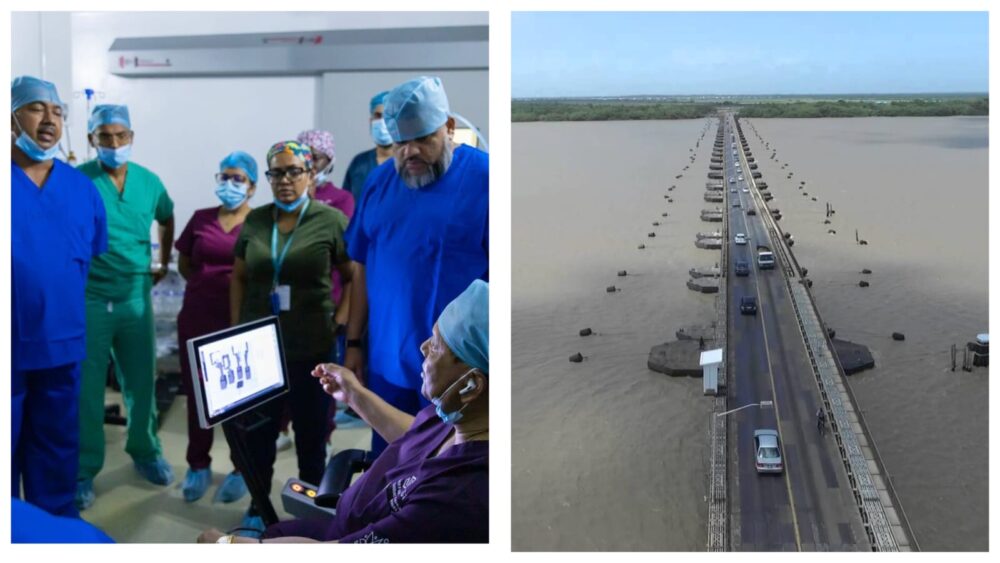
On Tuesday, the government announced what it described as a historic breakthrough in global medicine: a robotic cardiac telesurgery performed remotely from Guyana to India over a distance of approximately 20,000 kilometres.
According to the release, “Guyana has etched its name into global medical history with a groundbreaking series of robotic surgeries, including the world’s longest-distance cardiac telesurgery, performed across continents using advanced robotic technology.”
At 6:00 AM on May 26, internationally renowned cardiac surgeon Dr. Sudhir Srivastava conducted a Coronary Artery Bypass Graft remotely from Guyana on a patient in India using the SSI Mantra 3 robotic surgical system.
The government said the operation established “a new world record for the longest-distance telesurgery ever performed.”
The release also highlighted another milestone — Guyanese surgeon Dr. Hemraj Ramcharran becoming “the first Guyanese surgeon to perform robotic surgery in Guyana and the English-speaking Caribbean,” assisted by Dr. Bibi Hussain and Dr. Jagnanand Ramnarine after specialised training in India.
Undoubtedly, the medical achievement is significant for Guyana and demonstrates the country’s growing integration into high-tech global medicine. Yet many Guyanese have noted the irony that while the government is celebrating one form of history-making innovation, it is simultaneously preparing to discard another that placed Guyana on the global map nearly half a century ago.
The Demerara Harbour Bridge was commissioned on July 2, 1978 under the Forbes Burnham PNC administration. At the time of its opening, the bridge was recognised as the longest floating bridge in the world, instantly placing Guyana on the international engineering map.
Stretching approximately 1.85 kilometres across the Demerara River, the structure became a source of immense national pride and a visible statement that Guyana was capable of producing infrastructure of global significance despite limited economic resources and difficult geopolitical circumstances.
Far from being merely a transportation link, the bridge became one of the most recognisable symbols of post-independence Guyanese ambition and engineering capability. Generations of Guyanese engineers, technicians, welders, fabricators and workers played critical roles in maintaining and operating the structure over decades.
Even at the time of its closure on October 5, 2025, the Demerara Harbour Bridge still held the distinction of being the world’s longest all-steel floating bridge and ranked as the fourth longest floating bridge overall globally.
For many Guyanese, those distinctions matter because they reflect an era when Guyana earned international recognition not through imported technology alone, but through infrastructure tied directly to local skill, labour and national vision.
The irony, many observers argue, is that while the Ali administration is eager to showcase Guyana as a global pioneer through robotic surgery — a technological feat likely to be surpassed in relatively short order given the rapid pace of advances in artificial intelligence, robotics and telecommunications — the government appears less interested in preserving the enduring historical significance of the Demerara Harbour Bridge.
Unlike medical technology records, which are routinely broken as innovation accelerates, the bridge’s historical distinction as a pioneering floating structure cannot be replicated in the same way. Its place in Guyanese and Caribbean history is fixed.
Yet rather than preserving and elevating the structure as a heritage and engineering landmark, the government has focused almost exclusively on replacing it with a new fixed-span bridge.
Political commentators contend that the administration’s approach reflects a broader pattern in Guyanese politics: celebrating achievements aligned with the present PPP government while downplaying or removing symbols associated with previous administrations, particularly the Burnham era.
Supporters of preserving the bridge argue that the issue is not opposition to modern infrastructure, but opposition to what they view as the unnecessary erasure of a national achievement that brought Guyana international acclaim.
Around the world, historically significant infrastructure is often preserved even after replacement. Structures such as the Brooklyn Bridge in New York, Tower Bridge in London and the Sydney Harbour Bridge remain operational not only as transportation links but as national monuments and tourist attractions.
Many Guyanese believe the country, now flush with oil wealth and eager to market itself internationally, should similarly seek ways to preserve portions of the Demerara Harbour Bridge as a museum, heritage site or engineering monument rather than treating it as disposable relic infrastructure.
The contrast has become increasingly striking: on one hand, Guyana is celebrating a telemedicine world record dependent on imported robotic technology and international collaboration; on the other, it risks dismantling a uniquely Guyanese achievement built through local resilience, labour and innovation.
Even as the government rightly celebrates Dr. Ramcharran and his team for placing Guyana at the forefront of Caribbean robotic surgery, many are asking whether a nation truly advances by making new history while erasing the history that first made it visible to the world.