Questions are mounting over the transparency and integrity of Guyana’s public procurement system following Vice President Bharrat Jagdeo’s recent defence of the government’s small contractors’ programme amid growing controversy surrounding the distribution of state contracts.
Speaking to reporters on the sidelines of a Public Day activity at the Arthur Chung Conference Centre, Jagdeo assured that every “legitimately prequalified” small contractor would receive at least one contract this year. The vice president said approximately 12,000 persons had applied for prequalification under the government’s initiative targeting contracts valued at G$15 million and below.
However, Jagdeo claimed the process had become bogged down by widespread attempts to manipulate the system, including cases where family members allegedly registered multiple companies under different names and larger contractors attempted to access contracts intended for small operators.
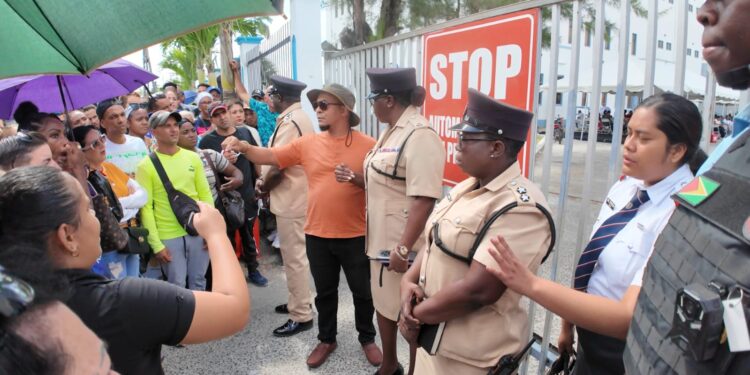
His comments came in the wake of the National Stadium contractors’ controversy exposed by We Invest in Nationhood (WIN) leader Azruddin Mohamed, whose public criticism triggered widespread backlash and ultimately forced the government to suspend the disbursement process pending review.
Political observers noted that it was not President Irfaan Ali or Public Works Minister Juan Edghill who emerged publicly to address the controversy, but Jagdeo himself, once again reinforcing perceptions that the Vice President remains the government’s dominant political authority and de facto executive head.
Jagdeo’s extensive involvement in state matters has long fuelled public discussion about the concentration of power within the administration. Although he does not hold the constitutional portfolio or responsibility of Finance Minister, Jagdeo’s signature appears on Guyana’s currency notes — a fact many Guyanese see as symbolic of his far-reaching influence over the country’s financial and administrative affairs.
Jagdeo has also long been viewed as the central political figure through whom major state decisions, contracts, and investments allegedly pass.
The People’s Progressive Party/Civic (PPP/C) government has also struggled to shake off longstanding allegations that state contracts and economic opportunities disproportionately benefit their “friends, family and favourites”. The phrase has increasingly become associated with public concerns surrounding procurement, appointments, and access to state resources, particularly as Guyana’s oil wealth has rapidly expanded government spending and contract opportunities.
A widely held public perception persists that unless individuals are politically connected or aligned with the PPP/C establishment, access to lucrative state contracts remains limited.
Concerns over corruption in Guyana’s procurement system are not new. Allegations involving bribery, favouritism, insider dealings, and political influence have circulated for decades, intensifying sharply since Guyana became a major oil-producing nation.
International attention focused on the issue in 2022 when VICE News released an undercover investigation involving Chinese businessman Su Zhirong, where conversations were secretly recorded during interactions, touching on allegations of political influence, business access, and state dealings in Guyana.
Jagdeo himself was allegedly fingered in aspects of the Chinese connection highlighted in the investigation, which reinforced public perceptions that he remains the central political gatekeeper within the administration. The investigation referenced longstanding claims that doing business in the country often required political connections or facilitation payments.
Despite the seriousness of the allegations and the international attention generated by the expose, neither President Ali nor Vice President Jagdeo ordered a broad independent investigation into the matters raised. That decision has continued to fuel public scepticism about the government’s stated commitment to transparency and anti-corruption measures.
Guyana’s corruption image has also come under increasing international scrutiny. Transparency International’s Corruption Perceptions Index has repeatedly ranked Guyana among the most corrupt English-speaking countries in the Caribbean and wider Americas under successive PPP/C administrations.
Critics argue that despite repeated public commitments to accountability and transparency, there has been little visible effort by the government to aggressively dismantle entrenched corruption practices or strengthen truly independent oversight institutions.
Further undermining public confidence is the state of parliamentary oversight. Guyana’s 13th Parliament has not sat for almost 90 days, effectively paralysing several important oversight mechanisms. As a result, critical parliamentary committees, including the Public Accounts Committee (PAC), have been unable to function effectively.
The PAC plays a central constitutional role in examining government expenditure and reviewing the Auditor General’s reports, which routinely identify concerns such as overpayments, breaches of procurement rules, weak financial controls, incomplete projects, and questionable spending practices across state agencies.
Observers say the prolonged inactivity of Parliament weakens democratic accountability at a time when Guyana is experiencing unprecedented oil revenues and massive increases in public spending.
Without regular sittings of the National Assembly and active scrutiny by oversight bodies, claims by government officials that they are serious about combating corruption are increasingly being viewed with scepticism.
Against that backdrop, Jagdeo’s explanation that delays in the small contractors’ initiative stem mainly from applicants attempting to “cheat the system” has drawn criticism from those who argue that the deeper issue lies within the procurement structure itself and the lack of strong, independent oversight.
The Department of Public Information’s coverage of Jagdeo’s remarks has also come under scrutiny. Observers noted that the report largely reproduced the vice president’s defence of the programme without including views from frustrated contractors, procurement specialists, opposition figures, civil society organisations, or transparency advocates.
Many Guyanese view the controversy surrounding the National Stadium contracts and the wider small contractors’ programme as reflecting deeper anxieties about governance during the oil boom era — particularly whether public resources are being distributed fairly, transparently, and free from political influence.
As billions of dollars continue flowing through state projects and procurement programmes, pressure is mounting on the government to strengthen oversight institutions, restore parliamentary scrutiny, improve transparency in contract awards, and demonstrate a genuine willingness to investigate allegations of corruption regardless of political affiliation