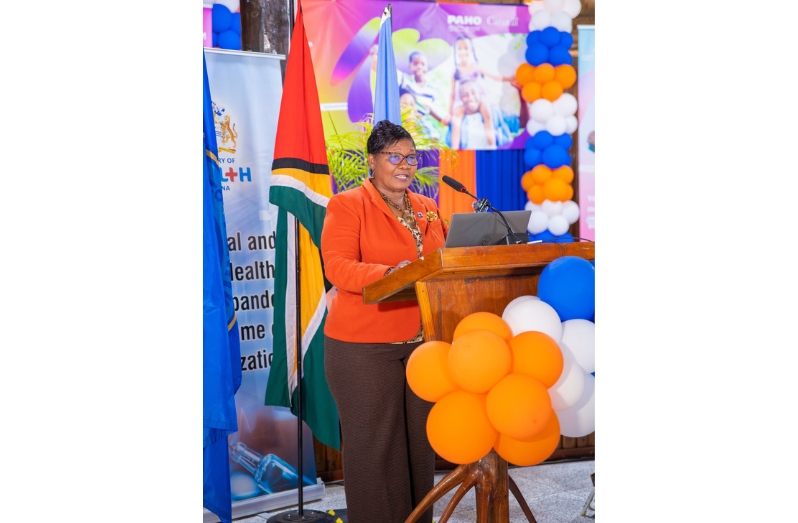
The Caribbean Community (CARICOM) has renewed its commitment to strengthening immunisation across the Region, joining regional health partners in commemorating the 24th Vaccination Week in the Americas with the Caribbean launch in Georgetown, Guyana on Saturday.
Delivering remarks on behalf of the CARICOM Secretariat, Director of Human Development, Helen Royer said this year’s theme — “Your decision makes a difference” — comes at a critical time as countries confront emerging health threats and the spread of vaccine misinformation.
Royer praised Guyana’s immunisation progress, noting that the country’s health leadership has positioned it as a model for the Caribbean.
“Our presence here also signals that our Region is firmly anchored in the 2023 Declaration of Nassau. Through that historic commitment, our Ministers of Health signalled that immunisation must remain central to our political and developmental agendas,” Royer stated.
She said the Caribbean’s public health achievements remain a source of pride, highlighting that the wider Americas became the first region globally to eliminate smallpox and poliomyelitis.
“The Region is moving with precision because of our collective actions. We take great pride in our legacy. The Americas was the first Region in the world to eliminate smallpox and poliomyelitis. Within our own Caribbean Community, we have reached even more extraordinary milestones, having successfully eliminated many vaccine-preventable diseases, including diphtheria, congenital rubella syndrome, and rubella,” she said.
CARICOM pointed to several recent milestones, including Jamaica receiving the Pan American Health Organisation’s Henry C. Smith Award for improved immunisation coverage, and Guyana’s introduction in 2025 of the 9-valent HPV vaccine and its first seasonal influenza vaccine.
Royer, however, warned that the Region cannot become complacent amid a resurgence of measles cases across the Americas.
She said the challenge is no longer solely vaccine availability, but combating what she described as an “infodemic” of misinformation that fuels vaccine hesitancy and threatens community safety.
The official also highlighted Guyana’s cross-border vaccination efforts with Brazil and Suriname as a practical example of regional cooperation, saying such partnerships are helping to build what she described as a “community of immunity.”
CARICOM, the Caribbean’s main regional integration body, was established on July 4, 1973, with the signing of the Treaty of Chaguaramas in Trinidad and Tobago by four founding leaders: Forbes Burnham of Guyana, Errol Barrow of Barbados, Michael Manley of Jamaica, and Eric Williams of Trinidad and Tobago.
The Community today comprises 15 full Member States: Antigua and Barbuda, The Bahamas, Barbados, Belize, Dominica, Grenada, Guyana, Haiti, Jamaica, Montserrat, St Kitts and Nevis, Saint Lucia, St Vincent and the Grenadines, Suriname, and Trinidad and Tobago.
It also includes six Associate Members: Anguilla, Bermuda, the British Virgin Islands, the Cayman Islands, Curaçao, and the Turks and Caicos Islands.
The vaccination initiative is being coordinated in collaboration with the Pan American Health Organisation (PAHO) as regional governments work to sustain immunisation gains and strengthen healthcare systems against future disease outbreaks.