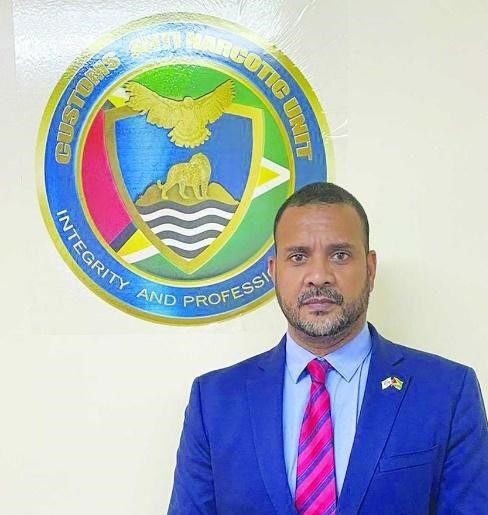
By Mark DaCosta- The Ministry of Home Affairs has launched a serious investigation into alleged threats made against the Director of the Customs Anti-Narcotics Unit (CANU), James Singh, as a viral video depicting these menacing statements circulates on social media.
In recent days, a disturbing video featuring an armed and masked individual making explicit threats against Singh has raised significant concern across the country. The man, brandishing a firearm and displaying a photograph of the CANU director, voices chilling declarations of violence, asserting that “the syndicate is coming for you” and promising, “we are going to kill you.” This shocking display of intimidation has prompted immediate responses from various government authorities, illustrating the seriousness with which threats against public officials are treated.
The Ministry of Home Affairs emphasises that any threat to the life of a public servant represents a grave criminal matter. “Law enforcement agencies have launched an active investigation to determine the origin, authenticity, and intent of the video, and all necessary measures are being taken to ensure the safety and security of those targeted,” a spokesperson stated. This call sets the tone for the government’s stance: threats and intimidation will not be tolerated, as they undermine our collective fight against organised crime and disrupt the rule of law.
The origins of CANU are rooted in the urgent need to combat illicit drug trafficking, particularly given our strategic location in the Caribbean. Formed in 1995, this law enforcement agency was birthed from increasing concerns about drug trade operations targeting our nation as a transshipment point for South American cocaine. Over the years, CANU has transformed from a modest task force into an advanced agency with a multi-faceted approach, combining intelligence and operational activities to thwart narcotics smuggling.
Under the supervision of the Ministry of Home Affairs, CANU operates with a significant level of autonomy while aligning its strategies with the National Drug Strategy Master Plan. At the helm is Director James Singh, who has been instrumental in fostering international collaboration and modernising the agency’s operations. CANU’s mission is clear: to dismantle and disrupt drug trafficking organisations through rigorous intelligence work, on-the-ground raids, and a comprehensive legal framework that supports investigations and prosecutions.
In the first quarter of 2026, CANU achieved notable successes, having seized over 371 kilograms of narcotics and dismantled several trafficking routes through focused, intelligence-driven operations. Such achievements testify to the agency’s commitment and effectiveness in its ongoing battle against drug-related crime. Yet, as this recent incident indicates, the threats faced by CANU are not merely operational; they are deeply personal, targeting individuals who dedicate their lives to public service.
The government’s response to this situation – however one looks at it – reveals an ongoing struggle against the tide of organised crime, with the Ministry of Home Affairs asserting, “intimidation will not succeed. Threats against law enforcement officials will be met with the full force of the law.” It is evident that the challenges posed by narcotics trafficking are intertwined with broader issues of governance and public safety. As drug trafficking systems become increasingly sophisticated, so too do the threats against those who fight them.
With our nation being a significant transit route for cocaine headed to North America and Europe, the stakes have never been higher. The potential of our country becoming a “narco-state,” where criminals exert greater influence than the government, looms large. CANU’s role as the frontline defence against such a catastrophic outcome cannot be understated. The agency’s efforts contribute significantly not only to public safety but also to the country’s international standing and economic stability, elements that could be jeopardised by the spectre of drug-related violence and corruption.
The need for unwavering coordination and focused strategies to dismantle these criminal networks persists, as does the importance of community engagement to build trust and encourage citizens to participate in the fight against drug trafficking. The ongoing investigation into the threats against Singh is thus not merely a legal effort; it is a vital aspect of reaffirming our national commitment to uphold justice and protect those who serve on the front lines.
Amidst these challenges, it is crucial that the government reassesses its strategies and actions concerning organised crime and public safety. The threats directed at Singh could serve as a sharp reminder of the battles faced by those in law enforcement and the socio-political dynamics underpinning our national security apparatus. Our collective future hinges on the resilience of not only the agencies tasked with upholding the law but also the commitment of our leadership to confront these challenges head-on.