Five years after Guyana recommitted itself to the Global AIDS Strategy aimed at ending AIDS by 2030, the country has failed to achieve one of its most critical public health targets: eliminating mother-to-child transmission of HIV.
The failure is becoming more glaring as regional neighbours continue to outpace Guyana in one of the most important benchmarks in HIV prevention.
The Bahamas was recently certified by the Pan American Health Organisation (PAHO) and World Health Organisation (WHO) for eliminating mother-to-child HIV transmission, becoming the 11th CARICOM territory to reach that milestone. The Bahamas joins Antigua and Barbuda, Belize, Dominica, Jamaica, Saint Kitts and Nevis, Saint Vincent and the Grenadines, Anguilla, Bermuda, the Cayman Islands, and Montserrat—all of which have already achieved the internationally recognised target.
Guyana remains absent from that list.
In January 2021, Guyana launched its National HIV Strategic Plan 2021–2025, recommitting to the Global AIDS Strategy with ambitious targets, including reducing new HIV infections among vulnerable groups by 95% by 2025 and ensuring that all babies would be born free of HIV and other sexually transmitted infections by 2025, effectively ending mother-to-child HIV transmission.
Those targets have not been achieved.
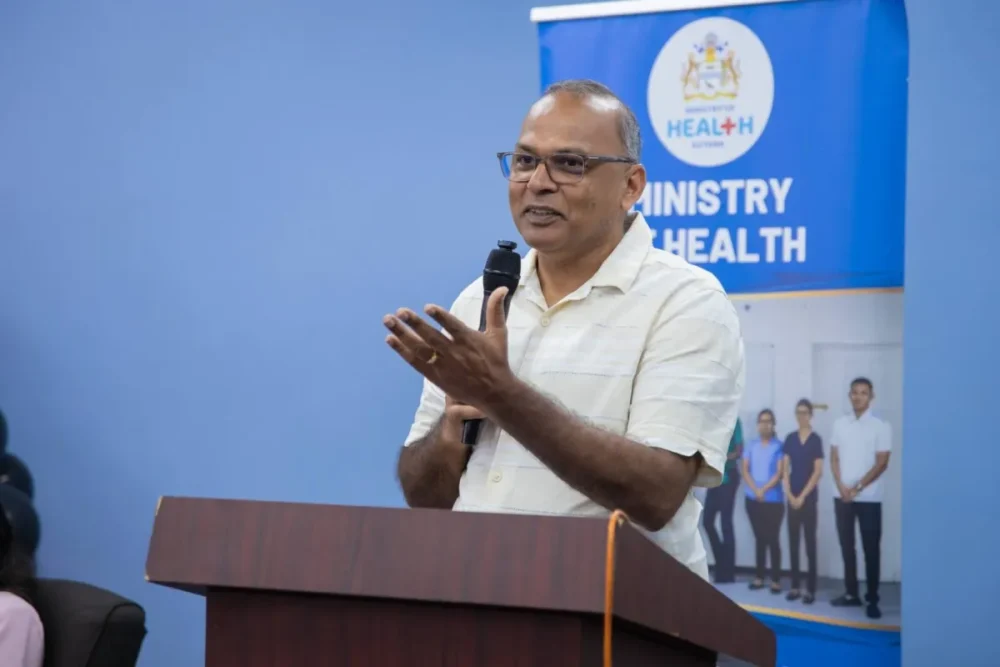
The missed benchmark is particularly striking given the scale of spending. Guyana allocated G$143.2 billion to health in 2025 and increased that figure to G$161.1 billion in 2026, one of the largest health budgets in the country’s history, under Health Minister Frank Anthony.
Yet, despite the billions invested, Guyana has not secured WHO certification for elimination of mother-to-child transmission (EMTCT), a critical marker of healthcare system performance.
Medically, EMTCT is one of the clearest indicators of whether a country’s HIV prevention system is functioning effectively.
Without timely HIV testing and treatment, the virus can pass from mother to child during pregnancy, labour, delivery, or breastfeeding at rates between 15% and 45%. With proper intervention, including antiretroviral therapy and viral suppression, that risk falls to below 2%.
Guyana has reported progress. The Ministry of Health said mother-to-child transmission rates fell to 1.1% in 2022, but progress alone is not elimination. WHO certification requires sustained results, universal antenatal screening, treatment coverage, infant testing, and independent verification.
Guyana continues to carry a significant HIV burden. UNAIDS estimates about 11,000 people are living with HIV in the country, with treatment coverage still below optimal global targets—an issue that continues to expose vulnerable mothers and newborns, particularly in hinterland and underserved communities.
The failure to meet the 2025 target under Guyana’s own National HIV Strategic Plan raises serious questions about implementation and accountability.
Every missed HIV diagnosis during pregnancy, every delay in starting treatment, and every failure in maternal viral suppression increases the risk of preventable infection in newborns.
Guyana promised HIV-free births by 2025. That target has passed without certification, leaving the country behind much of the Caribbean in a fight where prevention is measurable, and delay carries lifelong consequences.