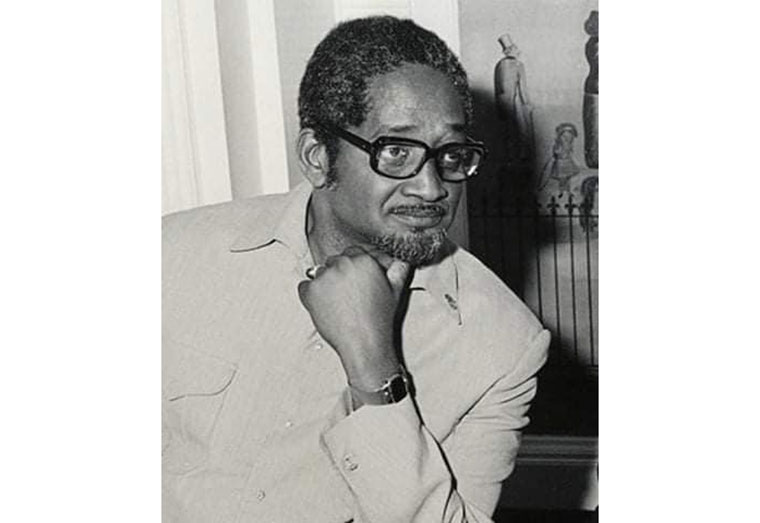
By Mark DaCosta- As we mark the anniversary of the birth of Linden Forbes Sampson Burnham on February 20, it is crucial to reflect on his complex legacy as one of the pre-eminent figures in our nation’s journey towards autonomy and self-identification. His historical significance extends beyond mere political leadership; it is interwoven with the very fabric of our collective consciousness, encapsulating the struggles and aspirations that have shaped modern Guyana.
Burnham’s formative years were marked by academic prowess and a drive for social justice. Born in 1923 in Kitty, Georgetown, to a family that valued education and hard work, he quickly distinguished himself as a gifted student. His educational journey took him to Queen’s College, where he not only excelled academically but also showed an affinity for public speaking and debate.
After winning the prestigious Guiana Scholarship in 1942, he completed his Bachelor of Arts degree through London’s external examinations due to the disruptions caused by World War II. Pursuing his legal education at the London School of Economics, he emerged as a prominent figure among Caribbean students, ultimately becoming the president of the West Indian Students’ Union.
Upon returning to British Guiana in 1949, Burnham realised that his newfound knowledge and status could be employed as instruments for change. Collaborating with Cheddi Jagan, a fellow visionary and strategist, Burnham co-founded the People’s Progressive Party (PPP) in 1950. Their partnership represented a significant multicultural political movement, uniting Afro-Guyanese and Indo-Guyanese in a shared aspiration for freedom from colonial rule. Their mission culminated in success during the 1953 elections, where the PPP secured a decisive victory, marking the first time that universal suffrage was used in the colony.
However, the partnership was short-lived. Just months after assuming power, the British colonial authorities suspended the constitution, demonstrating their fear of a leftward shift under the PPP banner. The suspension sowed discord between Burnham and Jagan, leading to an ideological split in the party by the mid-1950s.
While Jagan gravitated toward a more rigid Marxist framework, Burnham sought a path that would appeal to a broader constituency, albeit with a distinctly nationalist undertone. In 1957, he formally broke from the PPP to establish the People’s National Congress (PNC), that created fixtures and fodder to transform the political landscape into a battleground characterised by ethnic identities rather than class struggle.
As the 1960s unfolded, British Guiana faced mounting civil unrest, with recurring ethnic riots and strikes escalating tensions. Sensing the geopolitical implications, the United States and British governments intervened to curb Jagan’s influence, steering constitutional changes that would favour Burnham‘s coalition with the United Force. This paved the way for Burnham‘s ascension as Premier in 1964 and ultimately led to Guyana’s independence in 1966, where he famously embraced Jagan in a moment that hinted at a more collaborative future.
Upon independence, Burnham embraced a bold vision for the nation, declaring Guyana a Co-operative Republic in 1970. His government sought to grant empowerment to the working class, espoused through a doctrine of “Co-operative Socialism” that called for nationalisation of key industries — in effect, reasserting local control over resources that had long been imperialised. Burnham‘s government took decisive steps to nationalise the bauxite and sugar sectors, with the aim of rectifying the historical imbalances created during colonial rule.
However, these revolutionary ambitions were soon overshadowed by economic challenged occasioned by Cold War politics, escalating oil prices and internal political wrangling/dissent. Policies meant to uplift the populace led to shortages of essential goods, resulting in a reliance on local substitutes for basic food items. Burnham’s focus on self-sufficiency seemed noble in intention but was not without setbacks given the fractious political landscape.
Burnham’s reign ultimately concluded with his death in August 1985, but his impact remains profoundly felt in our nation today. His intellect and oratorical skills were vital tools in his arsenal. As he sought to “make the small man a real man,” he built a narrative that resonated with many unto today.
The legacy of Linden Forbes Sampson Burnham serves as a reminder of the complexities involved in nation-building. His role as a founding father of regional cooperation efforts, such as CARICOM, and his unwavering commitment to asserting Guyana’s independence must be weighed against internal and external factors. In a time when our country strives for unity and progress, examining the lessons from Burnham’s legacy allows us to better understand the intricate relationship between power, identity, and governance.
As we remember Burnham today, it is essential to engage critically with his story, understanding both the ideals that he championed and the consequences of his actions. The quest for a balanced and equitable society is far from over — a journey that demands the lessons of our past be carefully considered as we continue to shape our nation’s future.