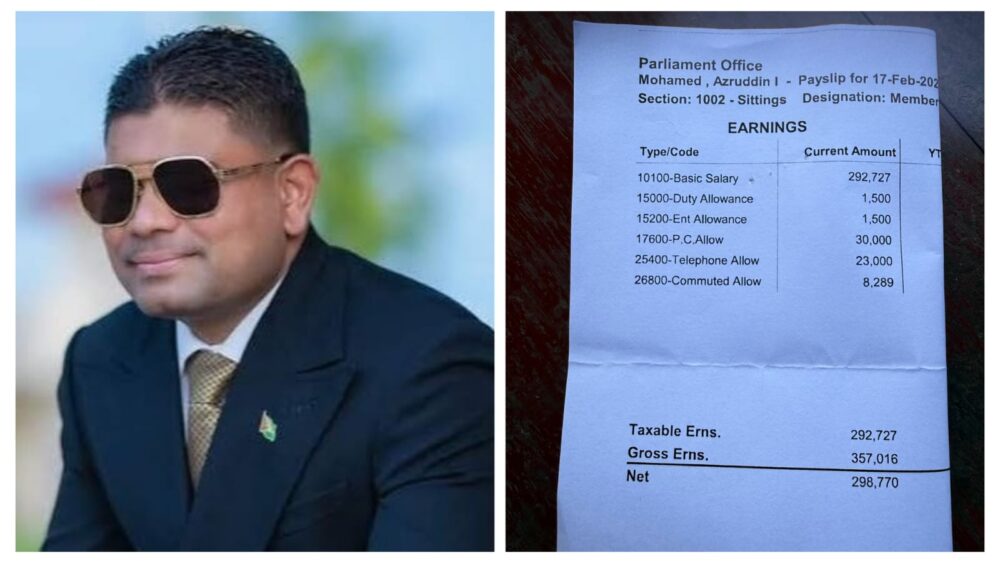
A pay slip released to the public-on Team Mohamed’s social media page- shows that Azruddin Mohamed, who was elected Leader of the Opposition on January 26, 2026, received only the basic Member of Parliament salary of G$ 292,727 for the month of February, despite the higher remuneration and benefits attached to the constitutional office.
Mohamed assumed the post two months after the National Assembly convened on November 3, 2025, following the 2025 General and Regional Elections. Under existing parliamentary provisions, the Leader of the Opposition is entitled to a salary and benefits equivalent to those of a senior cabinet government minister. Publicly reported figures indicate this totals approximately G$1.9 million per month, inclusive of allowances — or about G$ 21.6 million annually.
However, the February pay slip dated February 17, 2026 reflects payment only at the standard MP rate of G$ 292,727, with no indication of additional allowances or ministerial-equivalent compensation for that month.
Based on the reported average monthly remuneration of G$ 1.9 million for the office, the February payment represents a shortfall of G$1,607,273 — calculated as G$ 1,900,000 minus G$292,727 — below the expected monthly compensation for the constitutional post.
The 2026 National Budget allocated G$34.6 million to the Office of the Leader of the Opposition to cover staffing and operational expenses.
The matter has also drawn attention in light of Mohamed’s previous public commitments regarding official compensation. During the 2025 elections campaign, he pledged that if elected President, he would donate his salary. After it became clear he would serve instead as Leader of the Opposition, he reiterated that commitment, stating he would also donate the salary attached to that office.
The release of the February pay slip has therefore prompted questions about the status of his full remuneration package and whether adjustments will be made to reflect his election to the post on January 26.
To date, there has been public discussion regarding the implementation of the benefits and entitlements attached to the office, including security arrangements and staffing provisions. The discrepancy between the statutory entitlements of the office and the amount reflected on the February pay slip is likely to fuel continued debate over administrative processing and recognition of constitutional offices within the parliamentary framework.