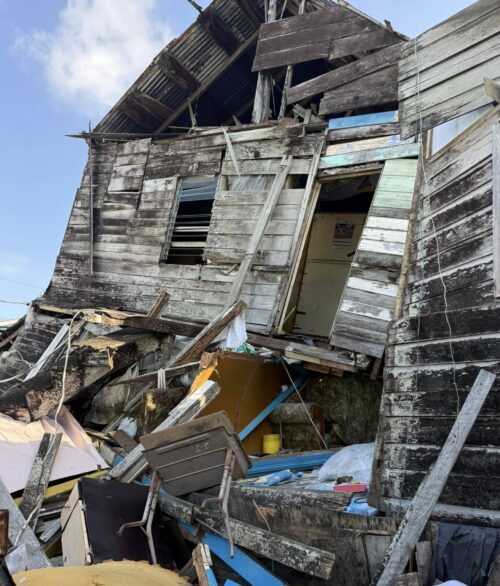
By Mark DaCosta- Last Friday a wooden structure in the impoverished community of Albouystown collapsed, leaving twelve individuals, including ten young children, without shelter and in urgent need of assistance. This incident highlights a critical failure in housing safety that disproportionately affects the most vulnerable members of our nation, raising serious concerns about government oversight and resource allocation.
The incident unfolded when the dilapidated home at the intersection of Hill and Sussex Streets crumbled, resulting in one adult being injured and transported to the Georgetown Public Hospital Corporation (GPHC). Thankfully, the other residents managed to escape before the structure gave way entirely.
Such tragic events are becoming all too common, posing dire questions about the state of housing and infrastructure in areas like Albouystown, where residents, often struggling to make ends meet, are left to fend for themselves in the face of disaster.
In a display of solidarity and support, the Leader of the Opposition, Mr. Mohamed, promptly visited the devastated family. During his visit, he extended financial assistance to them, which was a much-needed gesture amidst the government’s apparent neglect. This event has reignited calls for the ruling administration to utilise the substantial financial resources allocated to various humanitarian projects effectively.

“WIN calls on Men on a Mission, which received $900 million in this year’s budget, and the Office of the President, which received $300 million for humanitarian works, to provide emergency assistance to this family immediately,” the Opposition noted, urging those in power to act decisively in support of the displaced individuals.
The stark reality is that many families in similar circumstances remain unsupported while the government appears to mismanage and waste public resources. A particularly unsettling revelation was that Mr. Mohamed was reportedly followed by police in a state vehicle during his visit, raising eyebrows about the continued surveillance of opposition leaders in our country. This act of intimidation only reinforces the notion that those in power are more concerned with quelling dissent than addressing the real needs of the populace.
The collapse has far-reaching implications for the affected families, both physically and psychologically. The immediate dangers include severe injuries from the collapse itself, as well as the loss of essential belongings and access to basic sanitary conditions. Families, already living on the edge, face an imminent threat to their health and wellbeing.
For individuals with existing health issues, such as respiratory conditions, the consequences of displacement can be life-threatening as they are forced to navigate the adverse effects of temporary housing and reduced access to healthcare.
Beyond the physical toll, the psychological impacts are equally significant. Survivors may experience acute traumatic stress, causing anxiety, disorientation, and feelings of helplessness. The need for immediate psychosocial support has never been more urgent, and it is the government’s responsibility to ensure that those affected receive the care they need.
The underlying negligence that led to this catastrophe is indicative of a broader failure on the part of the Central Housing and Planning Authority (CHPA) to enforce building codes and ensure the safety of housing structures in vulnerable communities.
“Proactively, the CHPA should have implemented regular structural inspections of older, vulnerable buildings in high-density areas like Albouystown,” experts argue. The absence of such measures not only disregards the safety of residents but also reveals the government’s glaring lack of commitment to safeguarding its citizens.
Moving forward, immediate action is required from the government. The Civil Defence Commission (CDC) must step in to provide temporary housing options that prioritise the dignity and safety of the displaced families.
Access to essential medical care, food, and clothing must be guaranteed without delay. Additionally, counselling services from the Ministry of Human Services and Social Security should be deployed to assist affected families in navigating the psychological repercussions of this traumatic event.
Looking beyond immediate relief, the government must commit to a long-term recovery plan that invests in rebuilding efforts. This may include emergency grants, material subsidies, or the prioritised allocation of housing units to restore stability for those left homeless. Without a robust support system, families in our nation will continue to live in fear of similar disasters and face an uncertain future.
As we reflect on the events of that fateful day in Albouystown, it becomes painfully clear that many of our citizens are left without hope. The government’s mismanagement of resources and its failure to protect the most vulnerable demonstrate a profound disconnect from the needs of the people.
In a country rich with potential and resources, it is unacceptable that families should suffer in silence whilst the ruling administration turns a blind eye to their plight. Our leaders must remember that their primary responsibility lies with the people they serve. Only then can we move towards a future where no family is left behind in times of crisis.