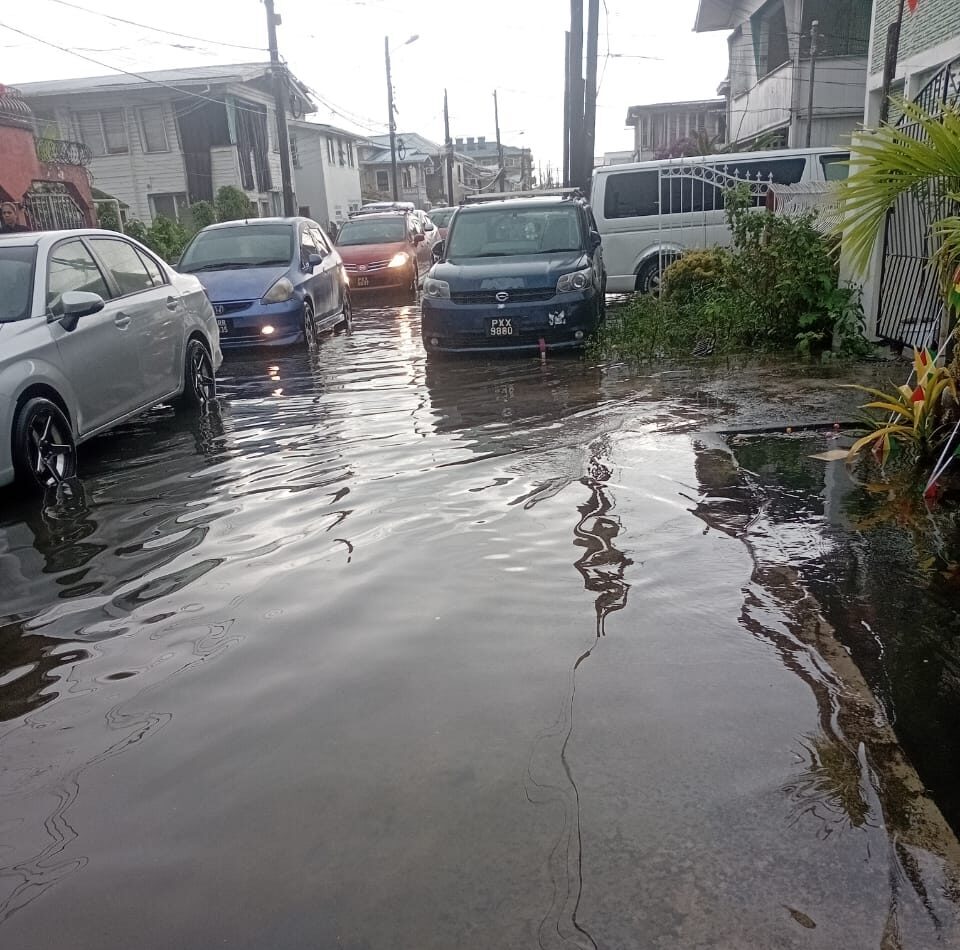
By Mark DaCosta- The capital city of Georgetown is grappling with severe flooding, the culmination of a relentless deluge that has overwhelmed its already challenged drainage systems. As the torrential rain lashed the city, authorities have mobilised to manage the crisis, yet the consequences are stark and immediate, with rising water levels causing significant disruption to daily life. Despite these efforts, many residents were left stranded, as streets turned impassable, prompting businesses to hastily erect barriers to protect their properties from the encroaching water.
“These conditions are expected to continue for approximately the next two hours,” warned the Hydrometeorological Service in its flood advisory, emphasising the heightened risk for low-lying and flood-prone areas. Visibility has plummeted across much of the city, further complicating the situation for commuters and emergency services alike.
Rasheed Kellman, the engineer overseeing the city’s drainage network, asserted that the pumps are operational and actively assisting in mitigating the flooding. However, he acknowledged that Georgetown’s unique geographical features make it particularly susceptible to such scenarios.
“We are putting together a plan in case we have any future events,” he stated, a sentiment that underscores the precariousness of the city’s infrastructure. Georgetown’s vulnerability to flooding is part of a broader, chronic struggle that dates back generations. Drawing on a confluence of topographical, climatic, and infrastructural factors, the city’s past is marred by historic floods that have left an indelible mark on our nation.
The catastrophic events of 2005 are perhaps the most notable, when sustained rainfall fuelled by high spring tides inundated two-thirds of Georgetown, resulting in staggering damage that amounted to around 60 percent of the country’s GDP. Such events have only reinforced the urgent need for effective flood management strategies and infrastructure improvements. The persistence of flooding in Georgetown can be attributed to several interlinked causes.
For one, much of the city lies at least 1.5 metres below the mean high tide level. Consequently, it relies heavily on a man-made network of sea defences and drainage canals to fend off encroaching ocean waters. During intense rainfall, when the ground is saturated, the ability for water to infiltrate diminishes drastically, leading to surface runoff that can overwhelm urban drainage capacity.
Another significant factor is the city’s tidal dependence, which constrains drainage efforts to the limited window of low tide. This means that when heavy rain coincides with high tide, excess water has nowhere to go, forcing it back into the streets and exacerbating flooding. As sea levels rise due to climate change, the window for successful drainage continues to shrink, presenting an ongoing threat to Georgetown’s well-being.
Adding to these challenges is the aging drainage infrastructure, which consists of a hybrid of antiquated Dutch designs and modern pumping stations that often fail to work in harmony.
The kokers, or sluices, intended to release water into the ocean often succumb to mechanical failures or are obstructed by debris, rendering them ineffective. Canals and trenches, the lifelines transporting water away from the city, are frequently choked by silt and refuse. Insufficient pumping capacity further compounds the matter, as these mechanical systems are often overburdened, leading to delays in effective water removal.
Despite significant investments in infrastructure over the years, including initiatives such as the Hope Canal to facilitate direct drainage of excess water, the city remains vulnerable. The government’s response to flooding incidents has been lacklustre and reactive rather than proactive. This delays improvements and adaptations needed to counter the increasing challenges posed by climate change and rising sea levels.
Each flooding event underscores the urgent need for systemic change and a comprehensive review of Georgetown’s flood management policies. As we navigate these turbulent waters, it is crucial that the decision-makers in our country heed the lessons of our past. Ensuring the safety of our citizens and the resilience of our infrastructure should be paramount, but the recent flooding reveals a troubling disconnect between policy and reality.
Our nation cannot afford to wait for disaster to strike before taking meaningful action. In the wake of these events, it is incumbent upon our leaders to initiate concrete plans that go beyond temporary fixes.
Investing in high-capacity pumps, restoring mangroves for natural coastal defence, and improving drainage systems must be prioritised. With storms expected to increase in intensity due to climate change, Georgetown deserves a future where such loss and disruption are no longer a daily threat. The time for decisive action is now, lest we find ourselves forever battling the rising tide.