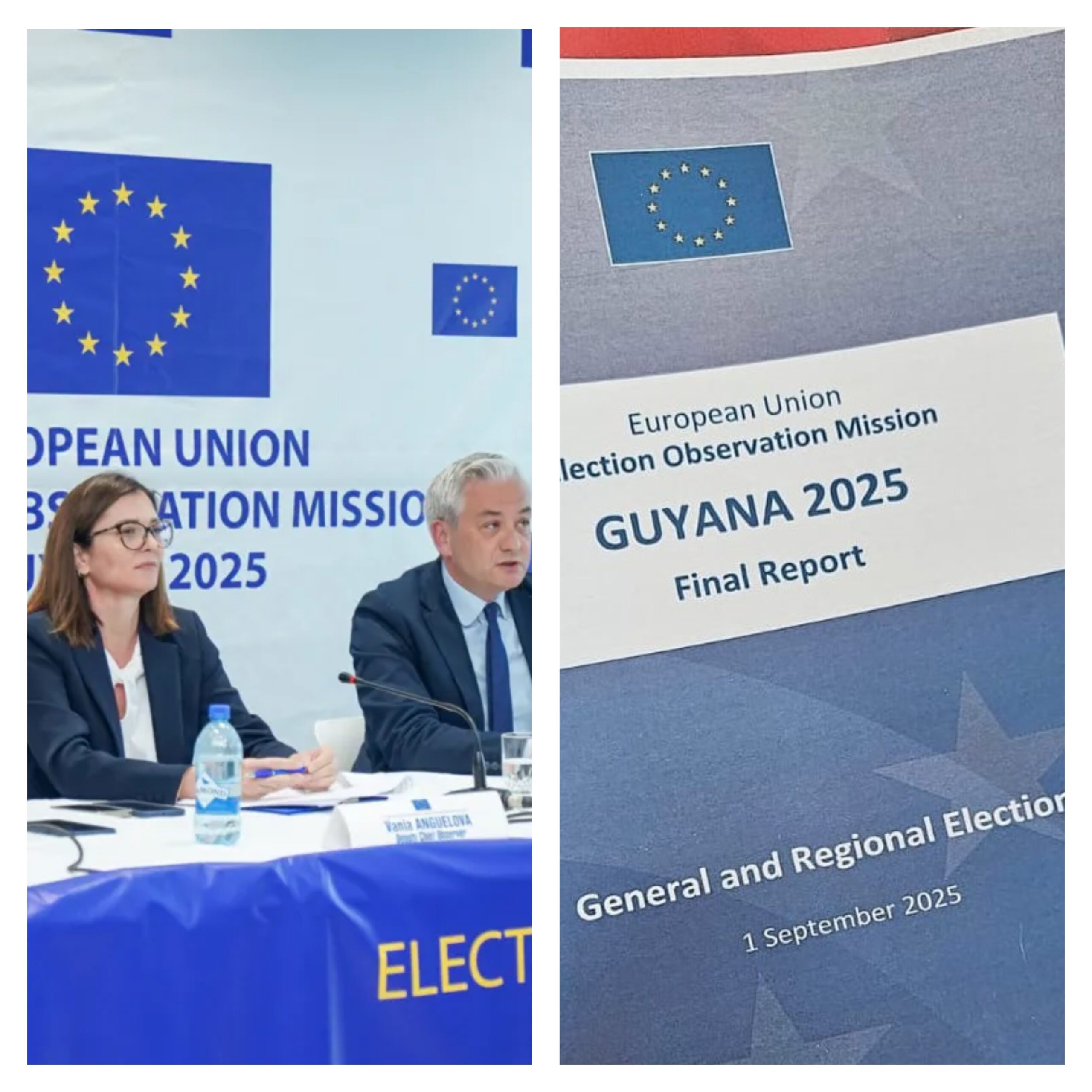
By Mark DaCosta- President Irfaan Ali has categorically rejected the final report of the European Union Election Observation Mission (EU EOM), labelling it as fundamentally biased and inadequate. This decisive stand comes in light of the EU’s serious allegations regarding electoral unfairness, which the president claims misrepresents the realities of the election landscape.
The EU EOM’s findings, released on Tuesday, highlighted significant shortcomings in the electoral framework surrounding the 1 September elections. Although the voting process was described as peaceful, the report raised serious questions about the integrity of the elections, noting that “the undue advantage of the ruling party… distorted the level playing field.” The report pointed out that the government had exploited its incumbency and state resources, thereby putting opposition parties in a considerably disadvantageous position.
President Ali, however, vehemently rejected these assertions during a Facebook Live commentary, insisting that his government did not misuse public projects for electoral gain and that all political factions engaged with cash grant beneficiaries, not exclusively the People’s Progressive Party Civic (PPPC). He dismissed the claim that his administration had employed cash grant registrants’ personal information to solicit votes, stating, “It’s a fact that persons received calls from all political parties; not only the incumbent; all political parties. This is not an incumbency problem.” He provided no evidence to corroborate the statements.
These remarks underscore an ongoing pattern from the PPP, which has been known to fiercely defend its actions while attempting to deflect responsibility for criticisms of its governance strategies. President Ali’s claims are particularly striking given the EU observers’ detailed recommendations for robust campaign regulations to ensure electoral fairness and integrity. The report highlights the misuse of data from the 2023 Data Protection Act to engage in “politically motivated doxing,” where citizens’ personal information was reportedly misappropriated for political campaigning.
In addressing the report, Ali questioned the origins of the narratives within the EU’s findings, suggesting they were biased and subjective, influenced by local political actors. He stated, “I’ve highlighted some areas in the report that are subjective, partisan and completely biased, and cannot by the lowest benchmark be viewed as fair and balanced.” According to one analyst, this observation speaks volumes about the administration’s reluctance to confront its own perceived shortcomings while attempting to stifle dissenting voices through ridicule of international assessments.
The EU’s detailed analysis also draws attention to the deeply entrenched issues of transparency and media bias that marred the electoral process. The report describes a media environment that is “vibrant but highly polarised,” emphasising that state-controlled channels demonstrated clear bias towards the ruling party, limiting the opposition’s reach and further entrenching disparities in public discourse.
The observers noted that while the Guyana Elections Commission (GECOM) handled the logistics of the election process competently, the lingering perception of partisan influence thwarted trust among opposition parties.
Political campaigning during the lead-up to the elections was fraught with tension and confrontation, particularly towards new contenders like We Invest in Nationhood (WIN) party. Instances of intimidation and aggressive retaliation against members of WIN raised grave concerns about the climate in which voters made their choices. Reports indicated that many affiliated with WIN experienced severe disruptions, including the closure of their bank accounts.
The findings also pointed out that the electoral process lacked sufficient safeguards for voters, highlighting numerous challenges, including the questionable accuracy of the voter list, which opposition parties have decried for years. Furthermore, the prevailing compliance framework concerning campaign finance was notably deficient, lacking necessary regulations that foster financial transparency. Such shortcomings only serve to deepen public scepticism around electoral integrity.
While the elections proceeded without notable incidents, the shadow of distrust looms large over our nation’s democratic framework. With widespread calls for reform echoing among citizens and civil society, the need for electoral transparency and fairness is more pressing than ever. The EU EOM has advocated for sweeping changes to the electoral legal landscape.
As the government responds to international criticism with defiance, it reflects a worrying trajectory that could undermine democracy in our country if left unchallenged, said an analyst.