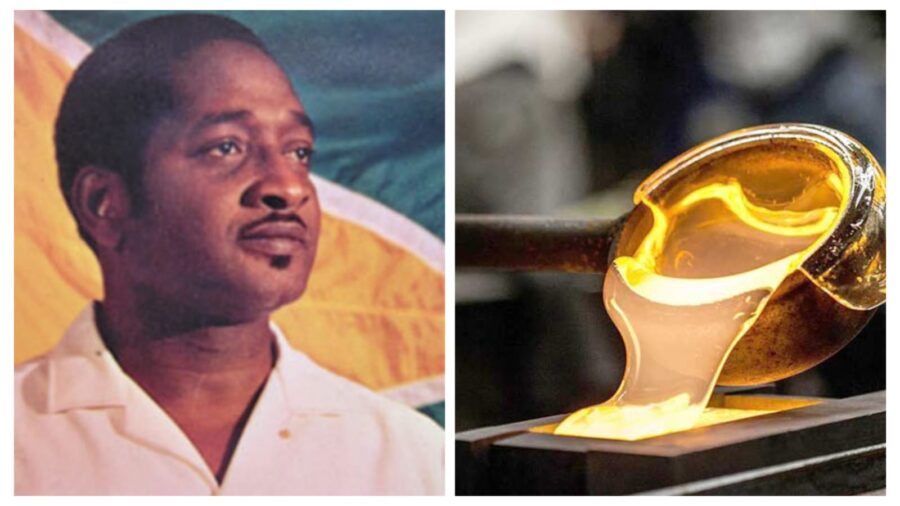
Guyana is once again turning its attention to glass manufacturing — a move President Irfaan Ali announced this week as part of his government’s plan to establish a major glass production facility at the Wales Industrial Zone. The initiative, unveiled at the Berbice Development Summit Agenda held at the Kingston Marriott Hotel on Tuesday, will utilise the country’s high-quality sand to produce glass products for international markets, including the automobile industry.
The project forms a key component of the government’s industrial diversification strategy, which aims to leverage Guyana’s natural resources beyond the oil and gas sector. The Wales Industrial Zone, anchored by the Gas-to-Energy Project, is being developed into a major industrial hub that will also house a fertiliser plant (ammonia/urea), data centres, and various manufacturing facilities.
“This is not only about the gas—it’s about the other natural resources we have that are integrated into the value chain,” President Ali told investors, private sector leaders, and stakeholders. “We are historically known for providing the finest beaches around the region with Guyanese sand, but now we want to add value to that commodity, use the gas, and create a whole new industry and hub right here in Guyana.”
However, the proposed project mirrors a self-sufficiency initiative first launched under the Forbes Burnham government, which the People’s Progressive Party (PPP) had long criticised while in Opposition. The Yarrowkabra Glass Factory, built in the late 1970s under Burnham’s leadership, was part of a broader import-substitution industrialisation policy designed to make Guyana more self-reliant.
Located at Yarrowkabra along the Soesdyke-Linden Highway, the factory produced a range of glassware, including bottles for beverages, jars for food storage, sheet glass for construction, and drinking glasses such as tumblers and tableware. It aimed to utilise Guyana’s abundant silica sand deposits to supply local industries and even export to the wider Caribbean.
Despite its ambitious vision, the Yarrowkabra Glass Factory was plagued by technical inefficiencies, persistent maintenance challenges, calls of political sabotage, and a shortage of skilled personnel — all of which hindered it from ever reaching full production capacity. The factory ultimately shut down in the 1980s, crippled by the aforesaid factors, limited market demand and chronic foreign exchange shortages needed to source spare parts and essential equipment.
Today’s proposed glass industry, therefore, represents a resurfacing of Burnham’s self-sufficiency vision—an irony not lost on political observers who recall the PPP’s earlier ridicule of similar state-led ventures.
President Ali, nonetheless, emphasised that the modern project will prioritise local participation, particularly among Guyanese investors and the diaspora. “Importantly, for the fertiliser plant and the gas bonding and logistics plan, we are first opening up this opportunity to every Guyanese here and in the diaspora to invest,” he said.
The initiative aligns with earlier calls from Ramsay Ali, President of the Guyana Manufacturing and Services Association (GMSA), who had highlighted the potential for a glass bottle factory and recycling plant under the Gas-to-Energy framework. He revealed that the Inter-American Development Bank (IDB) had already conducted a feasibility study on the viability of such a plant.
“Guyana used to have a glass bottle factory years ago,” Ramsay Ali said, referencing the Yarrowkabra facility. “A considerable demand for glass bottles has been generated by two large beverage companies, Demerara Distillers Limited (DDL) and Banks DIH Limited, as well as other manufacturers and agro-processors.”
He also envisions a solid waste recycling component to complement the new plant—collecting and processing recyclable materials to support environmental sustainability. He noted that in the past, high electricity costs made operating a glass factory impractical, since such facilities “have to keep running” once production begins.
Now, with the Gas-to-Energy project promising cheaper and more reliable electricity, Guyana appears ready to breathe new life into a Burnham-era dream — one that aims to transform the country’s natural resources into industrial strength and economic self-reliance.