

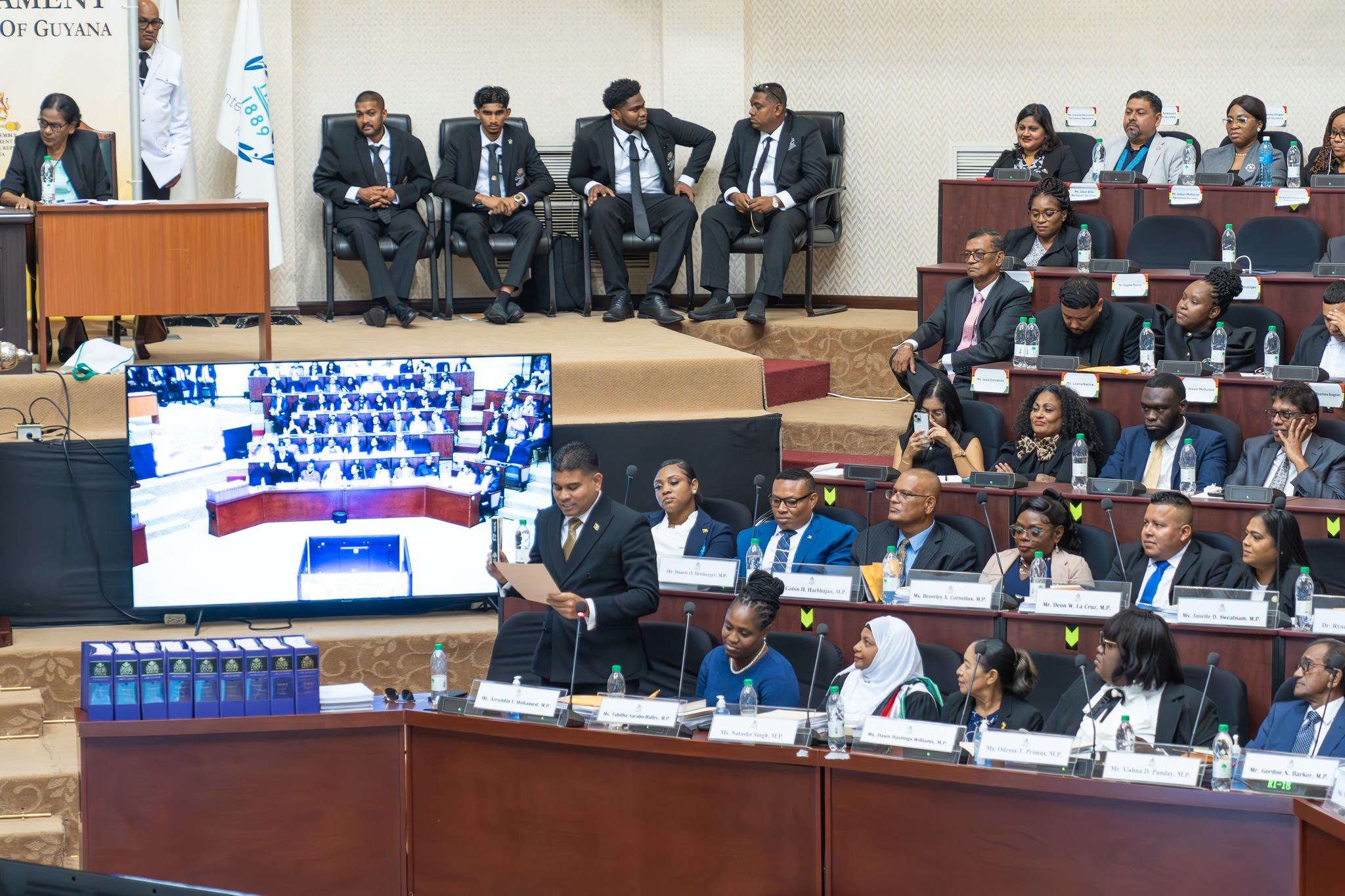
The 13th Parliament of the Co-operative Republic of Guyana was officially opened on Monday afternoon at the Arthur Chung Conference Centre in Liliendaal, Greater Georgetown, marking the start of a new legislative chapter against the backdrop of a shifting political landscape and an unresolved constitutional matter.
The 65-seat National Assembly now reflects a significant political realignment. The governing People’s Progressive Party/Civic (PPP/C) holds 36 seats, the newly ascendant We Invest in Nationhood (WIN) has 16, A Partnership for National Unity (APNU) occupies 12, and the Forward Guyana Movement (FGM) controls one seat.
This configuration gives the PPP/C a comfortable majority and confirms WIN’s emergence as the main opposition force, displacing APNU for the first time in over a decade.
Nadir Re-elected Speaker
During the first sitting, Manzoor Nadir was unanimously re-elected as Speaker of the National Assembly, following his nomination by Prime Minister Mark Phillips and seconding by Minister of Parliamentary Affairs and Governance Gail Teixeira.
Government parliamentarian Dr. Vishwa Mahadeo was elected Deputy Speaker, receiving 36 votes from the PPP/C benches. His challenger, WIN’s Tabitha Sarabo Halley, secured 17 votes, while APNU members abstained.
Opposition members quickly signalled their intent to be active in the new Parliament, submitting motions and Questions for Oral Replies during the session. APNU’s lead MP, Dr. Terrence Campbell, pledged that the partnership would hold the government to account at every sitting.
Vacant Opposition Leader Post Raises Constitutional Questions
One key agenda item remained unaddressed: the election of a Leader of the Opposition.
Under Article 184(1) of the Constitution of Guyana, “The Leader of the Opposition shall be elected by and from among the non-governmental members of the National Assembly at a meeting of all such members held under the chairmanship of the Speaker.”
Despite this clear constitutional directive, no date has yet been set for the vote. WIN leader Azruddin Mohamed, speaking to reporters after the session, asserted, “Of course, I am the presumptive Opposition Leader… we are hoping to get the election called as soon as possible.”
Observers warn that the continued vacancy could have far-reaching consequences. Without a formally elected Opposition Leader, the President cannot fulfil mandatory consultations on key constitutional appointments, including those of the Chancellor of the Judiciary, Chief Justice, and Commissioner of Police.
Former parliamentarian and minister of government Annette Ferguson cautioned that leaving the Opposition Leader seat vacant could trigger a constitutional crisis, stressing that the President is required to consult with the Opposition Leader on several constitutional matters.
Smaller Parties, Broader Stakes
FGM’s lone MP, Amanza Walton Desir, said she intends to use her single seat to advocate for electoral reform and proper representation for smaller parties. However, analysts note that such influence will depend on whether the major opposition blocs—WIN and APNU—can cooperate effectively.
The opening of the 13th Parliament followed the dissolution of the 12th Parliament and the September 1 General and Regional Elections. Legal experts point out that if the Opposition Leader’s post remains vacant, the government could proceed with certain key decisions without the constitutionally required consultation, invoking the doctrine of necessity—as occurred in the 2022 appointment of Clifton Hicken as Commissioner of Police.
A New but Unsettled Political Era
Political observers describe Monday’s opening as constitutionally compliant but politically unsettled. The PPP/C’s majority ensures legislative stability, yet the absence of a duly elected Opposition Leader casts uncertainty over the start of the new parliamentary term.
Analysts note that the early submission of motions and questions by APNU suggests the 13th Parliament could be more active and confrontational than its predecessor. However, while the new Parliament begins with an energized but fragmented opposition, experts warn that until the constitutional requirement under Article 184(1) is fulfilled, the overall effectiveness of parliamentary oversight remains in doubt.





![Yuan Xiaolou's exhibition at the National Museum of China demonstrates his exploration of mineral pigments to convey the cultural spirit of the country.[Photo by Jiang Dong/China Daily]](https://villagevoicenews.com/wp-content/uploads/2024/08/china-16-120x86.jpeg)

