(Newsweek)- The United States could fire long-range cruise missiles into Venezuela to ratchet up the pressure on President Nicolás Maduro, a former U.S. diplomat has warned, as doubts reign over just how far the White House will go amid a military build-up in the southern Caribbean.
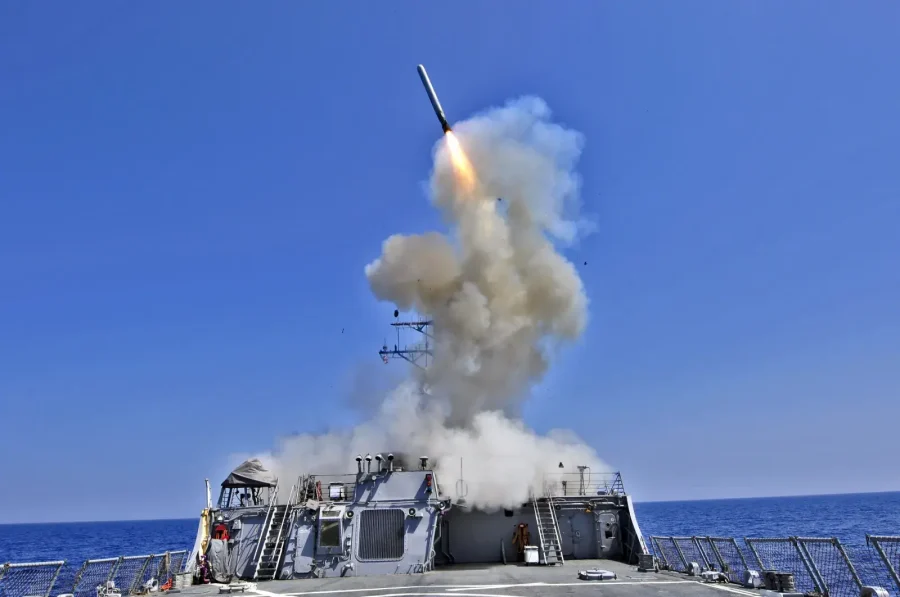
U.S. forces close to Venezuela may launch a series of Tomahawk cruise missiles at targeted sites in the South American country from outside of Caracas’ territorial waters, John Feeley, former U.S. ambassador to Panama who also served as the principal deputy assistant secretary of state for Western Hemisphere Affairs, told Newsweek.
President Donald Trump’s administration is almost two months into what it has characterized as an uncompromising crackdown on drug smuggling to the U.S., a strike campaign widely decried by Democrats and some Republicans, as well as United Nations experts and former officials as illegal under international law.
The Trump administration insists the attacks are legal
Washington has publicly acknowledged strikes on at least 14 vessels in both the southern Caribbean and Pacific since early September. A total of 61 people have been killed, according to the administration.
Defense Secretary Pete Hegseth said on Tuesday that U.S. forces had carried out three strikes on four vessels in the Eastern Pacific the previous day, killing 14 people. One person survived, Hegseth said. An Ecuadorian national and a Colombian citizen were returned to their home countries after a U.S. strike on an alleged drug “submarine” earlier this month. Hegseth said another strike in the Pacific on Wednesday had killed four “narco-terrorists.”
The U.S. has dramatically increased its military presence in the southern Caribbean by deploying troops, aircraft, surface vessels and a nuclear-powered fast-attack submarine to the region. The USS Gerald Ford, the Navy’s newest and largest aircraft carrier, is en route to the southern Caribbean with all the aircraft and warships that accompany it. U.S. bombers have repeatedly flown close to Venezuela’s coastline in recent weeks.
Observers say the show of U.S. military might is intended to send a message to Maduro, a leader many Western countries don’t consider to be Venezuela’s legitimate president, who is up against narcotrafficking and corruption charges in the U.S.
Just one of the multiple destroyers looming over Venezuela’s shoulder would be capable of launching a series of Tomahawk cruise missile strikes, prompting many onlookers to see the swollen number of forces in the region as a portend of regime change rather than counternarcotics operations.
Maduro himself has at once appealed, including in English, for peace, and warned that Caracas stands ready to respond to U.S. action.
Land Operations
Trump has left the door firmly open to attacks on Venezuelan soil. Three unnamed U.S. officials told CNN last week that the president was weighing up plans to target cocaine facilities and trafficking paths inside Venezuela.
“The land is going to be next,” he told reporters on October 23.
It’s not clear exactly what he means by this. Trump has already confirmed he has authorized CIA operations in Venezuela, extending a long history of the agency operating in Latin America.
It’s generally thought a boots-on-the-ground U.S. invasion of Venezuela is off the table, which would jar with the America First agenda the administration has trumpeted and would resurrect ghosts of U.S. military intervention in countries like Panama, Afghanistan and Vietnam. Trump would likely steer clear of land operations with troops, said Joe Sestak, a retired U.S. Navy rear admiral and former director for Defense Policy on the National Security Council staff.
“But he has backed himself into a corner,” Sestak said.
Maduro will be concerned about the possibility of a land strike, which would likely be very targeted, said Annette Idler, the director of the Minerva Global Security Programme at the Blavatnik School of Government at the University of Oxford.
“I do think we need to take that seriously,” Idler told Newsweek.
Tomahawks are land-attack cruise missiles made by defense giant Raytheon, designed for high-value targets. With an estimated range of roughly 1,550 miles, they can be launched from submarines or surface ships, and have long been coveted by Ukraine. It’s a “proven weapon,” the Center for Strategic and International Studies think tank said earlier this month.
Venezuela’s cache of mostly Russian-supplied, older air defense systems like the S-300 is unlikely to be a match for Tomahawk missiles in the event of a U.S. strike. “They’re scary; they come out of nowhere,” said Feeley.
One alternative could be firing AMRAAMs, a beyond-visual-range air-launched weapon, Sestak told Newsweek. Another tool in Trump’s hand could be special forces, like Navy SEALs, or drone strikes, said Robert Kelly, a former U.S. deputy assistant secretary of defense for drug enforcement.
“It would be difficult for someone like Maduro to to figure out what he needs to worry about first,” Kelly told Newsweek.
Even then, though, the path is obscure. “What happens if we do do those limited land strikes and nothing changes?” Sestak said. “Do you do more and more?”
Regime Change
Former officials and experts say the administration’s rhetoric doesn’t match its actions over the past two months. Tens of thousands of people in the U.S. die each year from fentanyl-related causes. The synthetic opioid mostly makes its way into the U.S. from China and India via the Mexican border.
“The biggest problem through every single one of these strikes is that the United States contends that they’re doing this to prevent the importation of fentanyl,” said Kelly. “Fentanyl doesn’t originate in South America,” he told Newsweek.
“This is a fig leaf of gigantic proportions,” added Kelly.
Much of the cocaine coming out of South America comes from countries like Colombia and Ecuador, and then transits through Venezuela. The routes typically then head to West Africa and Europe from Venezuela, rather than north to the U.S.
U.S. drug officials have long said the vast majority of the cocaine heading for the U.S. comes via the Pacific, with only about a tenth heading for American soil from the southern Caribbean. The U.S only started striking alleged drug vessels in the Pacific in late October. On top of this, a targeted strike will likely prompt traffickers to simply reconfigure their networks and find another route to transport narcotics.
“What we’ve seen is dealing with the symptoms, not really with the root causes,” Idler said. “The military is not the answer to stopping the flow of drugs into America,” said Sestak.
But the substantial U.S. assets gathered in the southern Caribbean could be put to good use, if the administration chose to do so, said retired Rear Admiral William Baumgartner, the former commander of the Seventh Coast Guard District now known as the Southeast District.
U.S. airborne snipers flying in helicopters have for years successfully targeted the engines of drug boats, the Navy working with U.S. Coast Guard law enforcement detachments to catch the boats, Baumgartner said. At least some of the ships and aircraft relocated to the southern Caribbean could build on this effort, he told Newsweek.
The Colombia Question
It’s not just Venezuela, a historic U.S. antagonist, that’s in the firing line. Neighboring Colombia is one of the U.S.’s most firm South American allies with a sizable military itself, but the country’s left-wing leader, Gustavo Petro, said the White House had killed a Colombian national in a mid-September strike and violated Colombian sovereignty.
Petro accused the U.S. of “murder,” and in fresh comments on social media on Tuesday, said the multiple strikes in the Pacific the previous day amounted to a war crime. Trump has called Petro an “illegal drug leader” and this month pulled longstanding U.S. aid for Bogotá. An American program dubbed Plan Colombia was established in 2000 to battle drug trafficking.
Slashing aid for Colombia ignores the heart of the issue, said Idler. Bogotá needs U.S. support to manage armed groups and illicit trade, while Washington needs Colombia for on-the-ground intelligence gathering, Idler added. Without this partnership, the drug trade and the armed gangs prevail, she said.
Republican Senator Lindsey Graham told CBS’s Face The Nation over the weekend that Trump planned to brief Congress “about future potential military operations against Venezuela and Colombia,” including “expanding from the sea to the land.”
U.S. relations with Colombia “are entering a very tense but not irreversible phase,” Idler said. Ties between the White House and the country that acts as the “linchpin of US regional security policy” are damaged, but not broken, she said.