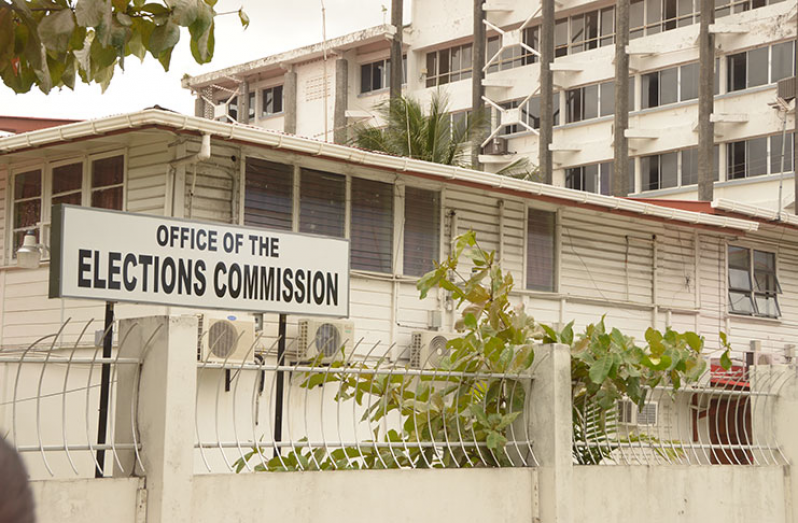
Political commentator GHK Lall has called for a serious reassessment of the roles and relevance of GECOM commissioners, questioning long-held notions of their independence and permanence in light of Guyana’s shifting political landscape.
In a strongly worded opinion, Lall challenged recent assertions by Opposition-nominated commissioner Vincent Alexander regarding the nature of the Guyana Elections Commission’s (GECOM) commissioners—particularly the claim that they were intended to be both independent and permanent.
In an interview with Stabroek News, Vincent Alexander reportedly stated that the positions are permanent. “Any relooking is an acceptance that there is something in place and cannot simply be changed administratively,” he said. “Replacements are only possible at this time if someone dies or resigns,” he added, noting that the Constitution outlines the tenure of the positions. Alexander also acknowledged the legal complexity, saying, “Obviously, what our law provides for creates a conundrum — but that is what the law provides for… This issue, if people are to respond, is a constitutional reform matter.”
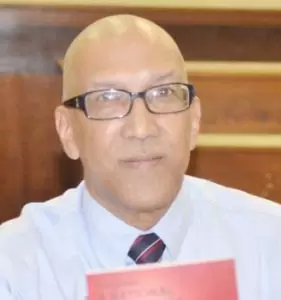
“Come, come, Mr. Alexander, GECOM commissioners were meant to be independent? Who threw up their name in the GECOM ring? Whose interests do the commissioners represent first, then forever?” Lall asked, sharply criticizing the idea that commissioners act independently of the political parties that nominate them.
He argued that, in practice, commissioners primarily serve the interests of their political sponsors and that any suggestion of impartiality or independence is often a “farce.” “Independent within the boundaries of orders, independent through set plays, independent via fixed postures,” he said, adding that true independence in GECOM has long been undermined by partisan influence.
Lall was equally dismissive of the notion of permanence, suggesting that the concept is both outdated and ill-suited to the current political environment. Referring to opposition-nominated commissioners, he wrote, “What claim [has] the now minor opposition, when it’s a shadow of its former self?” He suggested that continued tenure based on outdated mandates does a disservice to the electorate and undermines the credibility of the electoral body.
He further questioned the relevance of the current opposition commissioners, proposing that “allowance may be made for a close reading of the final voting numbers,” which could lead to a revised formula for seat distribution on the commission, reflecting new political realities.
Lall also criticised the appointment process for GECOM’s chairperson, noting that it, too, is heavily politicized. “The chairperson isn’t a creation of civil society, nor an agent of the people, but of the dictates and expectations of the sponsor,” he wrote, arguing that the appearance of independence is often a carefully staged illusion.
Calling for a more honest and practical approach to GECOM reform, Lall concluded, “Do the honourable thing, make the gracious move, and give way to those who took the town by storm, and wrested the mantle of the leading opposition presence in today’s Guyana.”
The reference applies to the We Invest in Nationhood (WIN) party, which, in less than four months since its formation, secured 16 seats in the National Assembly. By comparison, A Partnership for National Unity, with the People’s National Congress Reform (PNCR) as its major partner, secured 12 seats, while the Forward Guyana Movement (FGM) gained one seat, according to GECOM’s declarations following the September 1, 2025, General and Regional Elections.
The current Opposition-nominated commissioners were recommended by the PNCR and the A Partnership for National Unity and Alliance for Change (APNU+AFC) coalition.
According to Lall, continuing to maintain the status quo will only deepen public skepticism and contribute to a worsening political climate surrounding the country’s elections.