President Irfaan Ali, now seeking a second term under the People’s Progressive Party/Civic (PPP/C) with his slogan “Forward Together,” heads into the September 1 General and Regional Elections with a controversial record. Since assuming office in August 2020, Ali’s tenure has been characterised by a series of concerning developments that raise questions about his leadership, governance, and commitment to democratic principles.
While Guyana is one of the world’s richest economies, showing double-digit Gross Domestic Product (GDP) growth and grand infrastructure projects, analysts argue that these gains have done little to improve everyday life for most Guyanese—exposing deep flaws in both Ali’s governance and democratic integrity.
Cult of Personality and Questions Over Legitimacy
Ali has been criticised for fostering an image-driven presidency, pushing his campaign slogans onto passports, uniforms, and billboards—an overt blurring of state and party that echoes authoritarian tactics. Just last year, Shadow Foreign Affairs Minister Amanza Walton‑Desir decried the inclusion of the PPP’s slogan “One Guyana” in the national passport as a dangerous first step toward monolithic rule.
Further skepticism stems from Ali’s past. Back in 2019, he was embroiled in academic and land sale controversies: accused of inflating his academic credentials and implicated in a state land sale scandal for undervaluing plots worth over $200 million, before the charges were withdrawn in 2020 when he assumed the portfolio of president.
Corruption, Transparency, and Institutional Erosion
Guyana’s 2024 Corruption Perceptions Index shows the country slipping to 92nd out of 180 nations—scored a mere 39/100—a stark indicator of governance failure under Ali. Transparency International (TI) highlighted how economic elites continue to capture state power, enabling environmental crime and resource misappropriation.
Despite these assessments, Ali has publicly dismissed the TI findings as biased and politically motivated, while touting praise from bodies like the International Monetary Fund (IMF) and United Nations (UN) for transparency and climate compliance. But critics argue these accolades ring hollow in the absence of meaningful anti-corruption enforcement.
Additionally, human rights organisations have raised alarms about extra-judicial killings linked to security forces and reports of mistreatment of teachers and public servants, which threaten social stability.
Governance Failures and Public Humiliation
Despite promises of progress and inclusion, Ali’s tenure has been marked by policies and practices that have left significant segments of Guyana’s population behind—divided along lines of race, political affiliation, and socio-economic status.
At the heart of these concerns lies a stark contradiction. Guyana’s Constitution enshrines the political objective of establishing a state governed by the principle of “inclusionary democracy,” which calls for the active participation and representation of all citizens in governance. Yet, under Ali’s leadership, the government has repeatedly shut out parliamentary opposition and marginalised civil society groups, undermining this foundational tenet.
In November 2024, Ali held a startling 5:30 a.m. televised “call‑out” meeting, publicly berating ministers and contractors for project delays. The spectacle drew widespread condemnation as micromanagement masquerading as accountability—one that ignored systemic issues such as procurement issues and institutional weaknesses.
Territorial Insecurity and Leadership Gaps
Tensions with Venezuela over the contested Essequibo region have intensified—yet Ali’s response has been lukewarm. Despite securing support from international legal bodies and labeling himself the “Zelensky of the Caribbean,” observers say his administration failed to rally the nation or proactively address the looming security threat. A senior retired diplomatic equates Ali’s response to Venezuela’s increasing aggression to that of a buffoon in a crisis. The diplomat notes the President is banking on foreigners to defend Guyana while Guyanese remain divided, anxious, and voiceless in their own country,
Disconnected from the People
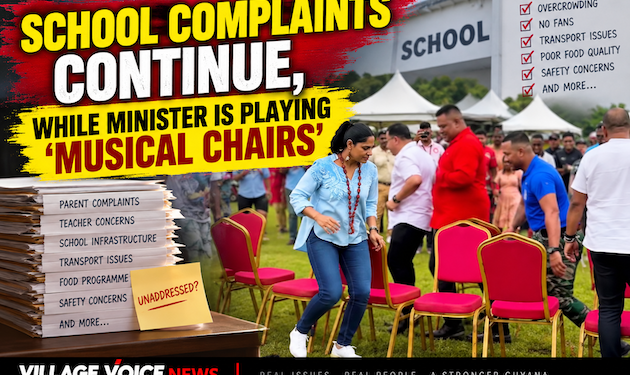
Critics argue that promises of free university education, subsidies, and infrastructure investments have not translated into improved standards of living. Many Guyanese still struggle with poverty and feel ignored. Analysts suggest that Ali’s focus on political messaging over economic inclusivity contributes to a growing sense of alienation.
Democratic Dilution and One-Man Rule
Ali- generations removed from the ethnic conflicts of the early 1960s- was meant to represent inclusion, but his tenure is defined by increasing ethnic tensions, political conflicts, growing intolerance for dissent and sidelining opposition. Persistent budget oversights, secretive policymaking, and closures of parliamentary mechanisms point to a troubling concentration of power.
As one commentator said: “Ali has spent his term hiding behind the figure of Vice President Jagdeo, while he runs unchecked.” Voters also recall his childish public temper tantrums—like bringing up hurt feelings over a handshake snub during constitutional talks—a far cry from the dignity expected of a head of state.
Philanthropy vs. Poverty
Ali can point to the oil-funded social programmes—free university education, housing schemes, cash grants. But according to a World Bank Report half the population still lives on less than US$5.50 a day (G$1200.00), showing that growth has not lifted most citizens out of poverty. Analysts suggest the figure is higher given Guyana’s poor data gathering techniques.
Finally, Ali’s autonomy has long been questioned. Observers argue the former president Bharrat Jagdeo continues to direct Ali’s major policy decisions—reducing the sitting president to a de facto puppet. This illusion of independence unravels with every avoided confrontation and deferred decision
An Election at a Crossroads
As Guyana heads to the polls, the core questions about President Ali’s leadership remain unresolved: Has Irfaan Ali been a visionary reformer—or a polished facade propped up by political theatrics? Has he strengthened or weakened democratic institutions? The “Forward Together” slogan increasingly rings hollow amid accusations of elitism, exclusion, and a disturbing drift toward personality politics.
Guyanese voters now face a crucial decision: whether to continue under a leader whose record is more image than substance—or to demand accountability, integrity, and true progress.