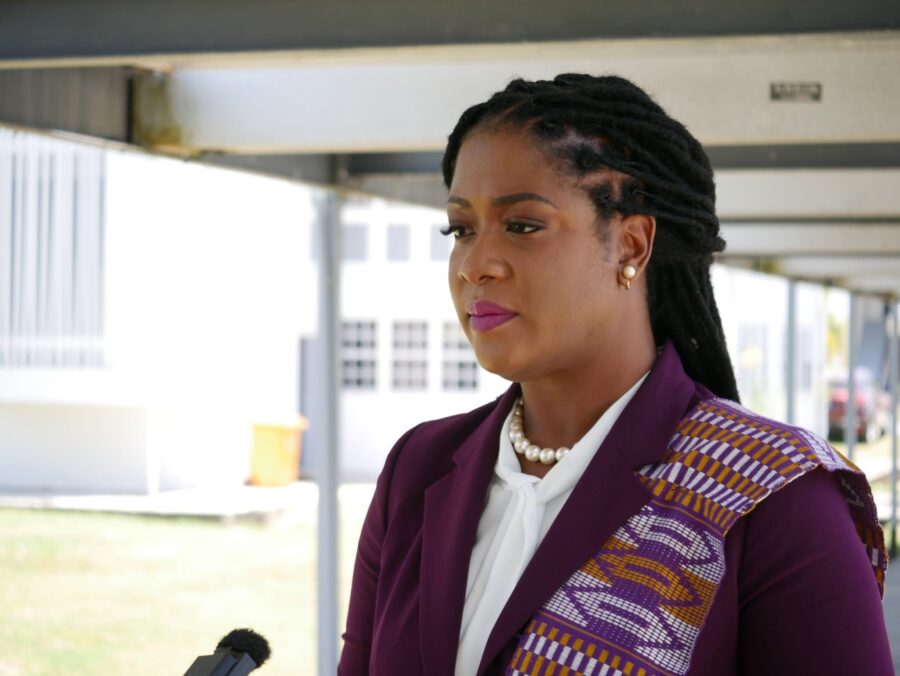
In a searing and impassioned address, Amanza Walton-Desir, presidential candidate for the Forward Guyana Movement (FGM), condemned the deepening crisis of femicide in Guyana and called for urgent, national action. Her remarks come amidst damning revelations in a recent World Bank report, which found that Guyana has the highest per capita femicide rate in the region—8.8 per 100,000 women.
“Femicide is the intentional killing of a woman because she is a woman,” Walton-Desir said. “Let’s talk about Janelle Pollydore, just 26 years old, a mother, a daughter, a friend, shot to death at a wedding in public with witnesses, and still no one could stop it. And now her child has lost both parents—one to death and the other eventually to the justice system.”
Referencing another recent horror, she continued, “Just days ago a 20-year-old Indigenous woman was drugged and raped in full view of a crowd at a bar in Soesdyke. People stood by. They filmed it. They shared it. And no one intervened. What does that say about us? What does it say about how we see our women?”
She declared that femicide does not begin with violence but with a culture that permits it. “It begins with disrespect, with objectification, with silence, with complicity.”
Walton-Desir didn’t mince words: “The devaluing of our women is killing us, not just in homes, but in the halls of Parliament, in bars, in courtrooms and police stations, and in the minds of those who look away from the lives of our women. This is the hidden cost of femicide—families shattered, children scarred, communities grieving.”
“This is not just a domestic issue. It is not. This is a national crisis,” she stressed.
The World Bank’s findings now cast an even darker shadow over the status quo. At 8.8 femicides per 100,000 women, Guyana ranks as the worst in the region, outpacing even countries with far larger populations.
Laying out FGM’s commitment, Walton-Desir promised national early warning systems, strict enforcement of restraining orders, safe houses in every region, and trauma-informed training for police and courts.
She also pledged intervention programmes for abusers and bold public education campaigns to reshape attitudes and break the silence.
“This is not about blame. This is about saving lives. It is about making sure that no child ever again has to grow up asking, ‘Why didn’t anyone help my mother?’”
With fierce determination, she concluded, “So let’s say it together—no more losing our daughters to violence. No more losing our sons to rage and ruin. No more excuses. No more silence. No more delay. Let Janelle’s name be not just one more tragedy but the moment we decided—never again.”
The Forward Guyana Movement has placed the fight against femicide at the center of its campaign, making it clear that under its leadership, silence and inaction will no longer be acceptable.