By Mark DaCosta- The Guyana Elections Commission (GECOM) has confirmed that six political parties will participate in the forthcoming General and Regional Elections scheduled for 1 September. This announcement follows a thorough review process that ensured all candidates’ lists complied with the necessary legal frameworks and statutory requirements following Nomination Day, which took place on 14 July. With the political landscape so keenly contested, the viability and legitimacy of these parties are paramount.
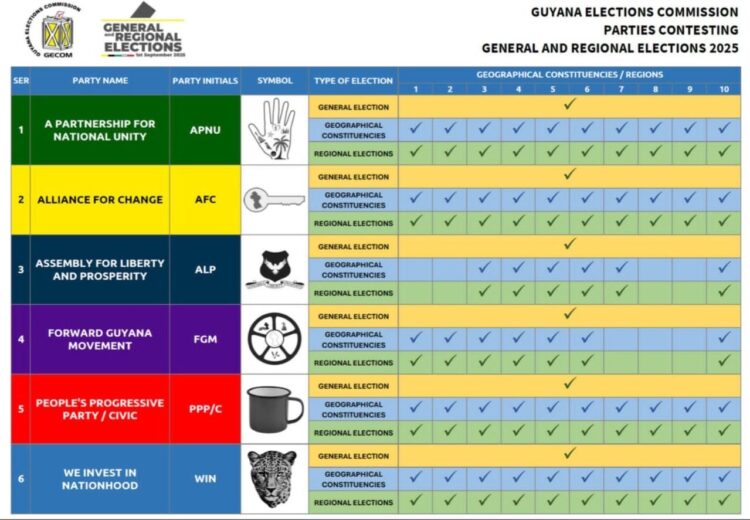
GECOM has officially approved the candidates from A Partnership for National Unity (APNU), the Alliance for Change (AFC), the Assembly of Liberty and Prosperity (ALP), the Forward Guyana Movement (FGM), the People’s Progressive Party / Civic (PPP/C), and the We Invest in Nationhood (WIN). Although all six parties are cleared to run in the General Elections, a distinction arises for the Regional Elections, as only APNU, AFC, PPP/C, and WIN have put forth candidates for all ten electoral districts. The ALP will limit its campaign to districts 3, 4, 5, 6, 7, and 10, while FGM will participate in districts 1, 2, 3, 4, 5, 6, and 10.
The selection process for these candidates was not without scrutiny. After the submission of lists of candidates, GECOM said that it conducted an extensive examination to verify compliance with legal requirements. Any discrepancies found in the submissions were promptly communicated to the parties involved. The commission’s Chief Election Officer reached out to alert the concerned parties by 15 July of the necessary corrections needed in their submitted lists. To ensure a fair chance, these parties were given until 17 July to rectify any flaws, and they adhered to this timeframe, allowing GECOM to finalise its approvals.
This approval represents a crucial moment leading up to the elections, as it is essential to maintain an atmosphere of trust and integrity in the electoral process. Vincent Alexander, an opposition-nominated GECOM Commissioner, highlighted the importance of diligence in vetting the submissions, particularly noting that the Horizon and Star party, led by Hubert Maloney, was disqualified due to insufficient documentation. In this competitive environment, compliance with electoral rules is vital to building public confidence.
Moreover, the commission is urging all representatives and their deputies to notify the CEO regarding any requests for joining lists of candidates, with a deadline set for 21 July. Following this, the approved lists will be gazetted and made public on 23 July. This procedural step is vital for ensuring transparency and clarity in the upcoming elections.
The stakes are undeniably high as the political parties prepare for these elections, amidst ongoing discussions surrounding outstanding logistical and administrative matters that GECOM still needs to address, such as counting votes for overseas ballots and resolving issues related to voters who have passed away. GECOM Commissioner Sase Gunraj reiterated that while the approved lists are a significant step forward, other unresolved questions also require urgent attention.
The political arena in our country is buzzing with activity as the parties gear up for campaigns, with each seeking to galvanise supporters and present compelling cases to the electorate. The approval of these candidates marks just the beginning of a dynamic pre-election period, where parties will be striving not only to communicate their platforms but also to solidify their positions within the electorate.
As we tread closer to the election dates, our nation watches with keen interest to see how these political entities will engage with the public and tackle the pressing issues facing our society. With each party’s strategy and messaging now under scrutiny, the continued development and transparency of the electoral process will be crucial in fostering a democratic spirit that reflects the will of the people.
In this landscape of anticipation and preparation, the involvement of civil society, media, and international observers will provide additional layers of oversight to ensure that the upcoming elections are fair and equitable. The call for collective engagement and vigilance echoes through our communities, as the electorate stands poised to exercise their rights in shaping the future.