
Thursday, June 18, 2026
Village Voice News
ADVERTISEMENT
  • Home
  • News
  • Sports
  • Editorial
  • Letters
  • Global
  • Columns
    • Eye On Guyana
    • Hindsight
    • Lincoln Lewis Speaks
    • Future Notes
    • Blackout
    • From The Desk of Roysdale Forde SC
    • Diplomatic Speak
    • Mark’s Take
    • In the village
    • Mind Your Business
    • Bad & Bold
    • The Voice of Labour
    • The Herbal Section
    • Politics 101 with Dr. David Hinds
    • Talking Dollars & Making Sense
    • Book Review 
  • Education & Technology
  • E-Paper
  • Contact Us
No Result
View All Result
  • Home
  • News
  • Sports
  • Editorial
  • Letters
  • Global
  • Columns
    • Eye On Guyana
    • Hindsight
    • Lincoln Lewis Speaks
    • Future Notes
    • Blackout
    • From The Desk of Roysdale Forde SC
    • Diplomatic Speak
    • Mark’s Take
    • In the village
    • Mind Your Business
    • Bad & Bold
    • The Voice of Labour
    • The Herbal Section
    • Politics 101 with Dr. David Hinds
    • Talking Dollars & Making Sense
    • Book Review 
  • Education & Technology
  • E-Paper
  • Contact Us
No Result
View All Result
Village Voice News
No Result
View All Result
Home News

St George’s School of Sciences represents new model of education—President Ali

Admin by Admin
July 2, 2025
in News
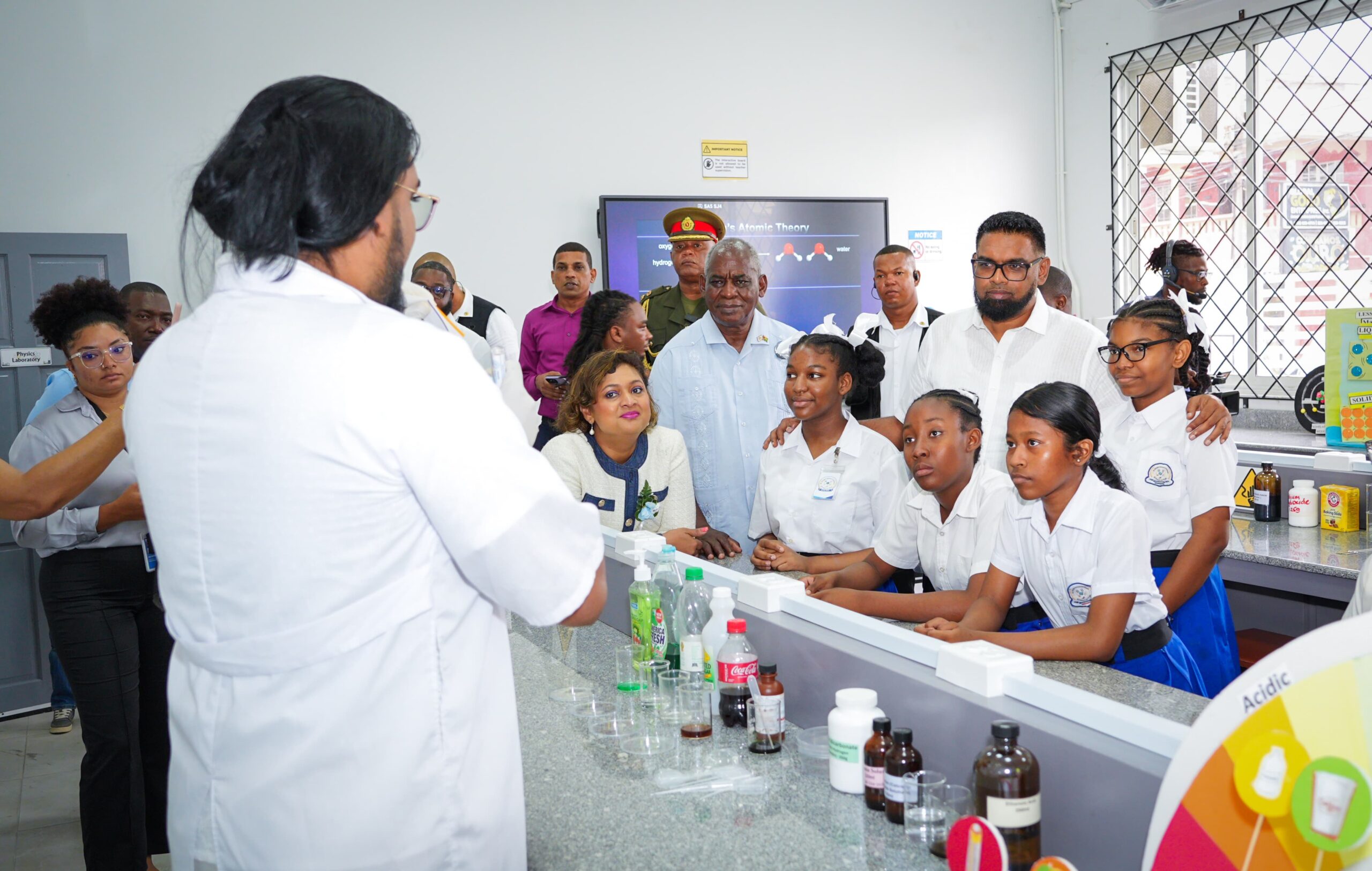
His Excellency President Dr Irfaan Ali described the St George’s School of Sciences as a pioneering step in reshaping Guyana’s educational landscape and as a “new model of education” tailored for the modern era.  The school, officially commissioned today in Georgetown, stands as the country’s first secondary institution solely dedicated to scientific education—an initiative, the President said, that promises to profoundly impact the academic and professional futures of Guyana’s youth.  “This is no ordinary school. It is a school of excellence, created for those with the hunger to learn and the commitment to achieve. Admission to this institution is not automatic—it is earned. Students must demonstrate strong competence in English, mathematics, and science, with marks that reflect discipline and potential.”  The school is equipped with smart classrooms featuring interactive boards, multimedia technology, and digital tools; state-of-the-art laboratories for science and information technology; and device-based learning whereby students will each receive a laptop, among other world-class facilities.  A new model of education  President Ali underscored that the school’s holistic curriculum marks a deliberate departure from the “narrow confines of rote learning”. Extended learning opportunities will be offered through tutorials, while students will also be required to participate in music, sport, foreign languages, technical and vocational education and training (TVET), and community service.  “We want to produce scientists with soul, technicians with talent, and leaders with compassion,” he stated.  “And let me emphasise—standards will be enforced. Students will be monitored for punctuality, attendance, and completion of assignments. Parents will be promptly notified of infractions. This school is not just about nurturing intelligence—it is about cultivating responsibility.”  The President highlighted the growing importance of STEM (Science, Technology, Engineering, and Mathematics) education in today’s rapidly evolving and technology-driven global economy.  “From climate change to artificial intelligence, from health to renewable energy, the challenges and opportunities of the 21st century demand problem-solvers who can think critically, analyse data, and innovate with purpose. In developing countries like Guyana, it is especially important, as it empowers young people to participate meaningfully in national development, close the digital divide, and compete on the global stage.”  He also emphasised that Guyana’s national transformation will require a new generation of scientific minds across sectors such as oil and gas, climate resilience, biotechnology, artificial intelligence, and healthcare.  “We need local talent to fill those roles. We need to train our children not just to get jobs—but to lead industries.”  President Ali further noted that his Government is currently building a national digital ecosystem that will connect classrooms, hospitals, government services, agriculture, commerce, and industry through the power of information and communication technology (ICT).  “As we roll out this system, we need to prepare our citizens for a digital future. We cannot do so unless science and technology assume greater importance within our education system. We need students to be equipped with the analytical skills, technical competencies, and creative mindset to thrive in a digitally connected and data-driven world. Without a strong grounding in science, we risk becoming consumers rather than creators in the digital age.”  He added that science education is a gateway to equality, teaching critical thinking, logic, and evidence-based decision-making.  “It empowers young people, especially those from marginalised communities, to challenge assumptions, solve real-world problems, and create innovative solutions.”  The Head of State added that while specialised learning is an idea long overdue in Guyana and represents a bold shift in the country’s academic approach, traditional schools, with their rigour and cultural legacy, will continue to serve as the bedrock of the nation’s education system.  He said that these traditional institutions must be complemented with specialised schools that focus on the arts and creative industries; agricultural science; engineering and robotics, and maritime studies and aviation technologies, among other areas.  “To all of Guyana, I wish to say that what was once a school reduced to ashes is now a symbol of resilience and reinvention.  Let the St George’s School of Sciences stand tall and vindicate the confidence which we have placed in its role as a torchbearer of the type of education system we are rolling out across Guyana.”  The school is equipped with 10 classrooms, five laboratories (three for science, one for IT and one for home economics), and other state-of-the-art amenities. It also has the capacity to house about 250 students.  Minister of Education, the Honourable Priya Manickchand, and other Government officials were also at the event.
His Excellency President Dr Irfaan Ali described the St George’s School of Sciences as a pioneering step in reshaping Guyana’s educational landscape and as a “new model of education” tailored for the modern era. The school, officially commissioned today in Georgetown, stands as the country’s first secondary institution solely dedicated to scientific education—an initiative, the President said, that promises to profoundly impact the academic and professional futures of Guyana’s youth. “This is no ordinary school. It is a school of excellence, created for those with the hunger to learn and the commitment to achieve. Admission to this institution is not automatic—it is earned. Students must demonstrate strong competence in English, mathematics, and science, with marks that reflect discipline and potential.” The school is equipped with smart classrooms featuring interactive boards, multimedia technology, and digital tools; state-of-the-art laboratories for science and information technology; and device-based learning whereby students will each receive a laptop, among other world-class facilities. A new model of education President Ali underscored that the school’s holistic curriculum marks a deliberate departure from the “narrow confines of rote learning”. Extended learning opportunities will be offered through tutorials, while students will also be required to participate in music, sport, foreign languages, technical and vocational education and training (TVET), and community service. “We want to produce scientists with soul, technicians with talent, and leaders with compassion,” he stated. “And let me emphasise—standards will be enforced. Students will be monitored for punctuality, attendance, and completion of assignments. Parents will be promptly notified of infractions. This school is not just about nurturing intelligence—it is about cultivating responsibility.” The President highlighted the growing importance of STEM (Science, Technology, Engineering, and Mathematics) education in today’s rapidly evolving and technology-driven global economy. “From climate change to artificial intelligence, from health to renewable energy, the challenges and opportunities of the 21st century demand problem-solvers who can think critically, analyse data, and innovate with purpose. In developing countries like Guyana, it is especially important, as it empowers young people to participate meaningfully in national development, close the digital divide, and compete on the global stage.” He also emphasised that Guyana’s national transformation will require a new generation of scientific minds across sectors such as oil and gas, climate resilience, biotechnology, artificial intelligence, and healthcare. “We need local talent to fill those roles. We need to train our children not just to get jobs—but to lead industries.” President Ali further noted that his Government is currently building a national digital ecosystem that will connect classrooms, hospitals, government services, agriculture, commerce, and industry through the power of information and communication technology (ICT). “As we roll out this system, we need to prepare our citizens for a digital future. We cannot do so unless science and technology assume greater importance within our education system. We need students to be equipped with the analytical skills, technical competencies, and creative mindset to thrive in a digitally connected and data-driven world. Without a strong grounding in science, we risk becoming consumers rather than creators in the digital age.” He added that science education is a gateway to equality, teaching critical thinking, logic, and evidence-based decision-making. “It empowers young people, especially those from marginalised communities, to challenge assumptions, solve real-world problems, and create innovative solutions.” The Head of State added that while specialised learning is an idea long overdue in Guyana and represents a bold shift in the country’s academic approach, traditional schools, with their rigour and cultural legacy, will continue to serve as the bedrock of the nation’s education system. He said that these traditional institutions must be complemented with specialised schools that focus on the arts and creative industries; agricultural science; engineering and robotics, and maritime studies and aviation technologies, among other areas. “To all of Guyana, I wish to say that what was once a school reduced to ashes is now a symbol of resilience and reinvention. Let the St George’s School of Sciences stand tall and vindicate the confidence which we have placed in its role as a torchbearer of the type of education system we are rolling out across Guyana.” The school is equipped with 10 classrooms, five laboratories (three for science, one for IT and one for home economics), and other state-of-the-art amenities. It also has the capacity to house about 250 students. Minister of Education, the Honourable Priya Manickchand, and other Government officials were also at the event.

0
SHARES
0
VIEWS
Share on FacebookShare on Twitter

His Excellency President Dr Irfaan Ali described the St George’s School of Sciences as a pioneering step in reshaping Guyana’s educational landscape and as a “new model of education” tailored for the modern era.

The school, officially commissioned today in Georgetown, stands as the country’s first secondary institution solely dedicated to scientific education—an initiative, the President said, that promises to profoundly impact the academic and professional futures of Guyana’s youth.

READ ALSO

2025 Election Requires New Opposition GECOM Appointments-Bissember

Benschop Questions Rodrigues-Birkett’s Credentials for UN’s Top Job

“This is no ordinary school. It is a school of excellence, created for those with the hunger to learn and the commitment to achieve. Admission to this institution is not automatic—it is earned. Students must demonstrate strong competence in English, mathematics, and science, with marks that reflect discipline and potential.”

The school is equipped with smart classrooms featuring interactive boards, multimedia technology, and digital tools; state-of-the-art laboratories for science and information technology; and device-based learning whereby students will each receive a laptop, among other world-class facilities.

A new model of education

President Ali underscored that the school’s holistic curriculum marks a deliberate departure from the “narrow confines of rote learning”. Extended learning opportunities will be offered through tutorials, while students will also be required to participate in music, sport, foreign languages, technical and vocational education and training (TVET), and community service.

“We want to produce scientists with soul, technicians with talent, and leaders with compassion,” he stated.

“And let me emphasise—standards will be enforced. Students will be monitored for punctuality, attendance, and completion of assignments. Parents will be promptly notified of infractions. This school is not just about nurturing intelligence—it is about cultivating responsibility.”

The President highlighted the growing importance of STEM (Science, Technology, Engineering, and Mathematics) education in today’s rapidly evolving and technology-driven global economy.

“From climate change to artificial intelligence, from health to renewable energy, the challenges and opportunities of the 21st century demand problem-solvers who can think critically, analyse data, and innovate with purpose. In developing countries like Guyana, it is especially important, as it empowers young people to participate meaningfully in national development, close the digital divide, and compete on the global stage.”

He also emphasised that Guyana’s national transformation will require a new generation of scientific minds across sectors such as oil and gas, climate resilience, biotechnology, artificial intelligence, and healthcare.

“We need local talent to fill those roles. We need to train our children not just to get jobs—but to lead industries.”

President Ali further noted that his Government is currently building a national digital ecosystem that will connect classrooms, hospitals, government services, agriculture, commerce, and industry through the power of information and communication technology (ICT).

“As we roll out this system, we need to prepare our citizens for a digital future. We cannot do so unless science and technology assume greater importance within our education system. We need students to be equipped with the analytical skills, technical competencies, and creative mindset to thrive in a digitally connected and data-driven world. Without a strong grounding in science, we risk becoming consumers rather than creators in the digital age.”

He added that science education is a gateway to equality, teaching critical thinking, logic, and evidence-based decision-making.

“It empowers young people, especially those from marginalised communities, to challenge assumptions, solve real-world problems, and create innovative solutions.”

The Head of State added that while specialised learning is an idea long overdue in Guyana and represents a bold shift in the country’s academic approach, traditional schools, with their rigour and cultural legacy, will continue to serve as the bedrock of the nation’s education system.

He said that these traditional institutions must be complemented with specialised schools that focus on the arts and creative industries; agricultural science; engineering and robotics, and maritime studies and aviation technologies, among other areas.

“To all of Guyana, I wish to say that what was once a school reduced to ashes is now a symbol of resilience and reinvention.  Let the St George’s School of Sciences stand tall and vindicate the confidence which we have placed in its role as a torchbearer of the type of education system we are rolling out across Guyana.”

The school is equipped with 10 classrooms, five laboratories (three for science, one for IT and one for home economics), and other state-of-the-art amenities. It also has the capacity to house about 250 students.

Minister of Education, the Honourable Priya Manickchand, and other Government officials were also at the event.

ShareTweetSendShareSend

Related Posts

Attorney-at-law Neville Bissember
News

2025 Election Requires New Opposition GECOM Appointments-Bissember

by Admin
June 17, 2026

Lawyer and Senior Lecturer in the Department of Law at the University of Guyana, Neville Bissember, argued in a letter...

Read moreDetails
L-R Carolyn Rodrigues-Birkette and Mark Benschop
News

Benschop Questions Rodrigues-Birkett’s Credentials for UN’s Top Job

by Admin
June 17, 2026

Social activist, broadcaster and host of 'Straight Up with Mark Benschop,' Mark Benschop, has criticised President Irfaan Ali's nomination of...

Read moreDetails
Businessman, Harold Hopkinson
News

Guyana Together Launches Fifth Video for Father’s Day: Proud Guyanese father champions inclusion

by Admin
June 17, 2026

Harold Hopkinson, a 71-year old businessman, has conquered the racing and sharp shooting arenas and now has his sights set...

Read moreDetails
Next Post

Word of the Day: GALUMPH


EDITOR'S PICK

Usain Bolt and company at the Nassau County International Cricket Stadium.

Bolt joined by multiple sports stars for first look at Nassau County International Cricket Stadium

May 16, 2024

Over 1000 residents to benefit from new water system at Moraikobai 

September 6, 2021

Former Ministry of Finance PR Officer Wanita Huborn Subjected to Horrendous Verbal Sexual Assault by Government Propaganda Unit

April 17, 2024
China Flag

China, Africa move to strengthen digital cooperation

July 30, 2024

© 2024 Village Voice

No Result
View All Result
  • Home
  • News
  • Sports
  • Editorial
  • Letters
  • Global
  • Columns
    • Eye On Guyana
    • Hindsight
    • Lincoln Lewis Speaks
    • Future Notes
    • Blackout
    • From The Desk of Roysdale Forde SC
    • Diplomatic Speak
    • Mark’s Take
    • In the village
    • Mind Your Business
    • Bad & Bold
    • The Voice of Labour
    • The Herbal Section
    • Politics 101 with Dr. David Hinds
    • Talking Dollars & Making Sense
    • Book Review 
  • Education & Technology
  • E-Paper
  • Contact Us

© 2024 Village Voice
