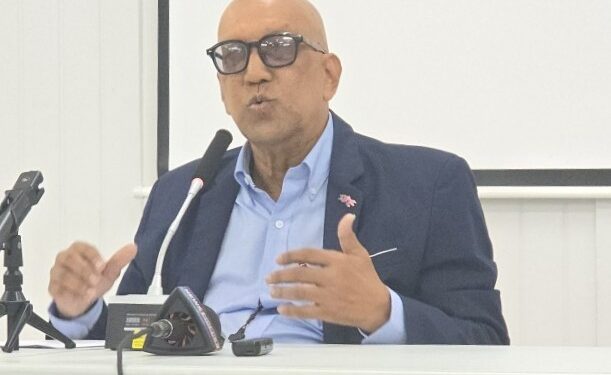
Education Minister Priya Manickchand wants Guyanese to believe that the country’s education system has undergone a quiet revolution. After five years at the helm, she claims credit for an unprecedented 14-point jump in National Grade Six Assessment (NGSA) pass rates, from 49% in 2020 to 63.7% in 2025. She credits this to providing “breakfast, textbooks, classrooms, teachers, and monitoring.”
But while these are commendable efforts, they do not explain the sudden, dramatic surge in national scores. In fact, such a leap demands deeper analysis, and perhaps a public investigation.
At the official NGSA results release, Manickchand proudly stated:
“When I came in, in 2020, 49% of our children had achieved 50% or more. Today it’s 63.7%. That’s more than 3,000 children we’ve moved over that bar—because we gave them what they needed.”
If that were true, it would mark Guyana as a global outlier in education reform success. But here’s the problem: the evidence doesn’t back up the narrative.
According to the World Bank, the average time it takes for countries implementing aggressive education reforms to raise standardized scores by even 5 percentage points is 5–10 years.
-
The United States, despite decades of investment, averages 1–2 point gains on national assessments every four years.
-
Jamaica’s Primary Exit Profile (PEP) has shown less than 4 percentage points improvement over 7 years, despite international support and digital transition.
So how did Guyana, with no major documented curriculum overhaul, no sweeping teacher retraining initiative, and no international aid partnership, suddenly outperform all regional benchmarks?
There is no published Ministry of Education reform document outlining a 5-year NGSA recovery plan. There is no evidence of:
-
Nationwide teacher re-certification or retraining
-
Major ICT integration for differentiated instruction
-
Longitudinal assessments to track interventions
-
School-level funding equalization or modernization
If such reforms happened, why weren’t they shared with the public, educators, or stakeholders?
If the Minister’s claims are genuine, she must immediately:
-
Publish the 2025 NGSA exam paper for comparison against previous years.
-
Release anonymized score distributions across regions and schools.
-
Detail all CXC quality control steps, including whether third-party audits were conducted.
-
Publish the actual 5-year plan, if it exists, that was responsible for this turnaround.
If these cannot be provided, the public has every right to conclude that these numbers were massaged, the exam was watered down, or the results were politically calibrated.
It is no coincidence that these record-breaking NGSA scores were announced just months before a national election. In the absence of any external audit, this looks less like progress and more like propaganda.
Let’s be honest: if Guyana truly improved by 14 points in five years, the world would be studying us. UNICEF, UNESCO, the World Bank, and regional education bodies would be documenting Guyana as a case study. But instead, we get a press conference and applause lines—no data, no peer-reviewed evaluations, and no proof.
The children of this country are not political pawns. Real education progress demands transparency, equity, and consistent investment—not manufactured statistics or miracle math. Until full documentation is released, these results should be treated with deep skepticism.
Manickchand may claim victory, but without proof, the numbers tell a different story: one of fiction over fact.