Warnings of empty store shelves have been in the headlines as multiple press reports indicate that CEOs of America’s top retail stores told President Trump that a prolonged trade war would lead to shortages.
When could that become a reality, and what product categories would be hit first?
Treasury Secretary Scott Bessent recently described a trade war with China as “unsustainable.”
Already, a decline in manufacturing orders from China, and a plummet in Chinese freight vessel bookings and sailings to the U.S., are edging the national supply chain closer to a tipping point. But when does the supply chain reach the point of no return, when currently paused orders need to be re-upped for the retail supply chain to be replenished?
Apparel and footwear are one key consumer product area to watch. In 2024, imports from China accounted for about 37% of all U.S. apparel imports and approximately 58% of all U.S. footwear imports.
“These prohibitively high new tariff rates operate as an import ban,” said Steve Lamar, president of the American Apparel and Footwear Association.
According to the AAFA, in 2024, the average tariff rate for apparel and footwear imports from China was about 18.5%, but for many, it is much higher due to additional duties. “When you add 145% on top of that, you get an average figure exceeding 160%, but in some cases, the actual tariff exceeds 200%,” Lamar said.
Because such a large portion of apparel and footwear comes from China, the effective date of the tariffs gave companies little opportunity to shift sourcing. “They will translate soon into product shortages as orders are canceled or goods are held in warehouses until a trade deal can be worked out,” Lamar said.
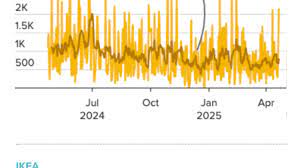
Companies are expecting many impacts, from price increases to consumer wariness, and orders of big-ticket items have surged on the expectation of sticker shock. Recent U.S. shipments data illustrate the tariff mitigation measures the companies are deploying to manage the delicate balance of supply and demand. A pullback in Chinese imports has been seen in recent Walmart, IKEA and Target orders, according to data from SONAR.
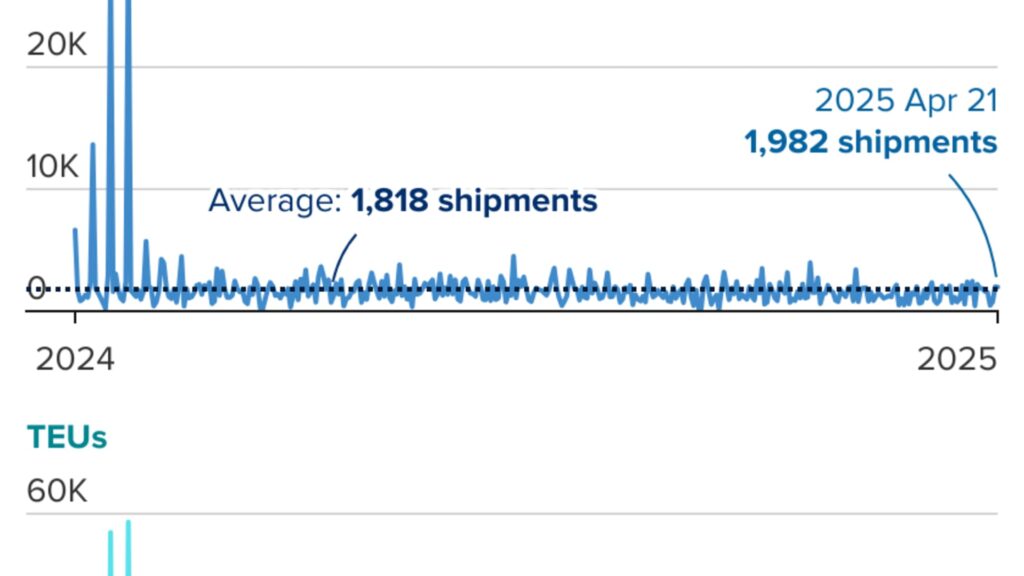
Declining Chinese freight ship visits to U.S.
But the risk of retail shortages will depend largely on how long the “unsustainable” tariff levels last, and the extent to which companies frontloaded inventory in the early months of 2025 based on Trump’s threats. A Chinese government minister recently said, “At present, there are absolutely no negotiations on the economy and trade between China and the U.S.”
If the tariffs do indeed go lower and are considered more manageable to absorb, production orders could resume and shipments could begin again. But if the high tariffs continue, expectations are that the U.S. consumer will be faced with more persistent shortages, especially as Chinese suppliers concentrate on other markets. If that happens, the U.S. supply chain would then have to compete for manufacturing capacity.
The next several months will provide critical information about the health of the supply chain, said Michael Salerno, vice president of international banking at FNBO (First National Bank of Omaha), whose client base is small to medium-sized businesses.
“We are looking at port container volumes mid-May, June, and July,” said Salerno. “We will be looking at the volume of containers and how long it will be sitting there. It’s too early to tell right now.”
New data from Sea-Intelligence shows a continued rise in canceled sailings as a result of the screeching halt of ocean freight orders.
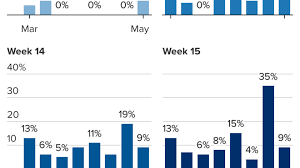
“Many of these blank sailings have been announced with very limited advance warning to the shippers,” said Alan Murphy, CEO of Sea-Intelligence.
The cancelled sails that first happened on the Asia-North America West Coast trade route are now becoming elevated on routes from Asia to East Coast ports.
“For the Asia-North American East Coast, there is now a major spike in blank sailings for the week starting on May 5, which is quite extreme,” Murphy said.
In recent weeks covering late April and early May, carriers scheduled blanked vessels equaling 35%-42% of the planned capacity.
Low margin, fast-moving goods disappear first
Supply chain experts say that lower-end stores will be hit hard by tariffs on low-cost imports and if they run lean on inventory, that will be seen much faster.
“The U.S. retail system is built on speed and scale,” said Casey Armstrong, CMO of ShipBob, a global fulfillment and supply chain platform. “When that engine stutters — whether from tariffs, customs delays, or sourcing constraints — it’s the lowest-margin, fastest-moving goods that disappear first.”
Armstrong warned the first signs of empty shelves would show up where price-sensitive imports dominate the shelf — like toys, games, and budget home goods, in addition to apparel. “These are the canaries in the coal mine of a disrupted supply chain,” he said.
Armstrong thinks toys and seasonal kids’ goods, including back-to-school items, will disappear first because of the shortened lead times and the timing of tariffs.
Fast fashion and apparel — basics, tees, leggings, socks, and some kids’ clothing — would follow. “There is often fast turnover on apparel, and thin margins mean low buffer stock,” Armstrong said.
Low-cost home goods and the consumer electronics supply will be constrained because even though many products in these categories are not “final-assembled in China,” their components often are, according to Armstrong. “Also, many products are refreshed frequently (phones, earbuds, etc.). Some Amazon sellers and big-box stores may have gaps in cheaper electronics and accessories,” he said.
But even as overall orders and sailings from China decline, it’s not a straight line to a sharp decline in every retailer’s activities. Home Depot has recently increased orders to the U.S. from Chinese suppliers, according to data from Import Genius.
Big box retailer inventories are not the only storefronts that may experience inventory pain depending on the severity and length of a trade war, with Armstrong expecting dropshippers (businesses or individuals who operate online stores without holding inventory) and those relying on the de minimis tax exemption from China also being impacted starting on May 2 when that trade loophole is closed.
Jonathan Gold, vice president of supply chain and customs policy for the National Retail Federation, said according to its latest Global Port Tracker report, mitigation measures such as frontloading of cargo have led to higher import levels so more inventory was in ahead of tariffs, but he warned the report also indicated that cargo volumes will significantly decline because of canceled or delayed orders due to the tariffs.
Gold warned that in the least, consumers should be prepared for less inventory and fewer choices, and increased prices, especially at small retailers.
“The effects will likely become tangible in the coming months as shipments that are subject to the higher tariffs begin to arrive and make their way through retail inventory,” said Gold. “The uncertainty around the tariffs is challenging for businesses, especially for small businesses that are currently preparing for critical winter holiday orders.” NBC News