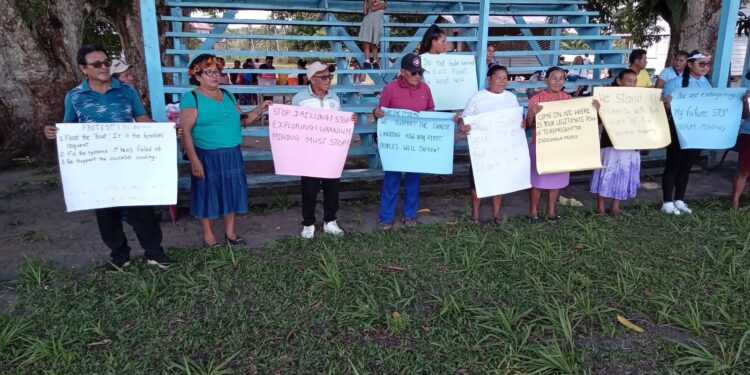
Reports of rapacious gold-mining and logging in the virgin forests of the Iwokrama International Centre for Rainforest Conservation and Development are, perhaps, the worst and most recent revelations of the revolting violation of Guyana’s pristine environment. Miners previously invaded and damaged the Kaieteur National Park and the Kanuku Protected area.
Indeed, Guyana should be a ‘green state’ – an earthly paradise – situated in the centre of the Guiana Shield − one of the world’s most immaculate rainforests and an important source of its freshwater reserves that is essential to the global ecosystem and ecological balance. In reality, however, cavernous mined-out pits, contaminated rivers, crumbling river banks, collapsing hillsides and receding mangrove forests are continuously disfiguring the once unsullied landscape.
Former President David Granger, speaking on the programme – The Public Interest – reminded that Guyana’s Constitution mandates that: “The State shall protect the environment, for the benefit of present and future generations, through reasonable legislative and other measures designed to prevent pollution and ecological degradation; promote conservation; and secure sustainable development and the use of natural resources while promoting justifiable economic and social development”.
He feels, therefore, that it is a gross dereliction of governmental obligation for the PPPC to ignore the rape of Guyana’s natural environment and the threat to clean water, fresh air, flourishing trees. verdant vegetation and a healthy landscape.
The former president pointed out that rivers have been polluted by reckless river-mining and spoilt by waste, particularly single-use plastics which accumulate in creeks, rivers and marine waters and contribute to congested drainage systems, flooding, squalor and depleted aquatic life. Sedimentation and erosion from mining degrade aquatic habitats. Mercury, used in gold amalgamation, contaminates rivers and creeks and threatens biodiversity, humans and the aquatic systems.
‘Draga’ dredges damage river banks and aggravate the turbidity of rivers, degrading water quality and food security. Gold-mining, particularly small-scale and artisanal operations, is a major source of river pollution. Waterborne diseases, such as cholera and typhoid, are prevalent in polluted water and infestation by vector-borne diseases such a dengue and malaria spread easily.
Deforestation from logging, mining and farming damages the environment. Mining covers a vast area of 18.6 million hectares but profiteers are degrading the environment and abandoning mined-out sites after profitable exploitation ends. Depleted pits and hazardous waste have become breeding sites for mosquitoes.
Forests cover nearly 19.3 million ha of the total landmass of 21 million ha but the integrity of the country’s five protected areas has been impaired by illegal exploitation. Mangrove forests cover 33,000 ha and 290 km of the 430km coastline but their depletion – such as the recent removal of mangroves in West Demerara – weakens natural coastal defences and increases vulnerability to erosion and flooding.
The former president explained that the APNU+AFC administration promulgated a plethora of measures to protect the environment and prevent the rape of the nation’s natural resources.
It promoted the Green State Development Strategy Vision 2040 that emphasises the importance of balancing economic growth with environmental protection; introduced the National Climate Change Policy and Action Plan 2020-2030; established the Department of Environment Trained the Corps of Wardens to enforce laws, regulations and codes of practice in the mining and forestry sectors and initiated the observance of National Tree Day to emphasize the importance of trees to all forms of life on earth.
The PPPC administration, however, peremptorily scrapped the ‘Strategy’, miniaturized the Department of Environment; discontinued the observance on National Tree Day and disabled the Corps of Wardens. The results are that the rape of Guyana’s virgin lands continues. The PPPC needs to think again about its policy for the environment if present and future generations are ever to be able to love and live in this earthly paradise.