Sunday, August 23, 2026
Village Voice News
ADVERTISEMENT
  • Home
  • News
  • Sports
  • Editorial
  • Letters
  • Global
  • Columns
    • Eye On Guyana
    • Hindsight
    • Lincoln Lewis Speaks
    • Future Notes
    • Blackout
    • From The Desk of Roysdale Forde SC
    • Diplomatic Speak
    • Mark’s Take
    • In the village
    • Mind Your Business
    • Bad & Bold
    • The Voice of Labour
    • The Herbal Section
    • Politics 101 with Dr. David Hinds
    • Talking Dollars & Making Sense
    • Book Review 
  • Education & Technology
  • E-Paper
  • Contact Us
No Result
View All Result
  • Home
  • News
  • Sports
  • Editorial
  • Letters
  • Global
  • Columns
    • Eye On Guyana
    • Hindsight
    • Lincoln Lewis Speaks
    • Future Notes
    • Blackout
    • From The Desk of Roysdale Forde SC
    • Diplomatic Speak
    • Mark’s Take
    • In the village
    • Mind Your Business
    • Bad & Bold
    • The Voice of Labour
    • The Herbal Section
    • Politics 101 with Dr. David Hinds
    • Talking Dollars & Making Sense
    • Book Review 
  • Education & Technology
  • E-Paper
  • Contact Us
No Result
View All Result
Village Voice News
No Result
View All Result
Home News

Guyana’s Parliament: When Words Become Weapons

Admin by Admin
January 26, 2025
in News
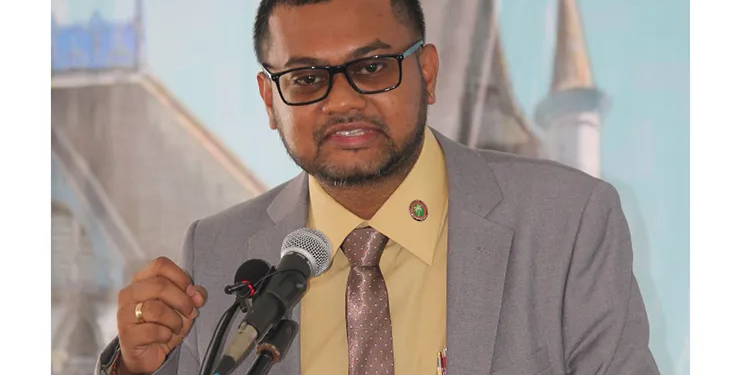
Opposition Whip, Christopher Jones

Opposition Whip, Christopher Jones

0
SHARES
0
VIEWS
Share on FacebookShare on Twitter

In Guyana’s National Assembly, the word “corruption” has become contraband. So too has “loot,” “dishonest dealings,” and virtually any term that might cast shadows on government conduct.

This linguistic lockdown came to a head during a recent budget debate when Opposition Chief Whip Christopher Jones found himself engaged in an absurd game of verbal gymnastics, his microphone repeatedly silenced as he attempted to address allegations of government misconduct.

READ ALSO

Shot Rings Out Near President’s Office, Suspected Warhead Recovered

Guyana’s Oil Wealth Must Create Real Opportunities for Young People- APNU

The parliamentary showdown, which unfolded during Jones’s 20-minute budget presentation, revealed the growing tensions between democratic discourse and institutional control in Guyana’s legislature.

When “corruption” was declared verboten, Jones pivoted to “dishonest dealings.” When that too was forbidden, he tried “loot,” only to face another interruption. Finally, at a colleague’s suggestion, he settled on “runnings” – though even this compromise drew the Speaker’s disapproval.

Speaker Manzoor Nadir’s crackdown extended beyond mere vocabulary policing. When Jones attempted to discuss allegations involving ministers’ family members and shell companies receiving contracts, he was accused of “imputing on honourable members.”

The censorship reached its zenith when Jones referenced a Vice News documentary concerning Vice President Bharrat Jagdeo – prompting Nadir to swiftly cut his microphone.

The absurdity of the restrictions was laid bare when Jones attempted to quote United Nations Human Rights Committee Member Laurence Helfer’s direct statements about “public frustration” over uninvestigated corruption allegations. Even these internationally-sourced remarks faced resistance.

The situation took on an almost Kafkaesque quality when Minister of Governance Gail Teixeira responded that no investigation had occurred because no police report was filed – seemingly ignoring that citizens were expected to report such allegations to a police force itself facing corruption claims at its highest levels.

“What is happening in Guyana’s Parliament flies in the face of Parliamentary democracy,” Jones later told Kaieteur News. Unlike other jurisdictions, where such prohibitions typically apply only to direct accusations against individual MPs, Guyana’s restrictions appear to ban discussion of systemic issues entirely.

More troubling still, these linguistic constraints seem arbitrarily imposed, with words not officially listed as “unparliamentary” being banned on the Speaker’s whim – a burden disproportionately borne by opposition members.

The parliamentary saga took a new turn last week when Opposition Member of Parliament Amanza Walton-Desir launched a pointed challenge to these colonial-era restrictions. “The timing couldn’t be more critical,” she argued, as the nation approaches crucial budget debates. “We’re bound by linguistic handcuffs that belong in a museum, not a modern parliament.”

Her challenge has exposed a curious paradox at the heart of Guyana’s legislature: while the government acknowledges the need to modernise these prohibitions, the Speaker’s office has doubled down on their enforcement, creating what Walton-Desir describes as a “counterproductive” barrier to meaningful debate.

In a nation grappling with rapid economic transformation and growing international scrutiny, this linguistic battleground has become a powerful symbol of the tension between democratic oversight and institutional control. (WiredJA).


ShareTweetSendShareSend

Related Posts

Office of the President
News

Shot Rings Out Near President’s Office, Suspected Warhead Recovered

by Admin
August 22, 2026

Police have launched an investigation into a late-night gunfire incident near the Office of the President after a vehicle belonging...

Read moreDetails
Michael Richmond
News

Guyana’s Oil Wealth Must Create Real Opportunities for Young People- APNU

by Admin
August 22, 2026

The A Partnership for National Unity (APNU) has raised concerns about the economic prospects of young Guyanese, questioning whether the...

Read moreDetails
President Irfaan Ali- May 22, 2026 press conference (screengrab)
News

President Ali Coming After Social Media Users as Govt Considers New Laws

by Admin
August 22, 2026

President Irfaan Ali has signalled that his administration is considering tougher legal measures against social media users, warning that Guyana...

Read moreDetails
Next Post
Dr. Henry Jeffrey

“The PPP foiled our ‘lucky achievement’”


EDITOR'S PICK

Barbados Prime Minister Mia Mottley

Right step… but PM Mottley urges development banks to do more

April 24, 2022

The people perish for a lack of vision

June 21, 2021
President Xi Jinping (center) walks out of the Elysee Palace in Paris, France, with French President Emmanuel Macron (left) and European Commission President Ursula von der Leyen (right) after a China-France-EU trilateral meeting on Monday. (FENG YONGBIN/CHINA DAILY)

EU urged to have fair perception of China

May 7, 2024

Equal access to state media by government and opposition needed

December 31, 2020

© 2024 Village Voice

No Result
View All Result
  • Home
  • News
  • Sports
  • Editorial
  • Letters
  • Global
  • Columns
    • Eye On Guyana
    • Hindsight
    • Lincoln Lewis Speaks
    • Future Notes
    • Blackout
    • From The Desk of Roysdale Forde SC
    • Diplomatic Speak
    • Mark’s Take
    • In the village
    • Mind Your Business
    • Bad & Bold
    • The Voice of Labour
    • The Herbal Section
    • Politics 101 with Dr. David Hinds
    • Talking Dollars & Making Sense
    • Book Review 
  • Education & Technology
  • E-Paper
  • Contact Us

© 2024 Village Voice