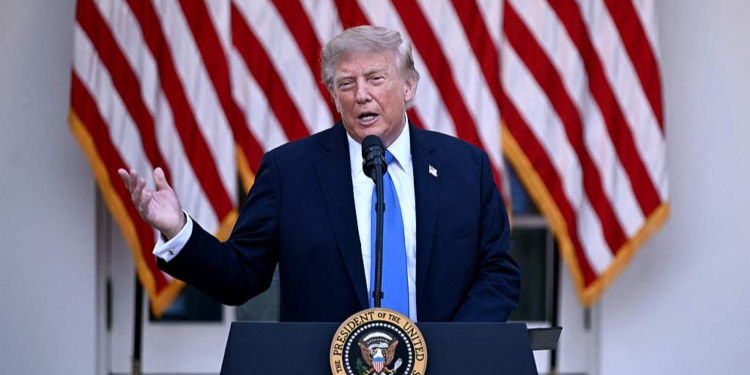
MONTEGO BAY, Jamaica (WiredJA) – Caribbean immigrants in the United States are grappling with renewed anxiety as former President Donald Trump promises to fundamentally reshape birthright citizenship through executive action if returned to office – a move that could affect thousands of families and test the boundaries of constitutional law.
The stakes are particularly high for the Caribbean diaspora in the United States, which numbers approximately 4.4 million people, including both legal residents and citizens.
Within this population, an estimated 500,000 to 550,000 individuals lack documented status, with the largest numbers coming from Haiti, followed by significant populations from the Dominican Republic and Jamaica. These communities, often featuring mixed-status families, could face profound disruption under the proposed policy changes.
For the half-million undocumented Caribbean immigrants and their families, the proposal has sent shockwaves through tight-knit communities already navigating complex immigration challenges.
With many families including both documented and undocumented members, the potential changes threaten to create a multi-tiered system of rights and privileges within single households.
The impact could be particularly acute in states with large Caribbean populations, where community leaders report growing anxiety about the proposal’s implications for future generations.

The controversial proposal, announced as part of Trump’s campaign platform, would require at least one parent to be an American citizen or lawful permanent resident for their children to automatically receive U.S. citizenship.
This marks Trump’s second attempt to challenge the longstanding interpretation of the 14th Amendment, which has historically granted citizenship to all persons born on American soil regardless of their parents’ immigration status.
The birthright citizenship guarantee emerged from the 14th Amendment, ratified in 1868 in the wake of the Civil War. This watershed constitutional change overturned the Supreme Court’s notorious Dred Scott decision, which had denied citizenship rights to both enslaved and free African Americans.
For over 150 years, the amendment’s citizenship clause has been interpreted to apply universally to births on U.S. soil, regardless of parental immigration status.
This isn’t Trump’s first attempt to challenge birthright citizenship. During his presidency in 2018, he announced similar plans for an executive order but never executed them, facing widespread skepticism from legal scholars about presidential authority to alter constitutional rights through executive action.
For Caribbean immigrants, particularly those with uncertain immigration status, the proposal has sent shockwaves through tight-knit communities already navigating complex immigration challenges.
While current U.S.-born citizens’ rights remain protected under the 14th Amendment, the proposal has sparked fears about future implications for mixed-status families.
Legal experts emphasize that citizenship acquired through birth on U.S. soil carries robust constitutional protections. Unlike citizenship obtained through other means, it cannot be revoked based on residency requirements or similar restrictions.
This distinction was crystallized in a landmark 1971 Supreme Court case, Rogers v. Bellei, which drew a sharp line between constitutional and statutory citizenship rights.
The Bellei case illuminates the crucial difference between birthright and naturalized citizenship. The Court ruled that Aldo Mario Bellei, born in Italy to an American mother, could lose his citizenship for failing to meet U.S. residency requirements – a decision that highlighted the unique protections afforded to those born on American soil.
Though Congress later repealed the Immigration and Nationality Act of 1952 that enabled Bellei’s denaturalization, the case’s constitutional principles remain intact.
While no current laws strip citizenship for failing to maintain U.S. residency, the Court’s ruling left open the possibility for Congress to impose such requirements on those who acquire citizenship through means other than birth on American soil.
Constitutional scholars argue that Trump’s proposed executive order would face significant legal challenges. The 14th Amendment’s language – “all persons born or naturalized in the United States” – has withstood various challenges since its ratification.
Any attempt to restrict its scope through executive action would likely trigger immediate court challenges and a potential Supreme Court showdown.
As the debate over birthright citizenship resurfaces in American political discourse, Caribbean communities find themselves at the intersection of constitutional law and immigration policy.
While U.S.-born citizens’ rights remain protected under current interpretations of the 14th Amendment, Trump’s proposal underscores the ongoing tension between executive authority and constitutional guarantees – a debate that could reshape the landscape of American citizenship for generations to come.