In celebration of the International Day for Biological Diversity, the much-anticipated book, Wildlife and People in the Rupununi – A Comprehensive Assessment based on Science and Local Knowledge, has been officially published online.
The book is a collection of engaging articles on the technical and scientific work completed by the Sustainable Wildlife Management (SWM) Programme in southwest Guyana’s Region 9 between 2018 and 2023.
Given the importance of wildlife for the Rupununi region, Guyana, and the world, and the risks of habitat and wildlife degradation that could occur due to recent large-scale development, community leaders – in close coordination with governmental institutions and local NGOs – have taken the lead in piloting wildlife management and conservation activities across the Rupununi.
This book, Wildlife and People in the Rupununi, has been funded by the European Union and presents the results of work led by community members, with support from local civil society organizations (such as Visit Rupununi, Caiman House, South Rupununi District Council, Rupununi Livestock Producers Association, North Rupununi District Development Board and the South Rupununi Conservation Society), and with active support from the Guyana Wildlife Conservation and Management Commission (GWCMC) and the National Fisheries Department.
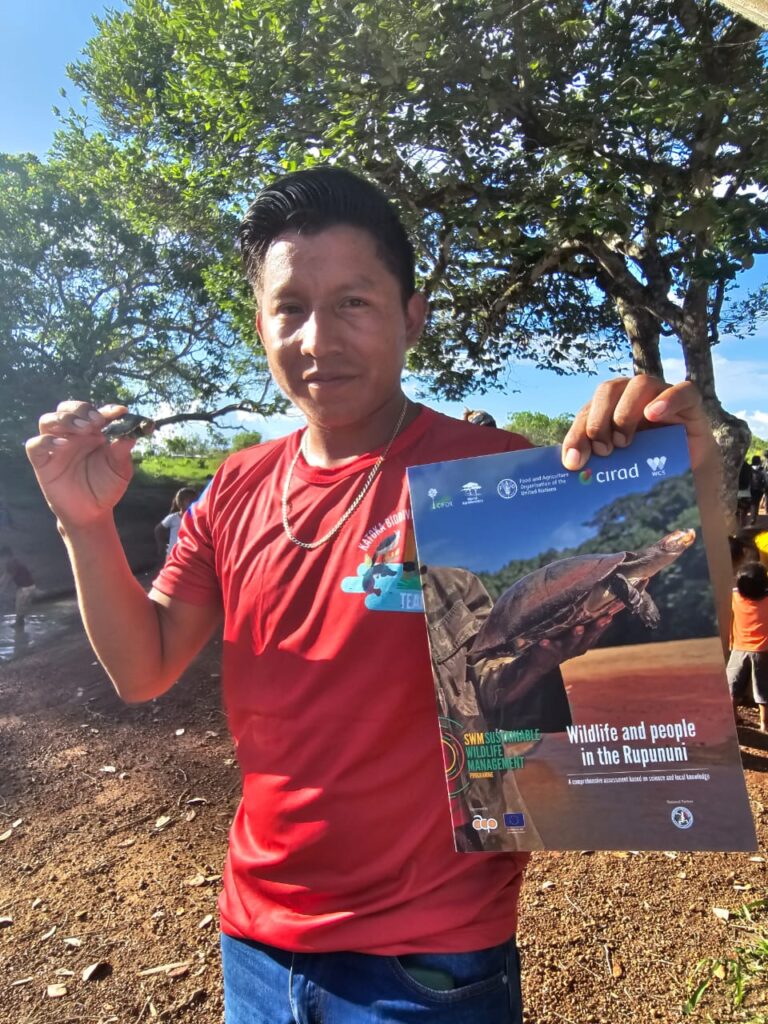
The book contains 15 chapters grouped into four broad areas, namely: the status of wildlife populations, local uses of wildlife, co-existence between humans and wildlife, and wildlife management and conservation initiatives in the Rupununi. This comprehensive document will serve as a reference for wildlife population assessments, understanding ways in which people and wildlife can co-exist, and as an overview of initiatives led by communities in collaboration with the government to ensure wildlife conservation and sustainable use.
One of the book’s central messages is the importance of empowering communities that rely on wildlife for their livelihoods to become stewards in the conservation, management, and sustainable use of that wildlife. An exemplary case study the book covers is the management of river turtles in the Yupukari community, which is an outstanding model for community-led management initiatives and is aimed at preserving the species whilst allowing for sustainable use to continue.
The chapter on the assessment of conflict between people, livestock, and carnivores also adds greatly to a body of information on human-wildlife co-existence in Guyana and aims to support GWCMC’s work in mitigating conflict.
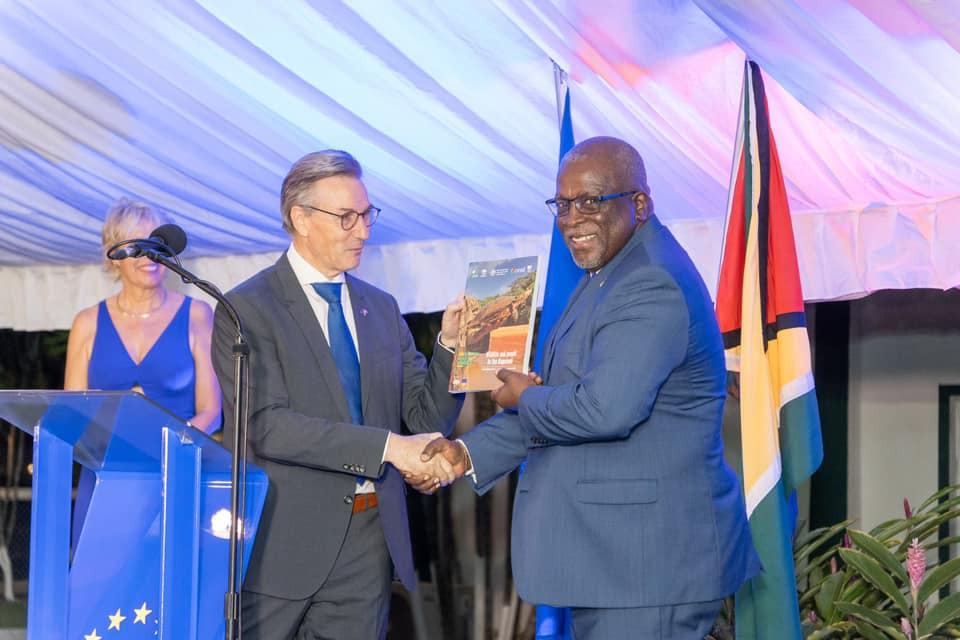
A first copy of the book was presented to Mark Phillips, Prime Minister of Guyana, by René van Nes, Guyana’s EU ambassador, during the celebration of Europe Day in Georgetown on 9 May. “We have extended this programme because it is very successful,” said Van Nes while presenting the book. “It’s one of my favourites. I’m pleased to present one of the very first copies of this beautiful book to the Prime Minister.”
A total of 100 books have been printed and are currently being distributed to key stakeholders involved in the SWM Programme, including authors and local partners.
Spanning almost 300 pages and featuring over 100 professional photographs, the publication is a beautiful testament to the amazing efforts of the SWM Programme’s local partners, and would not be possible without EU support and funding.
The Rupununi region, often referred to as the ‘Land of Giants’ because of its healthy populations of large-bodied neotropical species (such as the jaguar, giant anteater, giant armadillo, giant otter, and giant river turtle, among others), consists mostly of large tracts of primary forest and is likely the most biodiverse region of the country.
The SWM Programme is a major international initiative that aims to improve the conservation and sustainable use of wildlife in forest, savannah and wetland ecosystems. Projects are being piloted and tested with governments and communities in 16 participating countries.
This initiative in Guyana is totally funded by the European Union and coordinated by a dynamic consortium of four partners, namely the Center for International Forestry Research and World Agroforestry (CIFOR-ICRAF), the Food and Agriculture Organization of the United Nations (FAO), the French Agricultural Research Centre for International Development (CIRAD) and the Wildlife Conservation Society (WCS).