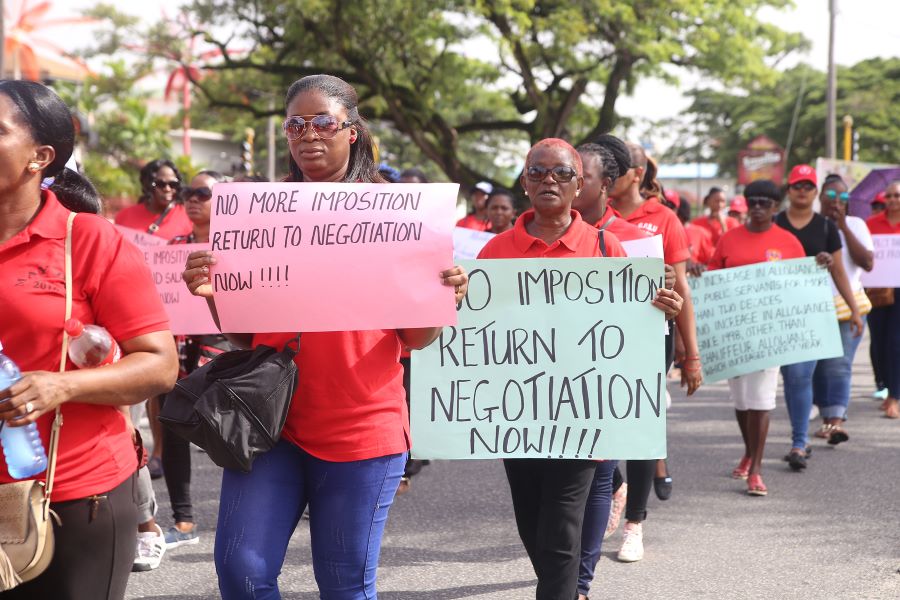
The Guyana Public Service Union (GPSU) has rejected President Irfaan Ali’s intention to use the expired 2024–2025 multi-year wage agreement as the basis for determining public servants’ salary increases in 2026, accusing the Government of undermining collective bargaining while workers struggle with rising living costs.
In a strongly worded statement, the Union said it was unacceptable for the President to announce the basis for salary adjustments while the Ministry of Public Service, Government Efficiency and Implementation had formally requested additional time before commencing negotiations with the Union.
The GPSU also accused the administration of failing to honour its commitment under the 2024 agreement to meet with the Union monthly, arguing that the Government’s approach was effectively sidelining collective bargaining.
The dispute follows the Government’s position that salary adjustments would be made under the existing agreement.
The GPSU said it had written to the Government as early as December 2025, requesting a review of the 2025 wage increases and the immediate commencement of negotiations for 2026. It said that request remains unfulfilled.
The 2024–2025 agreement provided for salary increases of 10 per cent in 2024 and eight per cent in 2025. However, the Union insists that those provisions cannot simply be extended to determine wages for 2026 without fresh negotiations.
“Collective bargaining cannot be pre-empted by unilateral presidential pronouncements, nor can an expired agreement be arbitrarily extended to govern a new period.”
The Union maintained that any adjustment for 2026 must be negotiated in accordance with the 1987 Agreement for the Avoidance and Settlement of Disputes, the Constitution of Guyana and applicable labour legislation.
Beyond the disagreement over the legal basis for the increases, the GPSU accused the Government of allowing negotiations to drag on while public servants absorb the effects of rising food prices, housing costs, utilities and transportation expenses.
It argued that although the 2026 National Budget was passed in February, funds allocated for workers remain withheld, with negotiations yet to begin.
The Union further contended that delaying any eventual salary adjustment until the end of the year could leave workers receiving retroactive payments in a lump sum, potentially attracting a 25 per cent tax deduction and reducing the immediate benefit to households.
The GPSU described the delay as a strategy that undermines workers’ purchasing power and weakens meaningful collective bargaining.
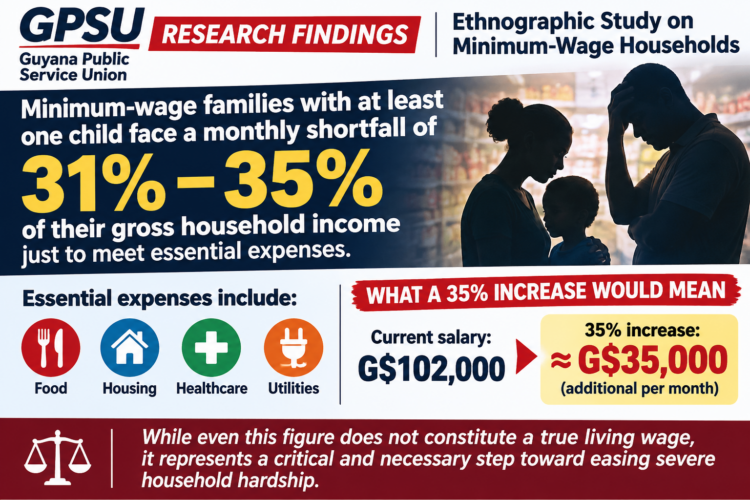
The Union also disclosed that it has submitted research to the Government indicating the extent of financial hardship experienced by minimum-wage households.
According to the GPSU, its ethnographic research found that minimum-wage families with at least one child face a monthly shortfall equivalent to between 31 and 35 per cent of their gross household income when attempting to meet essential expenses, including food, housing, healthcare and utilities.
Using a salary of G$102,000 as an example, the Union said a 35 per cent increase would amount to approximately G$35,000 monthly.
While acknowledging that such an increase would still fall short of establishing a genuine living wage, the GPSU described it as an important measure towards reducing the financial pressure on public servants and their families.
Despite submitting its findings, the Union said the Government has not provided a counter-proposal.
“Dedicated public servants continue to keep this country running while struggling daily to feed, house, and clothe their families.”
The GPSU also took aim at what it described as the President’s emphasis on macroeconomic growth and major infrastructure development while ordinary workers continue to struggle with household expenses.
It argued that economic expansion must translate into improved living conditions for Guyanese workers rather than prioritising the interests of foreign investors.
The Union declared that the Government’s foremost responsibility must be the welfare of the population and called on President Ali to honour the administration’s commitments by initiating formal negotiations without further delay.
“Public servants deserve fair compensation, a genuine living wage, and the dignity of being able to provide for their families.”
The dispute places renewed focus on the relationship between the Government and the GPSU, particularly the administration’s obligations to engage in collective bargaining over public servants’ wages and conditions of employment.
The Union is demanding that the Government stop relying on the expired agreement and return to the negotiating table to determine salary adjustments for 2026.