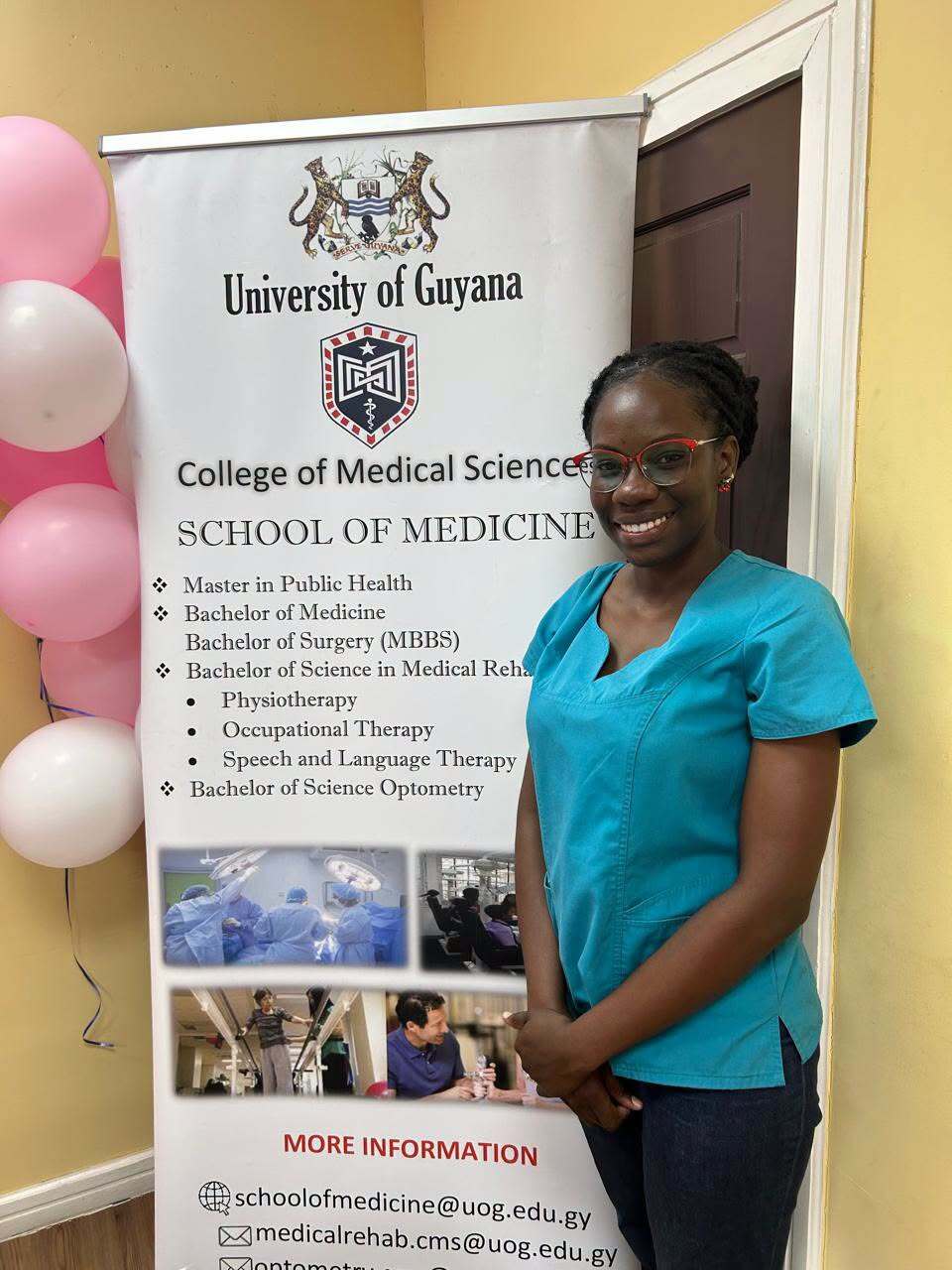
Danessa Blue-Smith, a registered nurse from Farm, East Bank Demerara (EBD), has every reason to be proud when she walks the University of Guyana Graduation stage on Tuesday, November 17, 2026, at the university’s Turkeyen Campus. She has achieved what seemed impossible – Ms Blue-Smith will be graduating with a double degree – a Bachelor’s Degree in Nursing and a Master of Public Health (MPH) degree, becoming the first graduate of the seamless MPH programme.
The three-year programme allows nurses to pursue both degrees simultaneously. For Blue-Smith, completing it marks an important milestone in a journey shaped by an early desire to help others, more than a decade in healthcare and the determination to advance professionally while raising a family. “I feel honoured to be the first graduate of this programme. There were times I didn’t think I would make it, so to reach this point is a blessing,” she said.
Her interest in healthcare began in her early childhood, following the death of her grandmother when she was in primary school. She remembers her family taking her grandmother, who was suffering from a chronic illness, to the hospital, from which her grandmother never returned home. “I always said I’m going to try my best to help people, so that they shouldn’t have to die from things that they could prevent,” she related. That desire led her into the nursing profession. She has since spent more than ten years in primary healthcare and is now the nurse in charge at the Agricola Health Centre, EBD.
Attending UG had also been a longstanding ambition. Shortly after she left secondary school, her father tried to enrol her at the university, unaware that nursing required additional stages of training. Although disappointed at the time, she eventually built her nursing career and returned to the university a few years later.
She joined the seamless programme three years ago as part of its first cohort, alongside fellow nurse Victorene Martin and others. While Blue-Smith has completed the requirements for graduation this year, Martin is continuing her studies and is expected to graduate next year (2027).
The cost of pursuing both degrees initially made Blue-Smith hesitant, but she decided to take the chance, “trusting that God would provide.” She paid her fees for the first year and a half before the University introduced tuition-free education.
The programme required Blue-Smith to attend nursing courses during the day and Master’s in Public Health classes in the evenings and on weekends. Having never completed a university degree before, she found herself studying alongside students who already held degrees, while also having to maintain a high Grade Point Average (GPA) to remain in the programme. “It was really hard,” she admitted, crediting Mr Raynell Gordon and Dr Davon Van Veen for their guidance.
With renewed motivation, she completed her research under the guidance of her supervisor, Dr Olly Pereira. Her study was inspired by what she had observed in primary healthcare: low vaccine coverage among children ages three to four, particularly since the COVID-19 pandemic. She examined healthcare workers’ perceptions of the factors contributing to low coverage in that age group. Her findings pointed to several barriers, including the distance some families live from health facilities, parents being unable to get time off from work, and a view among some that vaccination is not a priority
The experience further reinforced her commitment to preventive healthcare. “I’d rather prevention. I push more for prevention, because it’s easier, it’s cheaper to prevent something than to cure it,” she explained.
For Blue-Smith, further education is about more than career advancement or financial reward. She believes the knowledge gained will help her reach more patients and improve the service she provides. “Once my patients are happy and I could reach out more to them, be a better service to them, that to me is the best reward ever,” she said.
Beyond the academic demands, Blue-Smith had to manage her responsibilities as a nurse, wife and mother. Her workday at the Agricola Health Centre ran from 8:00 a.m. to 4:30 p.m., and some classes fell within those hours. Work colleagues also helped cover for her so she could attend classes and return to work later.
At home, her husband, Sven Smith, remained patient, while her mother-in-law and sister-in-law helped with household responsibilities. Her parents, who live in the United States, also encouraged her throughout the process.
There were moments when she considered giving up. Around September and October last year, as the programme neared its end, she put away her laptop and books, uncertain whether she would complete her studies in time to graduate.
Her family encouraged her to continue. She described the final stretch as being like childbirth: “It’s like labour. When you’re about to give birth, it becomes harder. But I just have to make one more push.”
Describing the people who supported her as her “village,” she believes the encouragement and practical help of family, friends and colleagues can make a significant difference to someone pursuing further education.
Looking ahead, Blue-Smith plans to spend more time with her family while continuing to develop her interest in public health, particularly school health and issues such as vaping, substance use and mental health among students.
Her advice to other nurses and working professionals considering further studies is to be willing to take a chance, even when the challenges seem overwhelming. “Be willing to take the risk. At first the obstacle might look big, but once you zoom into it, there is a way to make it small, to overcome it,” she advised. (Feature by the Department of Events, Conferences and Communication (DECC), University of Guyana)