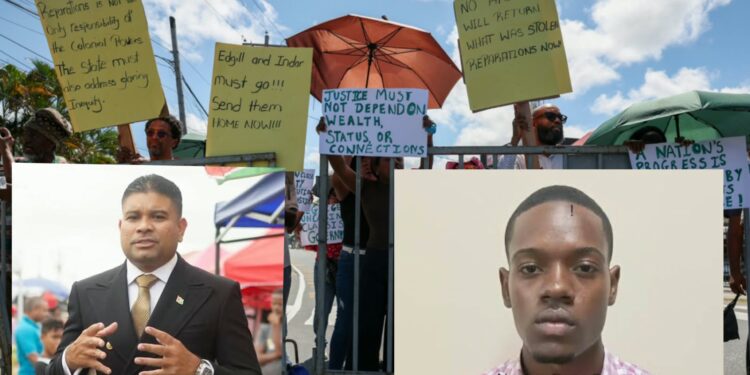
By Mark DaCosta-A Guyanese political action group wants the magistrate who refused bail to Opposition Leader Azruddin Mohamed to withdraw from all matters involving the Mohamed family. The Vigilant Political Action Committee (V-PAC) argues that the refusal looks like punishment before trial and casts doubt on the court’s impartiality.
V-PAC contends that Magistrate Abigail Gibbs should recuse herself because her reasoning, in its view, may have been coloured by Mr. Mohamed’s other pending cases, none of which has ended in a conviction. The group says a man who has honoured every court-imposed obligation should not lose his liberty on suspicion of what he might do.
The matter came to a head on Friday, 30 October 2026, at the Sparendaam Magistrates’ Court. Mohamed, 39, and Police Constable Ryan Greene, 20, were jointly charged under the Cybercrime Act No. 16 of 2018 with the unauthorised giving of electronic data. Reports link the charge to the alleged copying of CCTV footage onto external media and its delivery to Mohamed, and say Police Special Prosecutions successfully opposed his release. After lengthy arguments, Magistrate Gibbs refused bail and remanded both men until 24 November. Reports say the defence is turning to the High Court. The charge is an allegation only, and Mohamed has not been convicted of it.
Magistrate Gibbs reportedly gave three reasons. She acknowledged that the law provides for a defendant’s right to bail, but pointed to the “mysterious nature” of the offences and expressed fear that the men could commit another offence if released. V-PAC says she also weighed Mohamed’s other pending matters, a consideration the group finds troubling. In its words, “the denial of bail must not and cannot become a form of punishment.”
V-PAC was formed in early 2025 under businessman Dorwain Bess. It presents itself as a voice for marginalised communities and campaigns for transparency, judicial independence and fairer distribution of the country’s wealth. In July 2025 it helped found the Forward Guyana Movement (FGM), a three-party alliance that also includes Forward Guyana, led by Amanza Walton-Desir, and The People’s Movement.
The legal framework matters here. Bail is now governed by the Bail Act 2022, which consolidated rules previously scattered across the Summary Jurisdiction (Procedure) Act and the Criminal Law (Procedure) Act. Section 7 sets out the grounds on which a court may refuse bail, including reason to believe a defendant may commit an offence while on bail, interfere with witnesses, tamper with evidence or otherwise obstruct the course of justice. Reporting on the bill also recorded risk of harm to the defendant as a further ground. These provisions sit alongside the constitutional presumption of innocence, which is why refusal is meant to be exceptional and grounded in evidence, not suspicion alone.
The magistrate’s stated concern about further offending falls squarely within the statutory grounds, and her ruling rests on that footing. V-PAC’s objection is to the way the discretion was exercised. It stresses that bail exists to secure attendance, and it asks: “What exactly has changed” to make the court doubt that he will appear? The group notes that “the world knows Azruddin Mohamed’s face” and that he has presented himself for every court appearance and station report.
The wider backdrop is crowded. On 16 October, Mohamed and two other men were granted bail of $750,000 on each charge of unlicensed firearm and ammunition possession, with Magistrate Faith McGusty noting disputed circumstances around the alleged discovery and the absence of CCTV footage. He and his father, Nazar Mohamed, are also facing extradition to the United States on fraud-related allegations, and those proceedings were adjourned to 24 November.
In September, a court rejected an attempt to revoke his bail in the extradition case over a new police investigation. That history can be read two ways: as evidence of a litigant who keeps complying with his conditions, or as a pattern of fresh allegations that a court might reasonably weigh.
V-PAC’s demand that Magistrate Gibbs “should and must recuse herself” rests on the perception of fairness, not on any proven bias. The group itself concedes that members of the judiciary are expected to be “held above reproach” and that criticism of them calls for restraint. Recusal is traditionally tested by whether a fair-minded observer might reasonably doubt a judge’s neutrality, and it is for the court, and if necessary a higher court, to decide whether that threshold is met.
For now, Mohamed remains in custody, the High Court route is open, and the question of judicial independence has been placed squarely before the public. In a young oil economy where confidence in institutions is hard-won, how our courts answer will matter well beyond one man’s liberty.