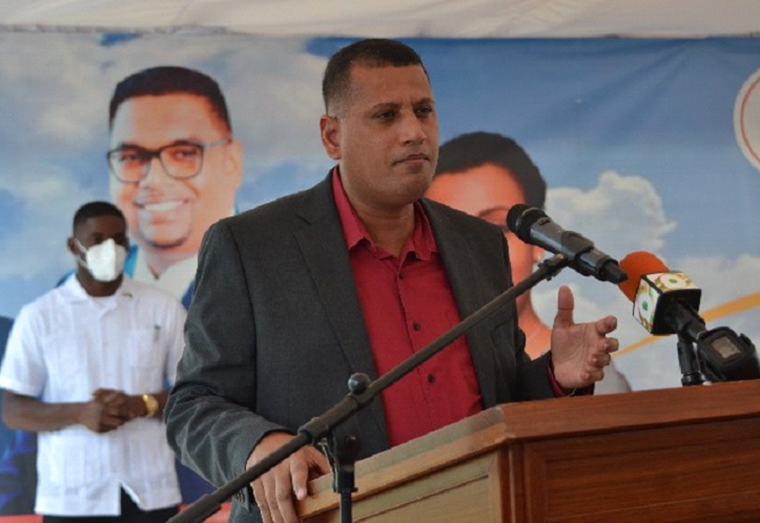
A Partnership for National Unity (APNU) lead parliamentarian and businessman Dr Terrence Campbell is warning that Guyana risks squandering its oil windfall unless the government moves beyond spending petroleum revenues and develops a strategy to preserve and grow national wealth for future generations.
In a statement, Campbell challenged the government’s approach to the Natural Resource Fund (NRF), arguing that after seven years of oil production, Guyana still lacks a sufficiently ambitious investment strategy to turn finite petroleum reserves into lasting financial assets.
His criticism follows remarks by Natural Resources Minister Vickram Bharrat on the October 15 edition of The Guyana Dialogue, where the minister acknowledged that the government was not yet ready to invest NRF resources locally or internationally.
“We are not in that position as yet; we are still using revenue to build out infrastructure, ensuring that we have good education, healthcare and maybe in the future, at some point in time, when we’re in a better position, then we too might look at investment, whether locally or internationally,” Bharrat said.
Campbell argued that postponing a long-term investment strategy leaves unanswered fundamental questions about how Guyana will sustain prosperity when its offshore oil reserves eventually decline.
“The PPP has consistently spent around 90% of earnings from oil,” he wrote, describing the approach as “profligacy” that threatens the goal of lasting national prosperity.
The scale of withdrawals is documented in official figures. In 2025, the government withdrew US$2.463 billion from the NRF, while the fund received approximately US$2.51 billion in petroleum-related inflows, according to the 2025 NRF Annual Report. The figures underscore the debate over how much of Guyana’s oil income should be spent now and how much should be preserved for the future.
Cash preservation versus investment
Guyana’s current NRF investment mandate requires funds to be held in an account at the Federal Reserve Bank of New York, earning overnight interest rather than being deployed through a diversified investment portfolio.
Campbell acknowledged the importance of protecting the principal and maintaining liquidity but questioned whether the existing arrangement represents the best long-term use of the country’s growing financial resources.
“There is an important distinction between keeping money safe and investing wealth strategically.”
He called for an independent review of the NRF’s investment strategy, including an examination of international best practices, investment risks, expected returns and the safeguards necessary to protect public funds.
He also wants the public to receive clearer information about the fund’s objectives, performance and the criteria used to determine whether its resources are being managed effectively.
Norway’s example and Guyana’s choices
Campbell pointed to Norway’s sovereign wealth fund, which invests internationally across equities, bonds and other assets, as an example of how oil revenues can be converted into enduring national wealth.
He argued that Guyana must confront three fundamental questions: how much to save, how much to spend and where to invest.
The comparison raises an important distinction. Government expenditure on roads, schools, hospitals and other infrastructure can generate long-term economic and social benefits, but those projects must be assessed for value for money, maintenance costs and their lasting contribution to productivity. A diversified financial portfolio serves a different purpose by generating returns and preserving wealth beyond the life of the oil industry.
The International Monetary Fund has noted that Guyana’s revised NRF withdrawal rules allow larger transfers to the national budget, increasing the resources available for development while reducing the fund’s potential accumulation compared with the previous rules. I
Campbell’s warning is that rapid economic growth and large budget allocations cannot, by themselves, guarantee lasting prosperity.
Without a transparent strategy for saving, investing and measuring returns, he argued, Guyana could exhaust its petroleum resources without building sufficient alternative wealth for future generations.
“Guyana’s oil wealth must become the foundation of lasting national wealth,” Campbell wrote.