In an open letter to every government on earth, political rivals from Barbados to Belize set aside old quarrels to urge a yes vote at the UN on Wednesday — and warn that Washington’s fuel blockade has turned a Cold War relic into a weapon of starvation.
By Calvin G Brown (WiredJA)— Ten former Caribbean leaders who spent their careers on opposite sides of the region’s political divides have found one thing they can agree on: the United States embargo against Cuba has to end, and the world should say so loudly on Wednesday.
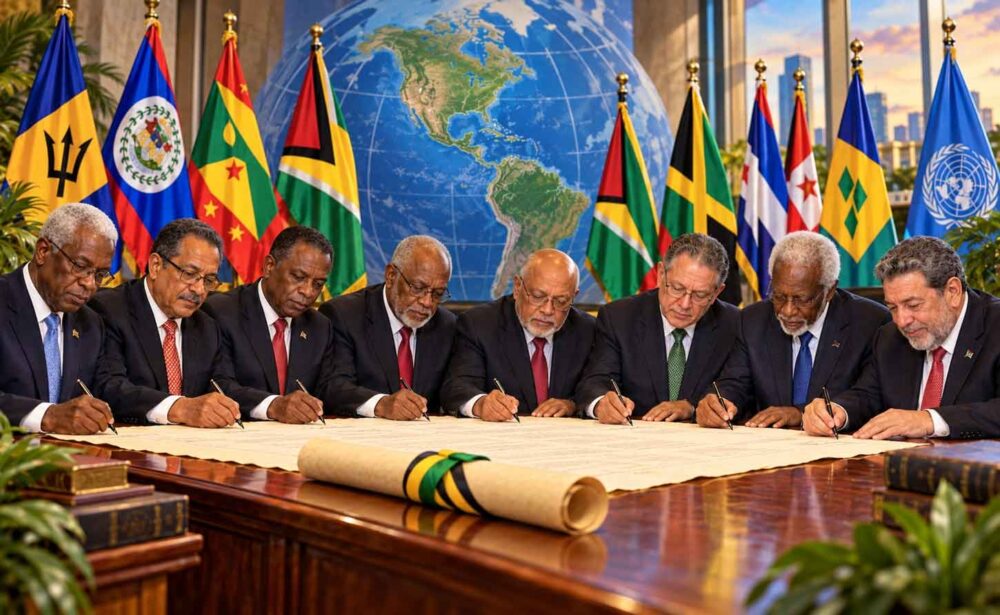
In an open letter dated October 24 and addressed “to all nations of the world,” former prime ministers Freundel Stuart of Barbados, Said Musa and Dean Barrow of Belize, Keith Mitchell and Tillman Thomas of Grenada, Bruce Golding and P.J. Patterson of Jamaica, Kenny Anthony of St Lucia, and Ralph Gonsalves of St Vincent and the Grenadines, together with former Guyanese president Donald Ramotar, “strongly and unequivocally urge all nations to vote in favour” of the UN General Assembly resolution on the embargo when it comes to the floor on October 28.
The language is not diplomatic. The embargo, the signatories write, “is contrary to international law and every civilised precept of life and living.” Washington’s refusal to heed three decades of UN votes shows it “ignoring the clear voice of the international community, the requisites of international law, and the most elemental of civilising principles.”
And in the letter’s sharpest line, the unilateral measures against Havana “represent the law of the jungle, and can in no way be justified by the Charter of the United Nations or any other source of international law and justice.”
“Cuba is not a threat to any nation or any person on planet Earth!”
A fuel blockade changes the stakes
What makes this year different, the former leaders argue, is that the embargo has stopped being a Cold War relic and become an active instrument of deprivation. “In recent months,” they write, “the US government has further ramped up its illegal embargo against Cuba in an attempt to starve the Cuban people into submission through the imposition of third-party sanctions against any government or entity which grants, sells or transports energy products, including gasoline and diesel, to Cuba.”
That is a reference to a January 29 executive order under which the Trump regime declared a national emergency and authorised sweeping tariffs against any country that directly or indirectly supplies oil to Cuba — in effect a proxy fuel blockade that threatens third countries with punitive duties rather than interdicting ships.
The effect was immediate. Mexico confirmed it had suspended all fuel shipments to Cuba to avoid the tariffs, and UN human rights experts condemned the order as “an extreme form of unilateral economic coercion with extraterritorial effects,” warning that Cuba was already enduring blackouts of up to 20 hours that threatened refrigeration for food and medicine.
Washington has since layered on more: a new sanctions programme created on May 1 that reaches non-Cuban companies and foreign banks dealing with blocked entities, and the blacklisting of Cuba’s state oil company in June.
Earlier this month, federal agents in Miami announced the seizure of 90 fuel shipments worth US$2.8 million they said were bound for a sanctioned Cuban wholesaler. “Surely,” the letter says, “such US conduct is inhumane, and undoubtedly contrary to international law.”
The human face of the blockade
Behind the statesmen’s legal language stands a Cuban voice the region has already heard. In February, days after the executive order was signed, an open letter to the world from an unnamed Cuban woman went viral across social media. Barbados’s ambassador to CARICOM, David Comissiong, took it up in a statement of his own, calling it a “piteous yet dignified message” from “our Cuban sister” and placing it squarely against what he described as the radical intensification of a 64-year-old illegal blockade.
Her testimony is the kind that no vote tally captures. Elderly Cubans, she wrote, are “dying prematurely because the blockade prevents the arrival of medications for heart conditions, high blood pressure and diabetes.” Newborn babies are fighting for their lives because “incubators in Cuba have had to be shut down due to a lack of fuel.” Comissiong’s own summary of what she was describing was blunter still: “terrorism through hunger,” inflicted through a deliberate policy to deprive an island of food and energy.
Eight months on, the former leaders’ letter reads as the diplomatic echo of that cry. The incubators have not been switched back on by a Russian tanker or a humanitarian licence; the blackouts returned in September. What the woman asked the world to see, the former prime ministers are now asking the world to vote on.
Why the warning about “blandishments and pressures”
The signatories make a point of urging that “the blandishments and pressures currently being deployed by the USA to derail and defeat the proposed UNGA Resolution must be resisted.” That is not paranoia; it is arithmetic. In 2024 the resolution passed 187 to 2. Last October it passed 165 to 7 with 12 abstentions, with Argentina, Hungary, Paraguay, North Macedonia and, for the first time, Ukraine joining the United States and Israel in opposition.
Cuba’s foreign minister told the Assembly that Washington had mounted “a brutal and unprecedented deployment of pressure, intimidation, and toxicity” to flip votes. Twenty-two countries moved in a single year. The former leaders are plainly worried that more will follow.
CARICOM, at least, held firm: all 14 member states voted in favour last year. The letter is, in part, a reminder to their successors not to be the first to blink.
The case Washington makes
The United States has never accepted the premise of the annual vote. Successive administrations have argued the embargo is a bilateral matter outside the General Assembly’s remit, and that the real cause of Cuban hardship is a one-party state that jails dissidents and mismanages its economy.
The Trump regime, with Secretary of State Marco Rubio as its Cuba point man, frames the fuel squeeze as pressure for political change, and officials note that licensed fuel exports to Cuba’s private sector and humanitarian shipments through religious nonprofits continue.
Supporters of the policy in the Cuban-American community would also point out that the letter says nothing about Cuba’s own human rights record.
The former leaders do not engage that argument. Their reply, in a single exclamatory line, is that Cuba threatens no nation and no person on earth — and that the burden of justification lies with the country doing the blockading, not the one being blockaded.
A regional reflex, not a radical one
For the Caribbean, solidarity with Cuba is old muscle memory. In 1972, Jamaica, Barbados, Guyana and Trinidad and Tobago recognised Havana in defiance of US wishes. Cuban doctors and scholarships have reached every island since.
Patterson and Golding, bitter rivals through the 1990s and 2000s, signing the same page is a measure of how deep that consensus runs. So is Mitchell beside Thomas, who defeated him and was defeated by him in turn, and Musa beside Barrow, who traded Belmopan back and forth for a quarter of a century.
The General Assembly cannot lift the embargo; only Congress can. What the vote measures is whether the world is still willing to say the obvious. “Let us all stand with Cuba and humanity on this matter,” the letter concludes. On Wednesday, 193 governments will decide whether they still can.