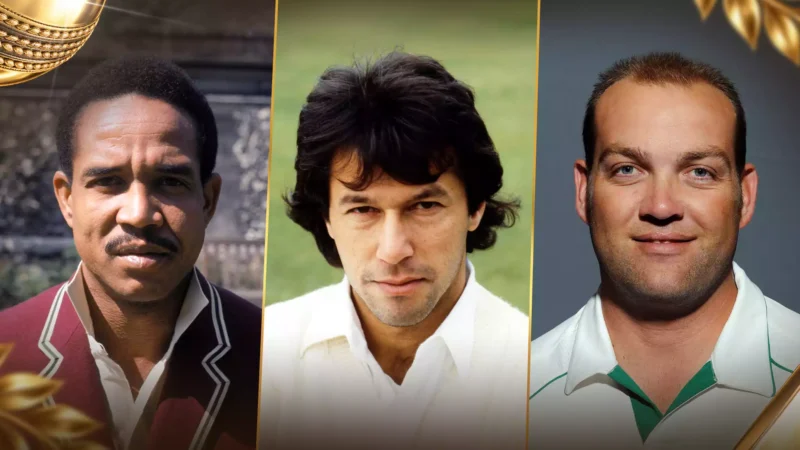
In terms of pure numbers, based on numerous analyses, it’s Imran Khan who ranks the all-time No.1 Test all-rounder, marginally ahead of Jacques Kallis and Sir Garfield Sobers. In the first part of this series, we looked at seven key parameters while rating 30 players who managed a double of 2000 runs and 100 wickets in the format with acceptable averages in either discipline.
Here’s an in-depth breakdown as to what separates these three from the rest, and why some of the most prominent ones, like Ben Stokes and Kapil Dev, don’t feature in the top 10.
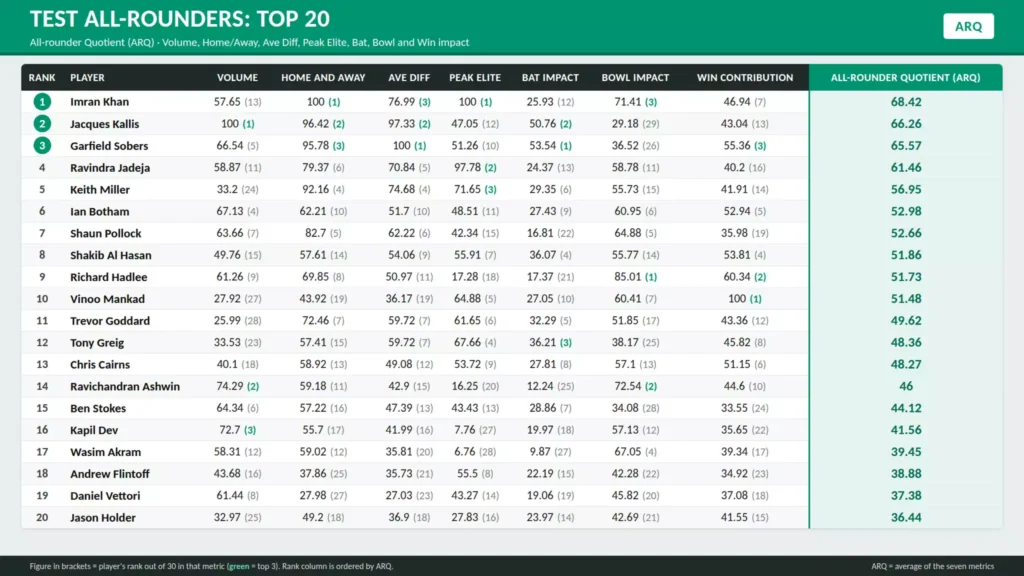
Top 20 all-rounders in Tests (min. 2000 runs and 100 wickets)
*brackets indicate rank out of 30 players on the given parameter
Here are the most frequently asked questions from our readers:
“I know you have taken the traditional meaning of an all-rounder, but can we not extend it to fielding as well? I feel it is an underappreciated aspect of cricket.”
– Prins S
(and Aishwarya Pandey, Hytool Patel, Ishit Prachchhak, Anthony Marsh)
Yes, Prins. That’s a fair point, and in tune with your username “prinsofalltrades”! I would also like to touch upon the other key aspect as some of our readers have raised – captaincy.
Fielding first. Close-in catching, especially in the slips, short-leg and silly-point positions form the key credentials for a fielder in Test cricket. The most athletic ones or those with the safest hands do not always necessarily take these positions in the format. Ravindra Jadeja, for example, has rarely done that despite being a great fielder, and would slip below most players in this category. Among the list of 36 players with the said double of 2000 runs and 100 wickets, the top four in terms of catches per innings ratio are Tony Greig (0.813), Ian Botham (0.67), Kallis (0.634) and Sobers (0.633). Stokes, having taken numerous stunners in a long career, ranks 10th here, while Jadeja (0.282) ranks 20th, just ahead of Kapil (0.278).
A fair assessment would then be to take fielding numbers in isolation, as we did for volume, win contribution, batting and bowling impact among the seven parameters. With a sizeable cut-off of minimum 40 matches (excluding the wicketkeepers), Tony Greig ranks fourth out of 396 players here, as his catches per innings ratio of 0.813 is bettered only by Bob Simpson (0.94), Steven Smith (0.929 – world record holder with 224 catches) and Stephen Fleming (0.859). Stokes ranks 97th out of 396, while Jadeja is way lower at 251st.
Likewise, not all players in the set have captained the side, the notable ones to miss out being Keith Miller, Richard Hadlee, Jadeja and Ravichandran Ashwin. Kallis took the responsibility as a stand-in captain twice in a career spanning nearly two decades. Nine of them led in 25 or more Tests: Imran (48), Stokes (44), Sobers (39), Jason Holder (37), Kapil (34), Daniel Vettori (32), Richie Benaud (28), Shaun Pollock (26) and Wasim Akram (25). Benaud leads with a win-loss ratio of 3 among these, followed by Pollock (2.8), Imran (1.75), Akram (1.5), Stokes (1.33) and Sobers (0.9).
Consider just the catching aspect alongside the seven parameters and Kallis and Sobers would gain more points. Captaincy would elevate Imran, Pollock and Stokes’ case further. Factor in both, and Sobers would be at the top. Arguably the most versatile cricketer ever, best reflected by his range as a bowler, Sobers was an all-round fielder. He was reliable in the slips, while also forming a formidable pairing with off-spinner Lance Gibbs with his sharp catching at short-leg and silly-point. 39 of Sobers’ 109 catches as a fielder came off Gibbs’ bowling, a number only exceeded by six other bowler-fielder pairs.
However, as mentioned earlier, since there were limitations on these two fronts for most other players, we have stuck to the two primary disciplines.
“The big one – What makes Imran greater than Sobers, Kallis and the rest? And what exactly separates Sobers and Kallis?”
– Salman Azmi
That keyword: All-rounder! In terms of pure statistics from the metrics used in this study, Imran is one with a fine balance between his bowling and batting credentials, compared to most others. A majority of the 30 players in the set are bowling all-rounders, Sobers and Kallis being the most notable of the rare exceptions. And so, the ones with exceptional numbers with the ball and a sizable contribution with the bat have benefited in this percentiles-based rating system. Only Imran, Ian Botham and Shakib Al Hasan rank in the top 15 in each of the seven categories.
Imran ranks second only to Richard Hadlee in terms of bowling impact, and his batting numbers don’t take a major hit, placing him at 12th. For context, Kallis and Sobers rank 29th and 26th out of 30 respectively on the bowling front. Imran had a long stretch of healthy averages in either discipline, and his exceptional record in home and away Tests compared to the rest further elevates his case.
Kallis and Sobers stand miles ahead of everyone else in terms of pure batting numbers, but the bowling stats in isolation pull them down. It is worth noting that Sobers’s bowling strike-rate of 91.9 is the 12th worst among the 206 bowlers with 100-plus Test wickets (highest among the 99 with at least 175 scalps). Kallis, having bowled in attacks led by Allan Donald, Shaun Pollock and Dale Steyn, to go with the rest, falls behind in terms of percentage of wickets contribution here. More on that later.
Sobers, brilliant across most parameters, falls marginally behind Kallis only because of the aggregates – 8032 runs and 235 wickets compared to 13289 runs and 292 scalps. Kallis scores a perfect 100 here, well ahead of the next best Ravichandran Ashwin (74.29), while Sobers ranks fifth at 66.53.
Imran’s respectable batting numbers, complemented by his superior bowling exploits, offers him a consistent rating across all parameters, unlike someone like Ben Stokes, who for a large part of his career featured in an attack led by James Anderson and Stuart Broad. Like Stokes, Imran did play a few Tests as a pure batter, and yet, his overall bowling numbers don’t take a hit. Moreover, he stood the best in terms of home and away comparison on both aspects combined, compared to every other player in the list.
The other factor is Imran’s Elite Peak, as we call it. He had an astonishing sequence of 81 matches where he maintained a batting average of 40.07 and bagged 348 wickets at 22.23. For context, Kallis’ longest streak of a 40-plus batting average and sub-30 bowling average spanned 76 Tests, which constituted 45.8% of his career appearances (166). For Sobers, it was 49.5% (46 out of 93). Both averaged 60-plus with the bat and marginally below 30 with the ball in their prime. Imran, meanwhile, aggregated 2516 runs at 51.34 and bagged 218 wickets at 19.16 across the last 52 Tests of his career.
“I think Kapil Dev should be in the top 10. He operated as a lone wolf pacer unlike the rich attacks from Pakistan and the SENA countries. Indian pitches didn’t suit fast bowling and he carried an immense workload.”
– Neelesh Potnuru
The most debatable one: “Imran, Hadlee and Botham in the top 10, but why is Kapil at 16th?”
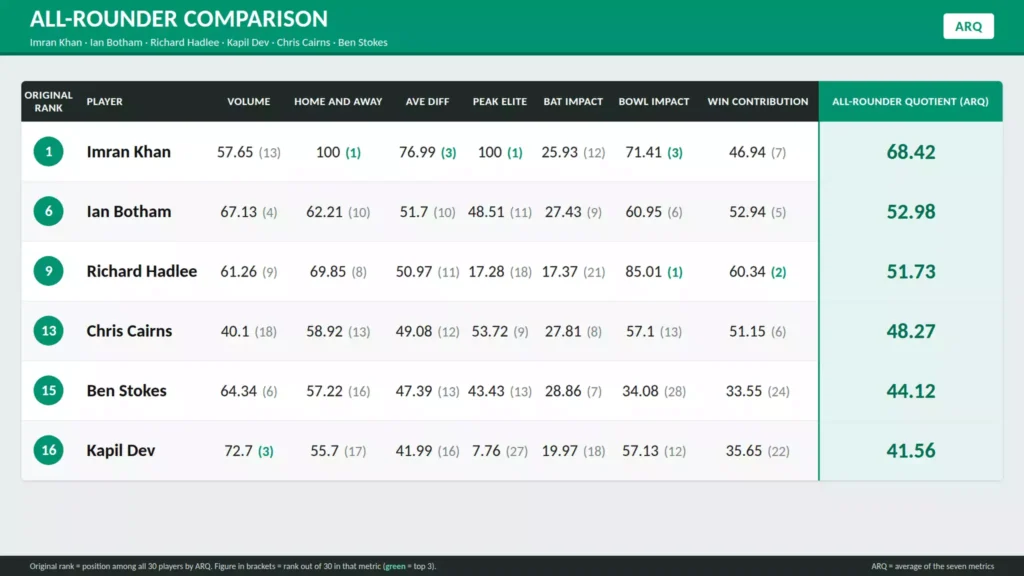
5248 runs and 434 wickets – Kapil is the only player with a stellar double of 5000-plus runs and 400-plus wickets in the history of Test cricket. Botham aggregated almost as many runs (5200) but finished with 383 scalps. Among the ones with over 400 wickets, Shaun Pollock has the next most runs (3781). In terms of raw volume, Kapil ranks third among the 30 players after Kallis and Ashwin, but falls way behind on every other parameter.
He ranks 12th on the bowling impact, which has Hadlee, Imran and Ashwin as the top three respectively. There’s a marginal difference between him and Chris Cairns here, who finished with 3320 runs and 218 wickets in 62 Tests. A statistical comparison with Cairns (ranked 13th overall) offers an interesting outlook. The New Zealander ranks 8th in terms of batting impact compared to Kapil’s 18th, and sixth in terms of win contribution, while Kapil ranks 22nd. Kapil’s major standout performances either came in draws or defeats. In some other cases, he was overshadowed by someone else’s outstanding performance. A case in point: he was the only one to score a hundred (from either side) in the Chennai Test featuring the West Indies in January 1988, but that was a footnote to Narendra Hirwani’s record 16/136 on debut.
A general consensus is that Kapil carried his team’s pace attack like no other before or since. That is backed to a great extent by numbers, though only in terms of the workload, unlike Hadlee, who boasts standout bowling credentials in terms of both volume and impact.
Across Kapil’s 131 Tests appearances, India delivered a much higher share of overs by the spinners compared to the quicks, especially at home (roughly 30% quicks and 70% spin). Of all the overs by Indian seamers across these 131 games, Kapil bowled 51% of them. The corresponding numbers read 32.17% for Botham, 35.7% for Imran and 32.9% for Hadlee. Botham had Bob Willis. Hadlee had Lance Cairns and Ewen Chatfield. Imran had Sarfaraz Nawaz first and Wasim Akram later. Across the 131 Tests featuring Kapil, all other India seamers collectively bagged 344 scalps (still 90 fewer than his tally), the next best being Manoj Prabhakar’s 92, followed by 57 for Chetan Sharma. Among Kapil’s many new ball partners was Sunil Gavaskar.
It’s noteworthy, however, that Kapil bowled 20.05% of the team overs overall, still inferior to Hadlee (24.86%), Imran (21.88%) and Botham (21.29%). Jasprit Bumrah (22.61%) tops it among India seamers with 100-plus scalps, followed by Javagal Srinath (20.92%). Hadlee bowled 42.3 overs per Test on average, Imran 36.5 (despite playing a few as a specialist batter), Botham 35.4 and Kapil 35.2. Cairns was there or thereabouts: 18.68% of team overs and 31.3 overs per Test.
As for the bowling contribution in wins, Hadlee (173 wickets at 13.06), Imran (155 wickets at 14.50) and Botham (172 wickets at 20.09) were far superior to Kapil. Eight of Botham’s 14 Test tons came in wins, Imran and Kapil got one each, while Hadlee scored 99 to go with eight wickets in an innings win over England in Christchurch in 1984. Cairns, meanwhile, took 76 wickets at 20.19 and aggregated 936 runs at 44.57 in 16 wins as a player. Kapil bagged 90 wickets at 18.3 and scored 904 runs at 33.48 in 24 wins.
To sum it all up, Imran was the highest-quality player of the four, with consistent ratings throughout. Hadlee was a specialist case – a true matchwinner with the ball and handy with the bat. Botham was the most balanced of the lot with a decisive impact in wins. Of the 30 players, he is the only one to rank in the top 11 in each of the seven parameters. Kapil Dev’s career was one with great longevity and volume. However, unlike India’s ODI success under him in the mid-1980s, the high points in Test cricket were rarer. He was India’s torchbearer with the ball, but couldn’t quite take his side to greater heights in Tests like Hadlee did for New Zealand.
Stokes, in this sense, is perhaps a mirror image of Kapil. He too was a volume player, his batting numbers making more impressive reading than the bowling exploits (he had his troubles with injuries). He produced numerous moments with the ball, like Kapil did with the bat. In terms of raw statistics however, both fall behind.
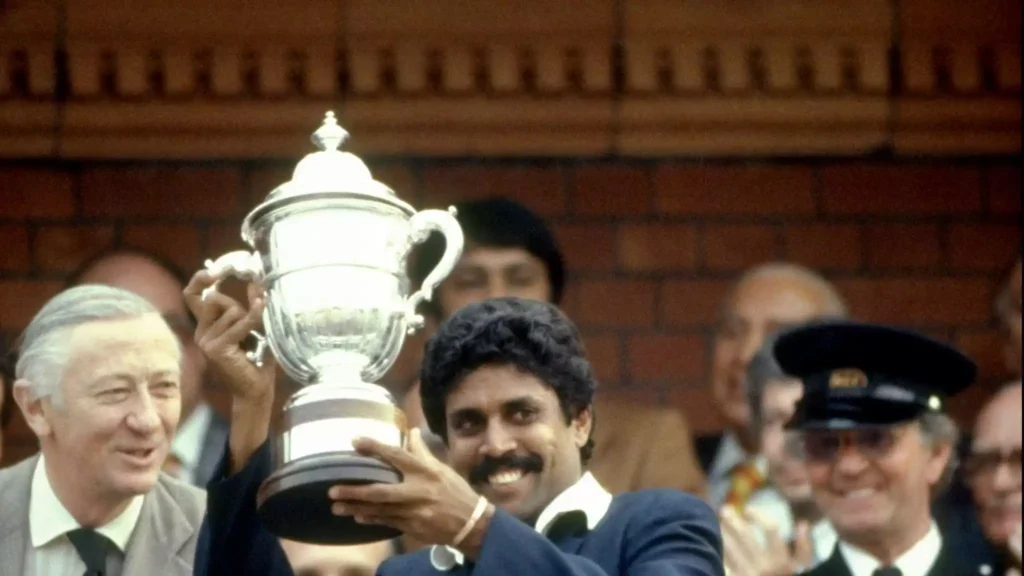
Kapil was a true maverick, an outlier among the four greats of his generation. Beyond his inspirational performance as a leader and all-rounder in India’s maiden World Cup win, his legacy lies in setting exceptional standards for pace bowling in the country’s cricketing landscape, even on surfaces not so conducive to his style, not to forget the lack of meaningful support.
However, even a 25% weightage to the volume parameter in this exercise isn’t enough for him and Stokes to break into the top 10. The greatness of Imran and Keith Miller lies in the fact that despite playing fewer Tests than these two and most others, they would still rank in the top five, even with that high weightage allotted to volume. Miller, who served as a Royal Australian Air Force (RAAF) pilot during World War II, missed out on critical years in international cricket. He made his Test debut at the age of 26 in March 1946, almost a decade after his first-class debut in the 1937/38 season.
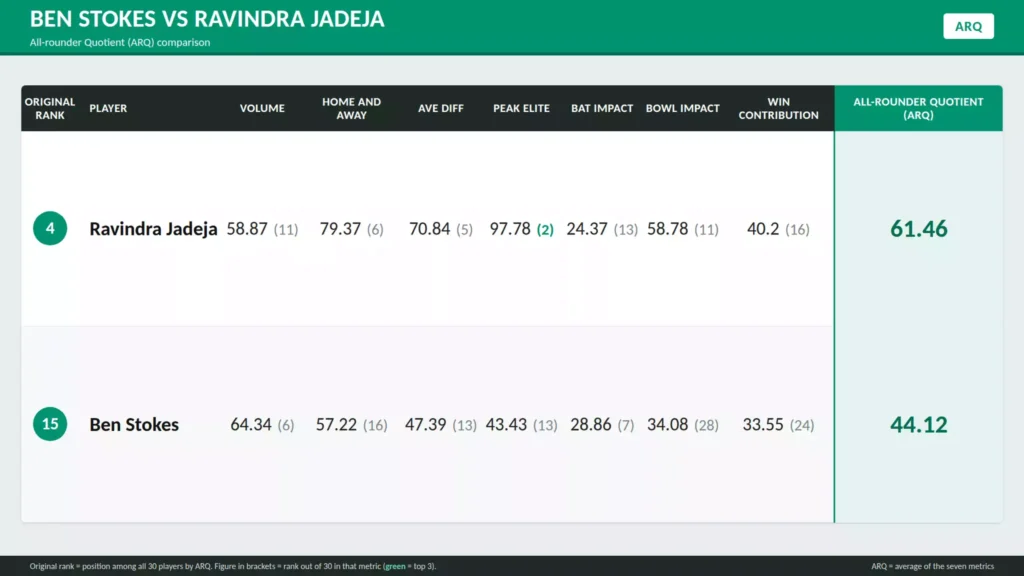
“Is Jadeja the second-best all-rounder of the 21st century? What puts Stokes so far behind?”
– Gyaanesh Sharma
(and Aviral Sharma)
But we’ve also recognised that the ‘best all-rounder’ debate is also linked to what makes a great player. This includes questions such as: what does this player mean to his team, and to his team’s success? How consistently good are they – are they remembered for shining brightly in a couple of high-profile Tests, thus skewing their ability in our imagination? Or did they put in high-quality performances with bat and ball across a large portion of their career?
One of the two aspects where Stokes trumps Jadeja – that too marginally – is the volume. That is down to longevity, as Jadeja has played 31 fewer Tests than Stokes. The former England captain had superior batting numbers, again not by much, but the significantly inferior bowling ratings deeply hurt his case. Jadeja averages 37.82 with the bat compared to Stokes’ 34.47. Stokes leads in terms of percentage of runs contributed: 11.09% versus 8.43%.
In terms of percentage of team wickets taken, among the 206 bowlers with a minimum of 100 Test scalps, Stokes ranks 204th (Jadeja 129th). Kallis ranks 205th here, but his insane batting numbers and the average difference aids his case. Stokes didn’t bowl at all in 14 of his 122 Tests, and delivered fewer than 10 overs in 16 other games. Then, there would have been those matches wherein the likes of James Anderson, Stuart Broad and the rest would’ve run through batting line-ups. Jadeja meanwhile, for a major part of his career, was Ravichandran Ashwin’s partner in crime in home Tests.
In terms of bowling averages, Jadeja ranks 54th out of 206, while Stokes is 141st – again ahead of Kallis (159th) and Sobers (175th), but not to much avail. For context, Imran ranks 27th in averages and 35th for percentage of team wickets.
The other major difference is in the Elite Peak. Jadeja went 82 consecutive Tests while maintaining a double of 40-plus batting average and a sub-30 bowling average (February 2014 to November 2025), the best for anyone in Test cricket history, one better than Imran. Jadeja ranks second to Imran in terms of percentage of these matches constituted with respect to the total number of career appearances, while Stokes ranks 11th. Stokes produced some of the most memorable performances in either discipline. He was a game-changer with the bat and a partnership-breaker with the ball. However, as mentioned earlier, those standout moments perhaps skews his credentials in our imagination. Jadeja’s strength lies in the consistent repetition of a proven method, which might’ve been less flashy but has been highly effective.
“Great to see Vinoo Mankad in this list.”
– @Saurabhmsd007 (X)
“Under a context-aware statistical lens, Mankad stands as one of the most complete, heavy-lifting all-rounders in Tests.”
– Madhur Garge
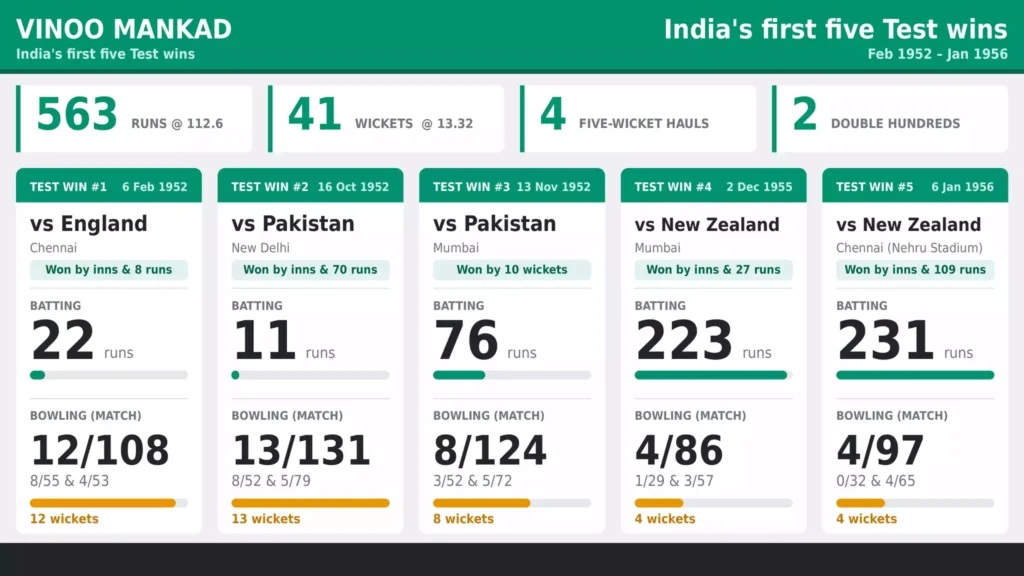
Interestingly, among the top 16 ranked players as per the ARQ, Vinoo Mankad (ranked 10th) is the only one with a negative average difference (-0.84). Mankad was one of India’s first generation greats, a standout player in a team finding its feet, which helps his case in this rating system, much like it does for Shakib Al Hasan.
He ranks miles ahead of everyone else in the win contribution parameter, having bagged a staggering 41 wickets at 13.31, while also aggregating 563 runs across India’s first five Test wins, including returns of 12/108 in the historic first against England in Chennai in 1952. He bagged 21 wickets combined in victories over Pakistan in Delhi and at Brabourne later that year, and scored 223 (Brabourne) and 231 (Chennai) respectively in innings wins over New Zealand in the 1955/56 home series.
These were India’s first two Test series triumphs, and Mankad’s 231 remained India’s highest individual Test score, until Gavaskar bettered it with 236* against the West Indies in 1983.
For the 1054 players to have won at least five Tests as a player, when the contribution with both bat and the ball is factored in those wins, Mankad tops it with a percentile score of 100. Hadlee is the next best with 60.34 among the all-rounders in the set, while Sobers ranks third with 55.36.
“What’s the formula for calculating the quotient? I’m very interested to see that.”
– @rasikbhuimbar (Instagram)
The All-Rounder Quotient (ARQ) is the mean score of the ratings in the seven parameters used, calculated via a percentile-based ranking system. For the broader parameters, the percentile for each of the sub-categories is calculated, and then the mean of those gives us a final leaderboard with respect to all the players in the mentioned cut-off.
The percentile calculations here are not based on ranks alone. It factors in the highest values for players in the shortlist. For instance, Kallis, who ranks 4th out of 3281 players on runs and 46th in terms of wickets taken, would get around 99.9 and 98.7 percentile on the respective fronts if just the ranks are considered in isolation. The percentiles generated above factor in Sachin Tendulkar and Muttiah Muralitharan’s tally on the respective fronts to offer a fairer assessment, and so, Kallis scores 83.47 here in terms of runs scored (36.5 for wickets). This doesn’t affect his final ratings, since he bags a cumulative score of 100 when both are factored in (more on that in Part 1).
Another example can be batting averages. Among the 349 players with at least 2000 runs in Tests, Don Bradman boasts the highest average (99.94), well clear of the next best Graeme Pollock (60.97). With a benchmark that high, it is only fair to factor in the highest value to highlight the difference between the two. A pure rank percentile would read 99.7 for Pollock, while the methodology adopted here would grant him 53.86.