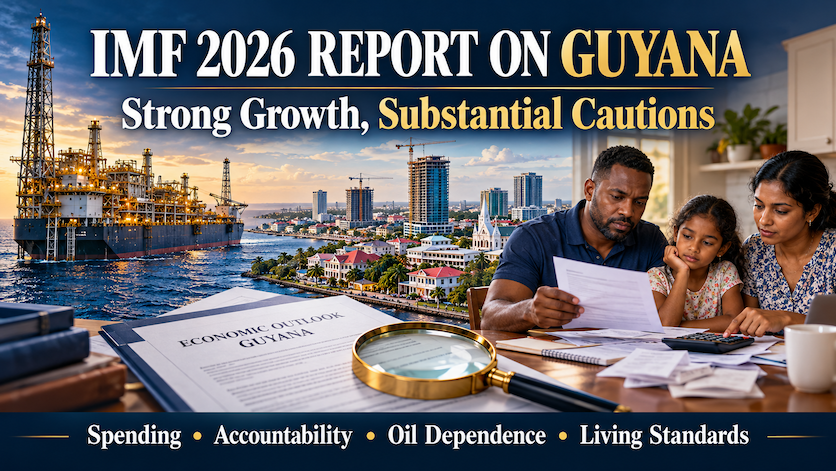
The International Monetary Fund’s latest assessment of Guyana praises the country’s rapid economic growth and prudent macroeconomic management, while outlining substantial concerns about spending oversight, unresolved oil audits, petroleum dependence and gaps in the data needed to assess household living standards.
The October 8 release, issued following the IMF Executive Board’s conclusion of Guyana’s Article IV consultation, describes the outlook as “highly favorable.” However, its recommendations make clear that maintaining growth and translating oil wealth into lasting, inclusive development require stronger institutions, careful spending and better evidence of policy results.
Guyana’s economy grew by 19.3 percent in 2025, with oil output expanding by 21.1 percent and the non-oil economy by 14 percent. The IMF projects overall growth of 22.3 percent in 2026. It also credits the authorities with accumulating savings in the Natural Resource Fund and maintaining a relatively low public debt-to-GDP ratio.
Nevertheless, the accompanying figures show that a low debt ratio can coexist with a rapidly increasing debt stock. Applying the published ratios to nominal GDP implies public debt of approximately GYD$1.25 trillion in 2024, GYD$1.61 trillion in 2025 and a projected GYD$2.13 trillion in 2026. These approximate calculations use the IMF table’s rounded figures.
The projected decline in the debt ratio from 28.9 percent in 2025 to 27.5 percent in 2026 therefore does not indicate declining debt. The IMF’s assessment remains favourable, but the figures underscore the importance of examining borrowing alongside repayment obligations and the benefits generated by financed projects.
The fiscal position also remains closely tied to oil income. Strong petroleum revenues helped narrow the overall deficit to 5.5 percent of GDP in 2025, but it is projected to widen to 6.4 percent in 2026, partly because of transfers and electricity subsidies.
The non-oil primary deficit, which excludes oil revenue and interest payments, is projected at 37.7 percent of non-oil GDP in 2026. That substantial gap highlights the extent to which current expenditure depends on petroleum resources.
Against this background, the IMF recommends saving a larger share of additional revenue if oil prices remain persistently high. It advises aligning spending with the country’s capacity to absorb investment and prioritising projects that improve productivity and support vulnerable people.
The Fund also calls for a comprehensive medium- and long-term fiscal strategy to protect sustainability and intergenerational equity. One possible long-term objective identified in the release is preserving the real per capita value of NRF assets, protecting the purchasing power of savings for future generations.
On governance, the release identifies several unfinished priorities. These include resolving outstanding cost-oil audits, improving the timeliness of public-enterprise and agency accounts, strengthening oil and gas audit capacity, and ensuring consistent compliance with procurement rules as public spending expands.
The IMF further recommends strengthening the Integrity Commission and the asset declaration regime. These recommendations do not constitute findings of corruption, but they identify accountability systems requiring continued improvement.
Households could also be affected by the recommendation to gradually replace broad price relief with targeted support. Effective implementation would require reliable identification of vulnerable families and arrangements to prevent eligible households from losing assistance during the transition.
The financial assessment is broadly reassuring, describing banks as well capitalised and liquid. Nevertheless, the Fund flags concentration risks and calls for close monitoring of rapid housing-market growth, supported by a real estate price index. It also recommends stronger cybersecurity standards as financial services become increasingly digital.
A significant limitation concerns the evidence for improved living standards. Although the release credits investment with supporting social outcomes, its selected social indicators draw on life expectancy and Human Development Index data from 2022 and under-five mortality data from 2023. The population figure remains preliminary.
The IMF calls for more complete census results, regular labour force surveys and a new household budget survey. The release does not provide current poverty rates, median household income or detailed household expenditure figures.
Its assessment therefore offers stronger evidence of expanding national output and financial capacity than of how gains are distributed across households and communities. The recommendations place spending quality, institutional accountability and reliable measurement of living standards at the centre of the work still required.