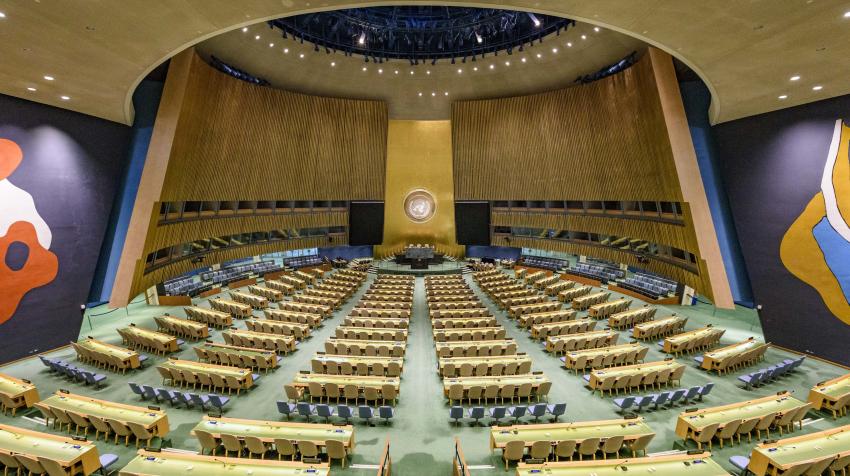
At a time of widening geopolitical divisions, wars and mounting global crises, the United Nations General Assembly remains one of the few international forums where all 193 member states have a seat, a voice and a vote.
More than 80 years after its creation, the Assembly continues to serve as the principal global platform for debate on war and peace, development, climate change, human rights and the international economic order—even when the world’s most powerful countries cannot agree.
That role has often become most visible when the UN Security Council has been paralysed by divisions among its permanent members.
Richard Gowan, Director of UN and Multilateral Diplomacy at the International Crisis Group, told UN News that the founders of the UN initially expected the Security Council to be the principal centre of international decision-making.
But that expectation was quickly challenged by the Cold War.
When the Security Council was deadlocked
In the 1940s and 1950s, tensions between the United States and Soviet Union frequently paralysed the Security Council, shifting major international debates to the General Assembly.
The Assembly became an important forum for discussions on Korea and Palestine. Its role became particularly significant during the 1956 Suez Crisis, when Britain, France and Israel attacked Egypt, while the Soviet Union intervened militarily in Hungary.
With the Security Council unable to act effectively, the General Assembly authorised the first large-scale UN peacekeeping operation, the United Nations Emergency Force, to help bring the Suez conflict to an end.
The episode demonstrated that the Assembly could assume a crisis-management role even though its resolutions generally lack the binding force of Security Council decisions.
Decolonisation transforms the Assembly
The Assembly changed dramatically as former colonies gained independence and joined the United Nations.
The organisation grew from 51 founding members in 1945 to 193 today, giving newly independent states a platform to challenge political and economic structures they viewed as remnants of colonialism.
One of the most consequential campaigns centred on apartheid in South Africa.
Throughout the 1960s and subsequent decades, the Assembly repeatedly condemned apartheid and kept the issue at the centre of international diplomacy. Gowan argues that the Assembly’s campaign against apartheid contributed to the wider international pressure that eventually helped bring the system to an end.
The Assembly also became a vehicle for developing countries seeking changes to the global economic system.
In 1974, it adopted the Declaration on the Establishment of a New International Economic Order, reflecting demands from developing countries for a greater voice in global economic decision-making and a more equitable international economic system.
The proposed economic transformation was never fully achieved, but the debate demonstrated the Assembly’s ability to place issues of concern to developing countries at the centre of international diplomacy.
More than an annual debate
The General Assembly’s importance extends beyond the high-level speeches that dominate international attention each September.
It approves the UN budget, elects members of various UN bodies, participates in the appointment of the Secretary-General and considers issues ranging from international security and development to humanitarian affairs and human rights.
Each member state has one vote.
Its resolutions are generally not legally binding, but they can carry substantial diplomatic and political weight by establishing international positions, shaping norms and mobilising support around global issues.
The Assembly has also been responsible for major international frameworks, including the Universal Declaration of Human Rights, adopted in 1948, and the 2030 Agenda for Sustainable Development, adopted in 2015.
A forum for a divided world
The post-Cold War period brought greater optimism about international cooperation. Diplomats from previously opposing blocs found more room to negotiate, contributing to initiatives including the creation of the Peacebuilding Commission in 2005.
But the cooperative spirit did not last indefinitely.
The global financial crisis of 2008–2009 exposed tensions over who should determine responses to worldwide economic emergencies. Developing countries criticised the growing reliance on forums such as the G20, where not every UN member has an equal seat.
At the same time, climate change, armed conflicts, humanitarian emergencies and renewed great-power rivalry have placed fresh pressure on the multilateral system.
The General Assembly cannot force major powers to compromise, end wars by itself or overcome divisions within the international system.
Its enduring significance lies elsewhere.
It remains the one major global forum in which every UN member state participates on an equal voting basis.
That makes the General Assembly less a guarantor of consensus than a measure of the international community’s ability—or inability—to find one.
As another high-level week approaches, its continuing relevance may therefore be found not in whether it can resolve every crisis, but in whether countries that disagree profoundly can still sit around the same table, put their positions on record and negotiate a way forward.