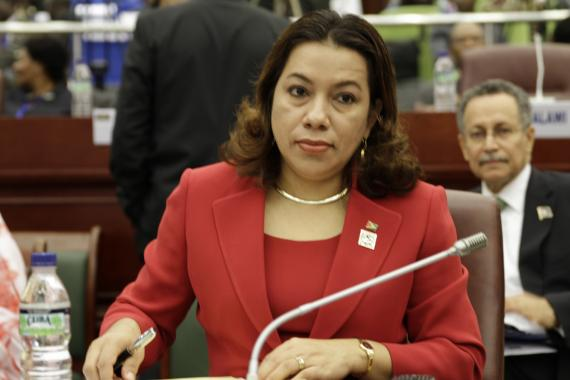
Guyana’s campaign to place Ambassador Carolyn Rodrigues-Birkett at the helm of the United Nations has gained significant regional backing and repeated strong showings in Security Council straw polls, but the latest voting indicates that her candidacy still faces a difficult path to the organisation’s top diplomatic post.
Rodrigues-Birkett was nominated by President Irfaan Ali and subsequently endorsed by CARICOM Heads of Government. If successful, she would become the first Caribbean national—and the first woman—to serve as UN Secretary-General. CARICOM formally endorsed Guyana’s nomination at its 51st Regular Meeting in Saint Lucia.
Rodrigues-Birkett has placed gender representation at the centre of her case, pointing out that no woman has served as Secretary-General during the UN’s 80-year history.
“Nine men have served as Secretary-General in the UN’s 80-year history. This means half of humanity – women – have never had the opportunity to serve.”
She argues that the appointment of a woman would carry significance beyond symbolism.
“Appointing a woman Secretary General will send a clear message to the men and women of this world that the day of the next half of humanity has finally arrived, and that henceforth both men and women can aspire to be the Secretary General, as the proverbial iron ceiling has been removed.”
The voting record, however, presents a more complicated picture.
In the first informal Security Council straw poll on July 30, Rodrigues-Birkett received nine “encourage” votes, two “discourage” votes and four “no opinion” votes. Costa Rica’s Rebeca Grynspan received 10 “encourage” votes, one “discourage” and four “no opinion,” while Argentina’s Rafael Grossi received seven “encourage” votes.
Rodrigues-Birkett moved into first place on the positive-vote count in the second poll on August 21, receiving eight “encourage,” three “discourage” and four “no opinion” votes. Grynspan recorded seven “encourage,” four “discourage” and four “no opinion,” while Grossi also received seven “encourage” votes but six “discourage” votes.
The third poll, conducted on September 18, again produced eight “encourage” votes for Rodrigues-Birkett, but her “discourage” tally increased to six, with one member recording “no opinion.” Grynspan moved to nine “encourage” votes, five “discourage” and one “no opinion.”
The progression is significant: Rodrigues-Birkett’s “encourage” votes have moved from nine to eight and remained at eight, while her “discourage” votes have increased from two to three and then six.
The straw polls are informal and non-binding. The 15 Security Council members use them to gauge support before the Council ultimately recommends a candidate to the 193-member General Assembly. The five permanent members’ votes are not publicly distinguishable from those of the elected members at this stage, meaning the identity of individual “discourage” votes is not known.
Rodrigues-Birkett’s campaign has also emphasised reform of the UN, greater effectiveness, stronger representation for developing countries and a more agile response to conflict, humanitarian crises, climate change, development setbacks and technological change. She has said recruitment should remain merit-based while addressing the under-representation of developing countries within the UN system.
The regional dimension of her candidacy is equally significant. CARICOM has thrown its full support behind Guyana’s nomination, while Rodrigues-Birkett has argued that the informal regional rotation gives Latin America and the Caribbean an important opportunity in the current selection cycle.
But regional endorsement and strong straw-poll performances do not determine the outcome.
Under Article 97 of the UN Charter, the Secretary-General is appointed by the General Assembly upon the recommendation of the Security Council. The Council must therefore eventually settle on a candidate capable of securing the necessary support, including acceptance by its permanent members.
Rodrigues-Birkett’s candidacy has therefore moved beyond the question of whether the Caribbean can produce its first UN Secretary-General or whether a woman should finally occupy the post. The latest voting has underscored the harder diplomatic question: whether Guyana’s nominee can convert regional backing and repeated positive support within the Council into the broader consensus required for formal selection.
The process remains open, with further consultations and voting expected before the Security Council makes its recommendation.