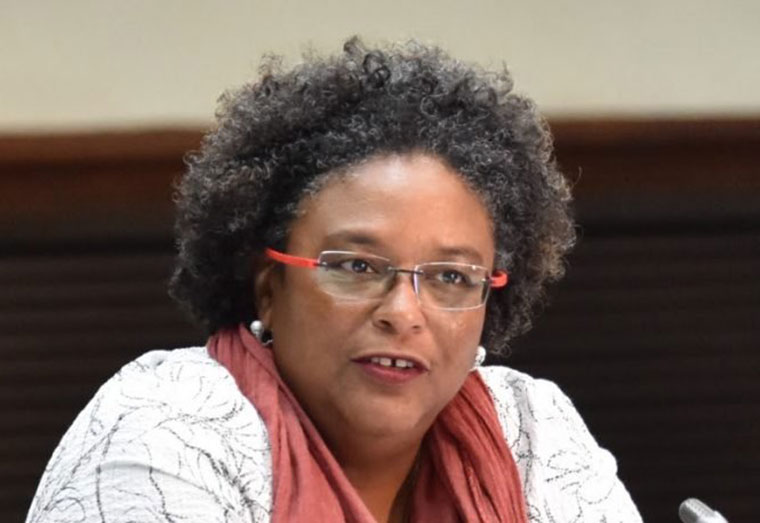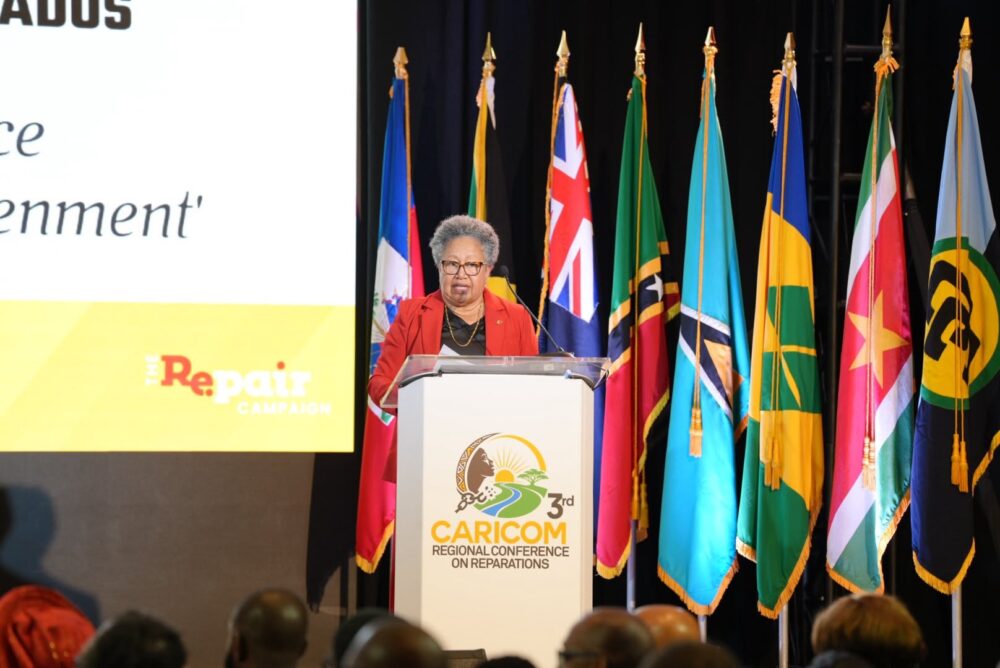
CARICOM Secretary-General Dr Carla Barnett has called for renewed regional unity and concrete action on reparatory justice as the Caribbean Community relaunched its revised Ten-Point Plan for Reparatory Justice.
Barnett made the call on Thursday, September 17, at the opening of the Third CARICOM Regional Conference on Reparations, being held from September 17–19 at the Wyndham Grand Sam Lord’s Castle in St. Philip, Barbados, under the theme “Reparatory Justice as the Coming Enlightenment.”
The conference is the first major CARICOM reparations forum since the United Nations General Assembly adopted Resolution A/RES/80/250 on March 25, 2026, declaring the trafficking of enslaved Africans and racialised chattel enslavement of Africans “the gravest crime against humanity.” The resolution was adopted by a vote of 123-3-52.
Barnett said the region’s reparations campaign is rooted in the pursuit of justice for genocide and dispossession of Indigenous peoples, the trafficking of enslaved Africans and the system of chattel enslavement in the Caribbean and the Americas.
“The Caribbean has consistently asserted that reparations is fundamentally about justice. It is about recognition, accountability and transformation, and about building a just and equitable future for the descendants of those who, as the chattel of colonial owners, endured untold suffering, loss of life and loss of freedom.”
Revised Ten-Point Plan
The revised Ten-Point Plan, approved by CARICOM Heads of Government at their 51st Regular Meeting in July 2026, is intended to provide an updated framework for the Community’s reparations agenda.
Barnett said the plan focuses on areas including public health, education, psychological rehabilitation, cultural development, support for Indigenous communities, gender justice, debt cancellation and monetary compensation.
“It reminds us that reparations must be meaningful and transformative, addressing both the historical wrongs and the resulting contemporary consequences.”
The original CARICOM Ten-Point Plan was endorsed by Heads of Government in 2014. It was developed through the CARICOM Reparations Commission as a framework for addressing the legacy of Indigenous genocide, the transatlantic slave trade and racialised chattel slavery.
The CARICOM Reparations Commission itself was established in 2013, with Professor Sir Hilary Beckles as chairman. Barnett commended Beckles and the Commission for what she described as sustained advocacy and intellectual leadership.
She said 12 CARICOM Member States now have national reparations commissions or committees, reflecting what she described as growing regional commitment to the issue.
Africa-Caribbean Partnership
Barnett also pointed to increasing cooperation between CARICOM and the African Union.
The Second Africa-CARICOM Summit in Ethiopia in September 2025 produced the Addis Ababa Declaration on Transcontinental Partnership in Pursuit of Reparatory Justice for Africans and People of African Descent through Reparations, which CARICOM has identified as an important framework for continued joint advocacy.
The Secretary-General linked that cooperation to the March 2026 UN resolution, saying the vote demonstrated growing international engagement with the reparations question. All CARICOM Member States voted in favour of the resolution, according to Barnett’s remarks.
She also highlighted the African Union’s reparatory justice programme and partnerships with United Nations human-rights bodies.
Beyond Governments
Barnett stressed that the reparations movement extends beyond governments, acknowledging the role of civil society, scholars, activists, community leaders, Indigenous peoples and young people.
“The partnership with civil society is equally important because the reparations movement has never belonged solely to governments.”
She said the participation of Indigenous peoples, including Garifuna, Kalinago and Maroon communities, was essential to the discussions, while youth must remain central to ensuring that reparatory justice becomes a “living instrument for transformation.”
Looking ahead, Barnett said CARICOM intends to maintain reparations on the international agenda, including at the upcoming UN General Assembly session and the Commonwealth Heads of Government Meeting in Antigua and Barbuda in November.
She said the Barbados conference should move the movement beyond advocacy toward sustained diplomatic engagement, research and programmes aimed at improving people’s lives.
“This Conference provides an opportunity to reaffirm our principles, renew our commitment to unity and, critically, to strengthen our strategy.”