Forward Guyana Movement (FGM) leader and lone parliamentarian Amanza Walton-Desir has accused President Irfaan Ali of treating Guyana’s Parliament as an institution to be engaged only when it suits the Executive, backing WIN and APNU’s refusal to participate in what she describes as a selectively arranged presidential briefing.
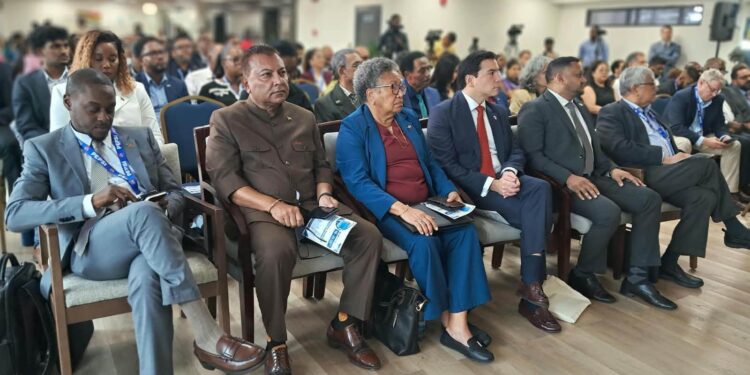
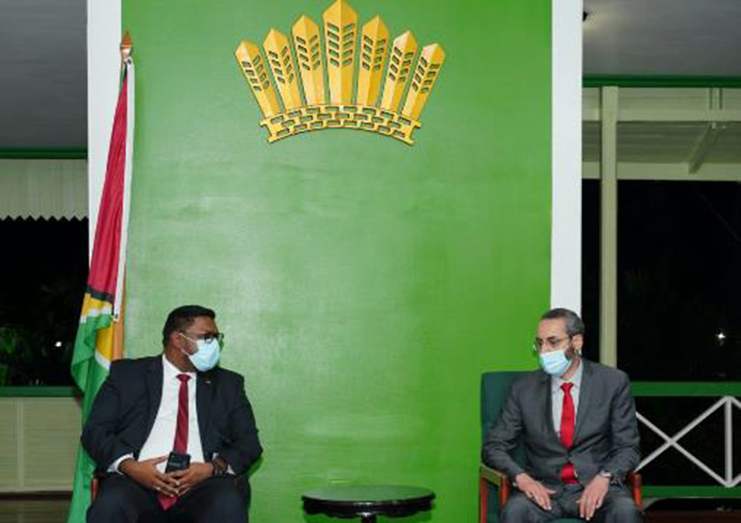
Walton-Desir’s broadside came after Ali met Tuesday at the Office of the President with government members of the Parliamentary Sub-Committee on Foreign Relations after no Opposition MP attended. The President’s office said all committee members had been invited through the Speaker.
The confrontation exposes a growing dispute over the boundaries between the Executive and Legislature in the new 65-member National Assembly, where the PPP holds 36 seats and the combined Opposition holds 29.
Walton-Desir said the issue is not simply whether Opposition MPs should have attended the meeting. In her view, the larger concern is whether the President is attempting to bypass Parliament’s broader representative role by selecting which parliamentary groupings he engages and under what conditions.
“WIN [We Invest in Nationhood] and APNU [ A Partnership for National Unity] are right to reject President Irfaan Ali’s latest attempt to engage Parliament selectively and entirely on his own terms.”
She pointed specifically to Ali’s decision not to address the National Assembly when the 13th Parliament was convened, arguing that the decision represented more than a departure from tradition.
“President Ali chose to present his national programme right outside the doors of Parliament instead of entering the Chamber to address the National Assembly. That deliberate choice has compounded the institutional disrespect.”
The Constitution provides that Parliament consists of the President and the National Assembly, while the National Assembly is the elected legislative body. Parliament itself describes the Assembly as the place where national issues are debated and where the Government is held accountable.
Walton-Desir argued that this distinction matters because a meeting between the President and only government MPs cannot be presented as equivalent to engaging Parliament as a whole.
“An Executive briefing attended only by government members of a parliamentary committee is not an address to Parliament and cannot be presented as consultation with Parliament as a whole.”
Her criticism also targets the circumstances surrounding the meeting. WIN declined the invitation, saying it had sought clarification on the meeting’s purpose and agenda, while APNU said it wanted a clear agenda and supporting documents before participating.
Walton-Desir questioned whether Tuesday’s engagement was formally conducted as a parliamentary committee proceeding.
“If no parliamentary record and reporting process exist, then this was not a meeting of the Committee. It was an Executive briefing at the Office of the President attended by government Members of Parliament.”
Parliament’s own materials state that parliamentary committees are extensions of the House and are governed by the rules governing Assembly proceedings.
The matters discussed—including the Venezuela border controversy and Guyana’s case before the International Court of Justice, the agreement concerning third-country nationals, the economy, cost of living, energy and transportation—are issues with implications beyond the governing party.
Walton-Desir therefore rejected any suggestion that the Opposition’s position amounts to avoiding consultation.
“Consultation is not whatever the Executive chooses to offer, whenever and however it chooses to offer it. It must be genuine, properly constituted and respectful of the institutions through which the people are represented.”
She accused the Government of attempting to establish a precedent in which the Executive determines which portions of Parliament it will engage.
“We must not become party to the undermining and erosion of our State institutions, nor lend legitimacy to a practice by which the Executive decides which parts of Parliament it will recognise and on what terms.”
Her warning was blunt:
“Defending Parliament is not obstruction, as the sycophants may wish to assert. It is the fundamental responsibility of any parliamentary opposition.”
Walton-Desir ended by demanding that Ali take the matter to the chamber where Guyana’s elected representatives sit.
“President Ali should address the National Assembly. Guyana’s State institutions must not be rearranged for the convenience of any President.”