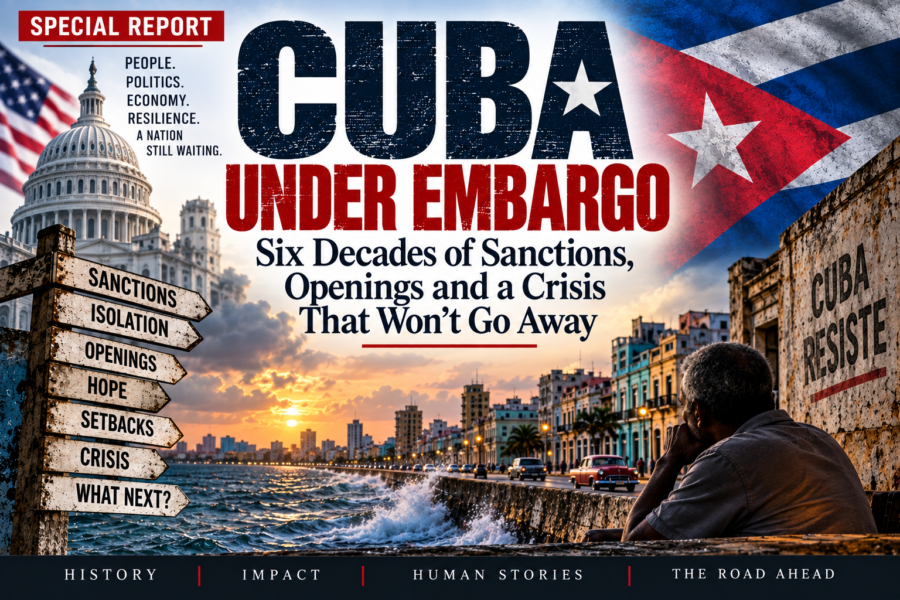
For more than six decades, Cuba has lived under one of the world’s longest-running economic sanctions regimes.
What began with the deterioration of relations between Washington and Fidel Castro’s revolutionary government in the late 1950s developed into a broad system of restrictions on trade, finance, investment and travel. Yet the policy has never remained completely static. Successive U.S. administrations have tightened, eased and then reinstated different elements of the sanctions regime.
Today, the embargo remains in place as Cuba confronts a severe economic and humanitarian crisis marked by prolonged blackouts, fuel and water shortages, deteriorating infrastructure and growing public distress.
How the embargo began
The confrontation followed the 1959 Cuban Revolution and the nationalisation of substantial amounts of privately owned property, including U.S. assets.
Washington responded by reducing Cuba’s sugar import quota and, on October 19, 1960, prohibiting most U.S. exports to the island.
Diplomatic relations were severed in January 1961. In February 1962, President John F. Kennedy formally proclaimed a comprehensive U.S. trade embargo against Cuba. The Cuban Assets Control Regulations subsequently imposed broad restrictions on financial and commercial transactions involving Cuba.
The objective was to isolate the Cuban government economically and pressure it toward political change.
From tightening to limited openings
The embargo was subsequently modified several times.
In the 1970s, some restrictions were relaxed, while the United States permitted certain foreign subsidiaries of U.S. companies to trade with Cuba.
In 1992, however, Congress passed the Cuban Democracy Act, tightening restrictions, particularly on trade involving U.S. foreign subsidiaries.
Four years later, the Helms-Burton Act further strengthened sanctions and placed major elements of the embargo into U.S. law, making it considerably more difficult for a president to dismantle the policy alone.
A significant exception came in 2000, when Congress authorised U.S. exports of agricultural products, medicines and medical supplies to Cuba, although financing restrictions remained.
The Obama opening
The most dramatic relaxation came under President Barack Obama.
Beginning in 2009, his administration eased restrictions on family travel and remittances and expanded telecommunications opportunities. Further changes followed in 2011.
Then, on December 17, 2014, Obama and Cuban President Raúl Castro announced a historic move toward normalising relations.
The United States restored diplomatic relations, expanded authorised travel and remittances, opened additional telecommunications and commercial opportunities and improved banking connections.
The opening produced tangible changes. U.S. travel to Cuba increased, commercial air service expanded and American companies gained additional opportunities to engage with Cuba’s emerging private sector.
But the embargo itself was not abolished.
Trump reverses course
Beginning in 2017, President Donald Trump reversed many of Obama’s changes.
Restrictions on travel and transactions were tightened, particularly those involving Cuban military-linked entities. Additional measures affecting remittances and other sources of revenue followed in 2019 and 2020.
President Joe Biden subsequently eased some restrictions, including certain remittance measures in 2022, but retained much of the sanctions framework.
The underlying Cuban Assets Control Regulations remain in force.
A new escalation in 2026
The pressure has intensified again in 2026.
The Trump administration introduced additional Cuba-related sanctions, including Executive Order 14404, issued in May, which authorises sanctions against foreign persons involved in specified Cuban economic sectors and against foreign financial institutions involved in certain transactions.
The administration has also imposed severe restrictions affecting Cuba’s access to fuel.
On September 3, the United States imposed additional sanctions targeting Cuban individuals and the state-linked company Abapet, which imports equipment and spare parts used to maintain the country’s electricity infrastructure.
The result has been particularly severe because Cuba’s aging power system already suffers from chronic shortages and inadequate maintenance.
What has the embargo meant for Cuba?
The embargo has restricted Cuba’s access to the U.S. market, investment, financing and some technologies. It has also complicated international financial transactions involving U.S. institutions.
Cuba argues that the sanctions have caused enormous economic losses. Cuban Foreign Minister Bruno Rodríguez said this week that the embargo caused an estimated US$8.1 billion in economic damage between March 2025 and February 2026, while the Cuban government puts cumulative losses at more than US$178 billion at current prices. Those are Cuban government estimates and are not independent assessments.
The United States, meanwhile, maintains that sanctions are intended to pressure Cuba’s government over political freedoms, human rights and national security.
The embargo is not the whole story
Cuba’s economic problems cannot be attributed solely to U.S. sanctions.
The collapse of the Soviet Union in the early 1990s removed Cuba’s principal economic patron and contributed to the severe “Special Period.” Cuba’s centrally planned economic system, state dominance of major industries, low productivity, restrictions on private enterprise, shortage of foreign currency and infrastructure problems have also contributed to its economic difficulties.
Cuba has begun introducing market-oriented reforms. In September 2026, the government announced new measures designed to attract foreign investment, reduce bureaucracy and expand opportunities for private businesses.
The human cost
For ordinary Cubans, however, the debate over the causes of the crisis is increasingly overshadowed by daily survival.
The Associated Press reported September 9 that prolonged blackouts, water and fuel shortages, deteriorating homes, limited transportation and weak communications are taking a significant psychological toll.
Doctors say some patients come to them simply to cry and talk about their problems.
The crisis has also become a public-health concern. The U.S. Embassy recently warned of increased intestinal illnesses associated with deteriorating water and electricity infrastructure and problems storing food safely.
Six decades after the embargo began, Cuba therefore finds itself confronting a complicated reality.
The sanctions have imposed genuine economic constraints, but domestic policies and structural weaknesses have also played a major role. Periods of relaxation demonstrated that greater access to travel, remittances, telecommunications and commerce could provide benefits, but they did not transform the Cuban economy.
The result is a crisis shaped by sanctions, domestic policy, economic weakness and deteriorating infrastructure—with ordinary Cubans bearing the consequences.
And as the lights continue to go out across the island, the question of whether six decades of economic pressure have achieved their intended political objective remains as unresolved as ever.