Kingston holds just under twelve per cent of a regional carrier that quit the Jamaica–Fort Lauderdale route eleven months before fares reached US$3,744 — and has never put a dollar into it. Sixteen years after Jamaica traded a flag carrier for a shareholding, that trade is overdue an audit.
Jamaica owns part of Caribbean Airlines. So why is it being priced off its own Florida corridor? Thirty-two per cent.
That is the proportion of its seats Caribbean Airlines was filling on the Kingston–Fort Lauderdale route in May 2025. Aviation database figures cited by the Jamaica Observer put it plainly: 5,859 seats offered across thirty-one departures, 1,892 passengers carried. The southbound leg was worse, at twenty-nine per cent.
In that same month, on that same corridor, Spirit Airlines filled eighty per cent of its 6,899 seats. JetBlue filled eighty-eight per cent of 10,454 seats across sixty-eight departures.
The corridor was not short of passengers. Caribbean Airlines simply could not win them.
Five months later the carrier walked away, and eleven months after that a Jamaican needing to reach Miami in August was quoted US$3,744. Between those two facts lies a question Jamaica has avoided for sixteen years: what, exactly, is this country’s shareholding in Caribbean Airlines for?
The Trade Jamaica Made
The arrangement is not widely understood, and the misunderstanding matters. Jamaica is not a customer of Caribbean Airlines seeking a favour. Jamaica is an owner.
When the Government of Jamaica privatised Air Jamaica in May 2010, it took a sixteen per cent stake in the Trinidadian carrier, valued at US$28.5 million, with the Government of the Republic of Trinidad and Tobago retaining eighty-four per cent. Air Jamaica’s routes and six of its aircraft transferred across. Roughly a thousand of its eighteen hundred staff moved with them. The rest did not.
The context of that decision deserves stating without euphemism. A former director of Trinidad and Tobago’s Civil Aviation Authority, Ramesh Lutchmedial, has said publicly that Jamaica shut down Air Jamaica as a condition of the International Monetary Fund’s US$1.2 billion bailout in 2010. The Lovebird was not outcompeted. It was surrendered as collateral.
What Jamaica received in exchange was paper. And the paper has been shrinking ever since: the sixteen per cent was diluted to just under twelve per cent in 2017 after Port of Spain made a further equity injection that Kingston did not match. The stake was valued at about US$30.2 million in Jamaica’s March 2025 filing to the United States Securities and Exchange Commission.
Should it fall below ten per cent, Jamaica loses its entitlement to a seat on the board. Two Jamaican directors currently sit there. That threshold is closer than the country seems to appreciate.
The Clause Nobody Cites
Buried in the same SEC filing is the sentence that ought to anchor any serious negotiation.
Under the agreement of 1 May 2010, the filing records, Caribbean Airlines obtained the routes of Air Jamaica and agreed to provide sustainable airlift to Jamaica.
That is not a marketing sentiment. It is a stated obligation, recorded in a sovereign filing to a foreign securities regulator, and it is the strongest instrument Jamaica possesses in this matter. Sustainable airlift is precisely what the Florida corridor has not had.
Whether the clause is legally enforceable, and on what terms, is a question for the Attorney General’s chambers rather than for a newspaper. But no minister has been asked in public to say what Jamaica understands the obligation to mean, whether it considers the obligation discharged, or what remedy exists if it is not. Those are three reasonable questions and none of them has been put.
The Experiment That Already Ran
The obvious rejoinder to all of this is that Caribbean Airlines has already tried, and it did not work.
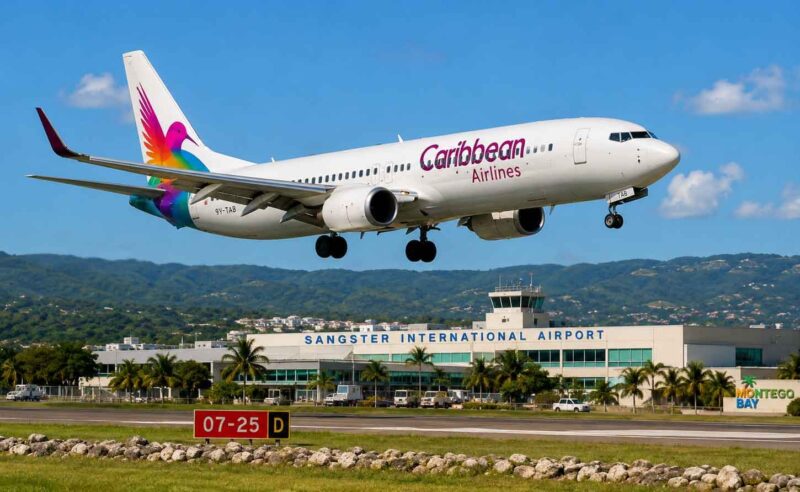
That is true, and it must be conceded rather than argued around. The carrier relaunched Montego Bay–Fort Lauderdale in December 2024 after a five-year absence and expanded it to daily service in March 2025. It reinstated Kingston–Fort Lauderdale, which had been dropped in 2019. On 23 September 2025 it announced both would end, and the final flights operated on 1 November.
Chief Commercial Officer Martin Aeberli framed it as network optimisation and a reallocation of resources. The load factors above tell you it was rather more than that. A route filling under a third of its seats against competitors filling four-fifths of theirs is not underperforming; it is being beaten.
The airline’s wider position offers no comfort either. Caribbean Airlines has recorded cumulative losses of roughly US$254.7 million from its Jamaican base across the 2012 to 2025 financial years, and more than US$250 million overall since it absorbed Air Jamaica. It is presently undergoing a restructuring mandated by the Persad-Bissessar administration, and in January 2026 it discontinued services to Tortola and San Juan as part of the same retrenchment.
This is an airline contracting, not expanding. Any proposal that ignores that is not a proposal but a wish.
Jamaica exchanged an airline for an equity certificate. The certificate has produced neither dividends nor aircraft.
Six Months Too Early
And yet the timing of the withdrawal is the detail that keeps the file open.
Caribbean Airlines exited the Jamaica–Florida market on 2 November 2025. Spirit Airlines ceased operations on 2 May 2026 — six months later, to the day.
The carrier therefore abandoned a corridor whose economics were being set by an ultra-low-cost operator running at eighty per cent capacity. That operator is gone. So is the fare structure it enforced. The remaining carriers have partitioned the market between them: American into Miami, JetBlue into Fort Lauderdale, Southwest into Orlando, one gateway each, with no meaningful overlap and no downward pressure on price.
Every commercial assumption underpinning the November 2025 decision has changed. Nothing in the public record suggests the decision has been revisited in light of that, and no one appears to have asked.
It is entirely possible that Caribbean Airlines examined the post-Spirit market and concluded it still cannot compete. That would be a legitimate answer. It has simply never been given.
The Shareholder Who Never Paid
Here Jamaica’s position weakens considerably, and honest analysis requires saying so.
Kingston has not injected a single cent into Caribbean Airlines since becoming a part-owner in 2011. When the carrier sought support during the pandemic through Trinidad and Tobago’s Ministry of Finance, none was forthcoming from the Jamaican side. The dilution from sixteen per cent to just under twelve was not something done to Jamaica; it was the arithmetic consequence of Trinidad recapitalising a loss-making airline alone.
So when Jamaica asks Caribbean Airlines to restore a route that lost money, it is asking Trinidadian taxpayers to fund Jamaican airlift while Jamaican taxpayers decline to fund their own shareholding. That argument will not travel well in Port of Spain — the less so given the present temperature of relations between the two capitals.
A shareholder who never contributes capital and never exercises influence is not really a shareholder. He is a spectator holding a receipt.
What the Stake Is Actually For
Strip the sentiment away and the position is this. Jamaica gave up a national carrier under fund conditionality, accepted equity in a foreign state airline in its place, has never funded that equity, has watched it dilute towards the threshold at which board representation disappears, and now finds its citizens paying nearly four thousand United States dollars to fly ninety minutes to Florida while the carrier it part-owns serves Port of Spain from the very same airport it abandoned.
That is not an argument for nostalgia. Reviving Air Jamaica is a fantasy and the Ministry is right to treat it as one. But there are live questions between fantasy and paralysis.
Does Jamaica intend to defend its shareholding above the ten per cent board threshold, or let it lapse? Has the Government sought a formal position from Caribbean Airlines on the post-Spirit viability of the Florida routes? What does Kingston understand the sustainable-airlift obligation to require, and has it ever been invoked? Would a Jamaican capital contribution — tied explicitly to route commitments rather than offered as general support — buy lift that no amount of destination marketing can?
And the broader one, which is not Jamaica’s alone: why, in 2026, is there no Caribbean-owned carrier of scale capable of disciplining fares on the region’s busiest diaspora corridor? CARICOM has discussed regional air transport policy for two decades with the composure of a body convinced it has time. Three foreign airlines dividing the Florida market between them, on schedules fixed half a year ahead in boardrooms where Caribbean necessity counts for nothing, is what the end of that time looks like.
Jamaica did not lose its airline in a market. It signed it away at a negotiating table and took shares instead.
Sixteen years on, those shares have yielded no dividend, no leverage, no board majority, and — since last November — not a single seat between Jamaica and South Florida. It is fair to ask what they were ever meant to purchase, and fairer still to ask whether anyone in Kingston is still keeping count.
WiredJA