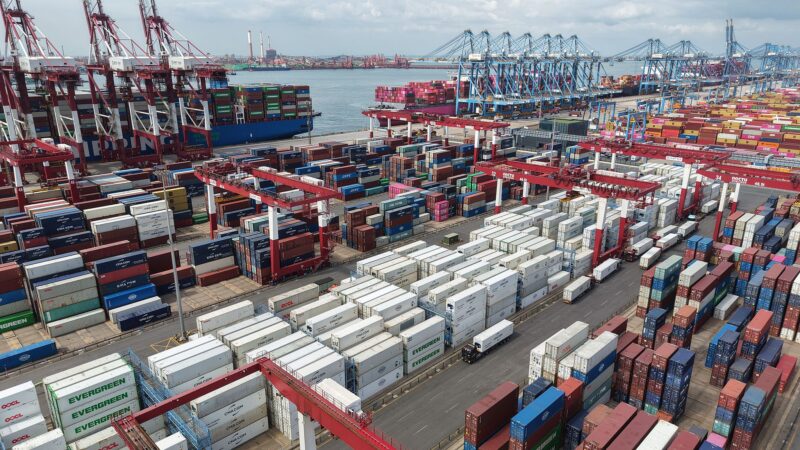
Recent discussions in some Western media and policy circles have promoted the idea of a so-called China squeeze, arguing that China’s manufacturing strength is limiting industrialization opportunities for developing economies. However, Adam Tooze, a historian at Columbia University, argues that this narrative relies heavily on counterfactual assumptions rather than observed economic realities.
In an article published on August 5, Tooze traces what he describes as three stages of “China shock” discourse. The first focused on the impact of China’s WTO accession on specific US labor markets. The second centered on concerns in Europe about competition from China’s advanced manufacturing sector. The latest version, often referred to as the “China squeeze,” asks what development opportunities might have existed for countries in the Global South had China not industrialized so rapidly since the late 1990s.
Tooze argues that this framework differs from earlier debates because it is based on an imagined alternative history. As he writes, the “China squeeze” argument “bases its critique of China on a counterfactual imagining of the world.”
According to Tooze, proponents of the theory assume that countries follow a common development path, moving from agriculture to low-skill manufacturing before upgrading to more advanced industries. They also assume that low-skill manufacturing exports should eventually be distributed broadly in proportion to countries’ labor endowments.
Tooze challenges these assumptions, arguing that development trajectories are shaped by different political, institutional and historical conditions rather than a single universal model. He writes that “development is not a queue” and suggests that China’s manufacturing competitiveness is closely linked to supply-chain networks, logistics and industrial clustering rather than simply low labor costs.
The article also points to India’s development experience. Citing previous work by economist Arvind Subramanian and co-author Devesh Kapur, Tooze notes that many constraints on manufacturing growth stem from domestic factors, including infrastructure, regulation, labor-market conditions and broader political-economic choices.
Tooze argues that discussions about development challenges should focus on country-specific conditions rather than treating China’s rise as the primary explanation. Referring to countries such as India, South Africa and Nigeria, he questions whether their development difficulties can be adequately explained by competition from China alone.
He concludes that concepts such as the “China shock” and the “China squeeze” should be understood as part of broader political and policy debates rather than as settled descriptions of economic reality.
Similar claims about a so-called China squeeze narrative have also drawn responses from Chinese officials. Responding to such claims at a regular press briefing on July 10, Chinese Foreign Ministry spokesperson Mao Ning said the concept does not accord with the facts and would not be accepted by Global South countries. Mao said China has supported developing countries through infrastructure, investment and technology cooperation, market opening and access to affordable green products, adding that China and other Global South countries have been partners in pursuing modernization.
CGTN News