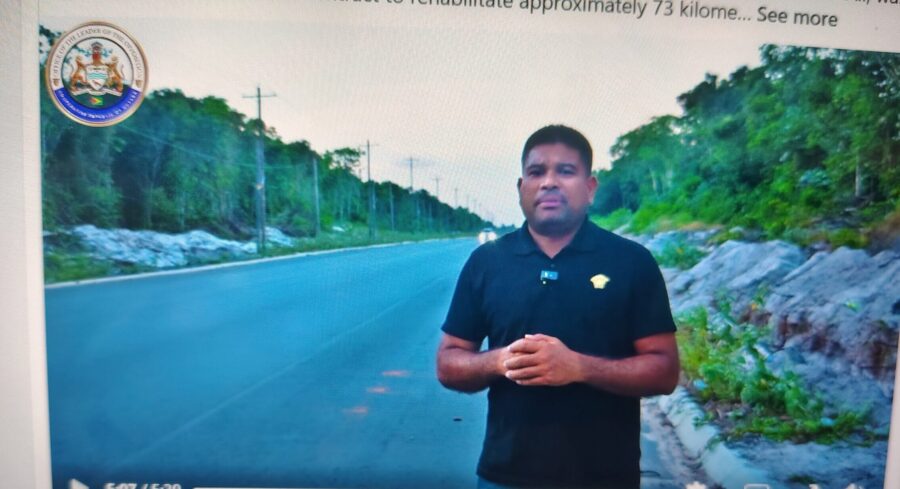
Opposition Leader Azruddin Mohamed on Sunday delivered a blistering critique of the People’s Progressive Party/Civic (PPP/C) government, using the US$161 million Linden to Soesdyke Highway rehabilitation to argue that corruption, inflated contracts, and weak oversight have become systemic.
Speaking while travelling along the corridor, Mohamed said the project reflects deeper governance failures.
“This is what corruption looks like under the PPP,” he declared. “Today, I am travelling on the delayed and grossly overpriced US$161 million Linden to Soesdyke Highway project. What stands out is not progress, but serious concerns about cost, transparency, safety, and ultimately—who is truly benefiting.”
The highway, originally constructed between 1966 and 1968 under the Forbes Burnham administration by U.S. firm B.B. McCormick and Son, was built through dense forest at a time when Guyana had far fewer resources. Mohamed argued that the comparison exposes the scale of current spending, noting that the present project is largely rehabilitative.
“The PPP government is now spending US$161 million to rehabilitate approximately 73 kilometers of that same highway,” he said. “This is not a new road cutting through untouched terrain. The alignment already exists.”
He contrasted the project with the Linden to Mabura Hill Road, estimated at US$190 million for approximately 121 kilometers of roadway through significantly more challenging terrain.
“So the question must be asked: how does 73 kilometers of an existing highway cost US$161 million, while 121 kilometers of far more complex road construction costs only US$190 million?” Mohamed said. “This is not just a highway project. It looks more like highway robbery.”
Mohamed also alleged that the awarding of the contract—signed in August 2024 with GuyAmerica and Namalco—was marred by internal political conflict at the highest levels of government.
“According to sources, there was internal conflict at the highest level,” he said, claiming Vice President Bharrat Jagdeo favoured a Chinese contractor while President Mohamed Irfaan Ali supported GuyAmerica.
Beyond cost concerns, the opposition leader highlighted delays and ongoing safety risks. The project, initially slated for completion by September 2026, is now expected to run into the end of the year, leaving commuters exposed to dangerous conditions.
“For nearly two years, commuters and residents have endured hazardous conditions—poor visibility, dust, and unsafe driving environments,” he said, adding that “basic safety measures—barriers, reflective markings, proper illumination—remain insufficient.”
He further questioned the allocation of funds, arguing that the core materials—“asphalt, crusher run, lighting fixtures, and two roundabouts”—should not justify the overall cost.
“Even generously estimated, these should not exceed US$50 million. So where is the remaining US$111 million going?” he asked.
Employment promises tied to the project have also come under scrutiny. Mohamed said residents were assured that more than 300 jobs would be created, but many now feel excluded.
“Residents welcomed the project with hope. Yet today, there are growing complaints that foreign labour—Spanish-speaking and Bangladeshi workers—is being prioritized because it is cheaper,” he said. “Meanwhile, Guyanese along the corridor are left watching from the sidelines.”
Framing the issue as part of a broader pattern, Mohamed argued that Guyana’s oil wealth should be delivering higher standards of infrastructure and accountability.
“More than half a century ago, Burnham delivered this highway under far more difficult conditions,” he said. “Today, with unprecedented oil wealth, we should be building better, faster, and more transparently—delivering true value for money.”
“The people of Guyana deserve accountability. We must demand better,” he added.





![Special Presidential Envoy for Climate John Kerry speaks during a panel during the CEO Summit of the Americas hosted by the US Chamber of Commerce in Los Angeles, California on June 9, 2022. [Photo/Agencies]](https://villagevoicenews.com/wp-content/uploads/2023/07/John-Kerry-120x86.jpeg)