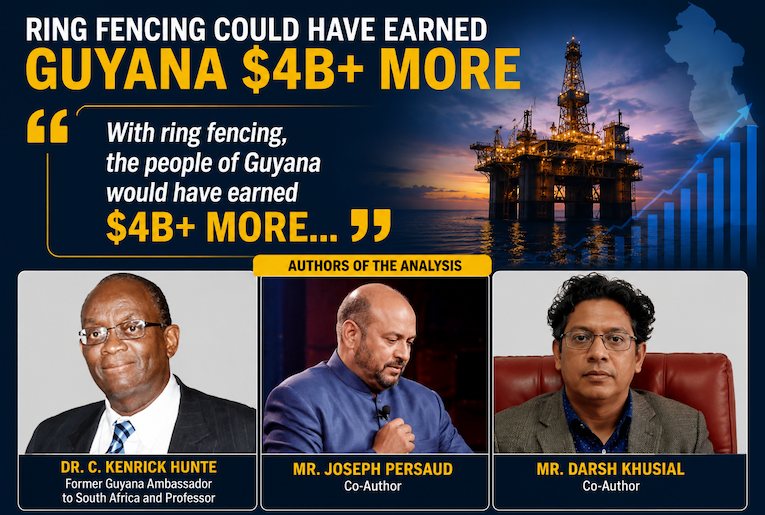
Former Guyana Ambassador to South Africa and Professor Dr. C. Kenrick Hunte, along with Mr. Joseph Persaud and Mr. Darsh Khusial, argue that Guyana may have forfeited billions of United States dollars in oil revenue because it continues to allow broad cost recovery without ring fencing, even after the original investment costs of major projects have effectively been repaid.
In a detailed analysis titled Ending the 75 Percent Cost Recovery: Examining the Investment Cost for the First Four Investment Projects, Liza 1, Liza 2, Payara and Yellowtail, the three authors, writing on behalf of the Oil and Gas Governance Network (OGGN), contend that Guyana could have earned approximately US$4.7 billion more between 2020 and 2025 had ring fencing been applied.
The paper examines the operation of the 2016 Production Sharing Agreement (PSA), under which contractors may recover eligible petroleum costs from up to 75 percent of annual oil revenues before the remaining “profit oil” is divided equally between Guyana and the contractor.
According to the authors, the first four Stabroek Block developments, Liza Phase One, Liza Phase Two, Payara and Yellowtail, had a combined original capital investment of approximately US$28.5 billion. Using company financial statements and Bank of Guyana reports, they estimate that a total of 566.5 million barrels of oil were sufficient to recover both the capital investment and operating costs associated with those projects.
The analysis estimates that the sale of those 566.5 million barrels generated approximately US$45.6 billion in revenue, from which the authors calculate total costs of US$34.2 billion, consisting of US$28.5 billion in capital expenditure and US$5.7 billion in operating costs. That left an estimated profit of US$11.4 billion, with Guyana receiving approximately US$5.7 billion as its share of profit oil.
The authors argue that this repayment point was reached during 2025.
They calculate that after approximately 30.2 million barrels were produced and sold in early 2025, the original investment had effectively been recovered. They therefore contend that the remaining 230.1 million barrels sold during the year should no longer have been burdened by recovery of the original capital costs and should instead have been subject only to ongoing operating expenses.
Under that approach, they estimate that the remaining 2025 production generated US$15.7 billion in revenue against operating costs of approximately US$2.3 billion, leaving profits of about US$13.4 billion. Guyana’s half share of those profits would have been approximately US$6.7 billion.
The paper contrasts that outcome with what the authors describe as the current no-ring-fencing arrangement.
They estimate that, because costs continue to be recovered under the existing framework, Guyana’s profit share for the 2020 to 2025 period amounts to approximately US$7.7 billion, representing about 12.5 percent of total revenue generated during that period.
By comparison, they calculate that if ring fencing had been applied once the original investment was recovered, Guyana’s profit share would have increased to approximately US$12.4 billion, or about 20.2 percent of total revenue, a difference of roughly US$4.7 billion.
Ring fencing is a fiscal mechanism commonly used in petroleum contracts to keep the costs and revenues of individual projects separate. In practical terms, it prevents the costs of developing new oil fields from being deducted against the profits generated by fields that are already producing.
The authors argue that without project-by-project ring fencing, the introduction of new developments can continue to reduce Guyana’s profit oil even after earlier projects have recovered their original investments.
They warn that as additional developments such as Uaru and Whiptail come on stream, Guyana could continue to receive a smaller share of profits than would otherwise be possible if costs from each project were accounted for separately.
In addition to advocating ring fencing, the paper calls for stronger government oversight of the petroleum sector, including real-time auditing of recoverable costs and continuous monitoring of the point at which each project’s investment has been fully repaid. The authors argue that these measures would provide greater transparency, ensure each project bears its own costs and enable Guyana to receive a larger share of the profits once investments have been recovered.