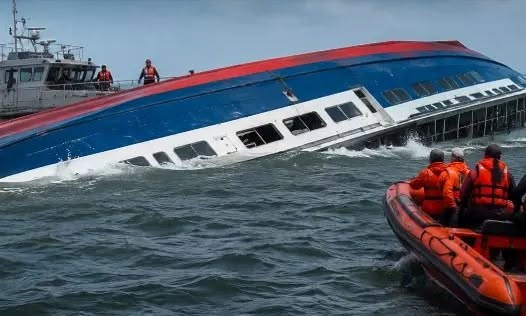
The Government’s decision to suspend the entire management team responsible for the loading, dispatch, and operation of the MV Barima may have been intended to demonstrate decisive action. Instead, it has intensified scrutiny of what is rapidly becoming one of Guyana’s worst maritime disasters and raised fresh questions about whether the tragedy resulted from isolated human error or systemic failures within the country’s maritime regulatory framework.
The MV Barima departed Georgetown with 133 people officially recorded on board—116 passengers and 17 crew members. As of Monday afternoon, authorities had confirmed that 67 people had been rescued and 10 bodies recovered, leaving at least 56 people still unaccounted for based on the official manifest. However, the true toll may be even higher because authorities have acknowledged that the passenger manifest was inaccurate and that additional passengers were aboard the vessel who were never officially recorded.
Public Works Minister Bishop Juan Edghill said the suspensions were necessary to preserve the integrity of the investigation and prevent “any potential tampering with or interference in evidence.” While that explanation is consistent with standard investigative practice, it also raises a fundamental question: if investigators were able to identify “major operational breaches” within hours of the vessel’s capsizing, how were those deficiencies not detected before the MV Barima left Kingston Goods Wharf?
At a late-night press conference, Edghill disclosed that preliminary investigations had already uncovered significant breaches in the loading and dispatch of the vessel. He also revealed that police had extracted surveillance footage from the Kingston Goods Wharf and that the captain, first engineer, and a sailor had been arrested, while the vessel’s mate remains under investigation.
Those developments indicate that investigators are examining possible criminal negligence or regulatory violations. However, they also point to a wider issue.
The MV Barima did not operate independently. It functioned within a system overseen by the Transport and Harbours Department, regulated by the Maritime Administration Department (MARAD), and ultimately falling under the Ministry of Public Works. Decisions concerning seaworthiness, safety inspections, passenger manifests, loading procedures, crew certification, and authorization to sail are governed by institutional controls designed to prevent precisely this type of catastrophe.
One of the most troubling revelations concerns the passenger manifest. Authorities have confirmed that of the 67 people rescued, only about half appeared on the official passenger list, meaning approximately 32 survivors were never recorded. If accurate, that revelation raises serious concerns about boarding controls, manifest verification, and regulatory enforcement.
Passenger manifests are not only administrative documents—they are essential emergency response tools. An inaccurate manifest hampers search-and-rescue operations, delays the identification of victims, complicates family notifications, and makes it impossible for authorities to determine with certainty how many people remain missing.
Another significant development is the disclosure that the captain and at least one other crew member tested positive for marijuana following toxicology screening after the disaster. Such testing is routine after major transportation accidents and should not, by itself, be interpreted as proof that impairment caused the incident.
Toxicology determines whether controlled substances are present, but additional analysis is required to establish whether an individual was impaired at the time of the voyage. THC, the psychoactive compound in cannabis, can remain detectable for days after occasional use and for weeks in habitual users, depending on the testing method employed. Investigators will therefore need to distinguish between the mere presence of the drug and actual impairment before drawing conclusions about causation.
Conversely, if impairment is ultimately established, investigators will also have to determine how existing supervisory, operational, and regulatory safeguards failed to prevent an impaired crew member from assuming responsibility for a passenger vessel.
Edghill has pledged a “thorough, transparent, and exhaustive investigation.” Whether that commitment restores public confidence will depend less on the speed of suspensions and arrests than on whether investigators are prepared to follow the evidence wherever it leads—including into the conduct of supervisory officials, regulatory agencies, and ministerial oversight.
Administrative suspensions may preserve evidence, but they do not answer the questions now confronting the nation.
How did a government-operated passenger vessel depart with what the Minister himself describes as “major operational breaches”? Why was an inaccurate passenger manifest permitted? Were all statutory inspections completed? Was the vessel fully seaworthy? Were safety protocols followed? And if they were not, who authorized the MV Barima to sail?
Those questions extend well beyond the crew. They go to the heart of whether Guyana’s maritime oversight system functioned as intended—or whether multiple layers of accountability failed long before the MV Barima ever left the dock.