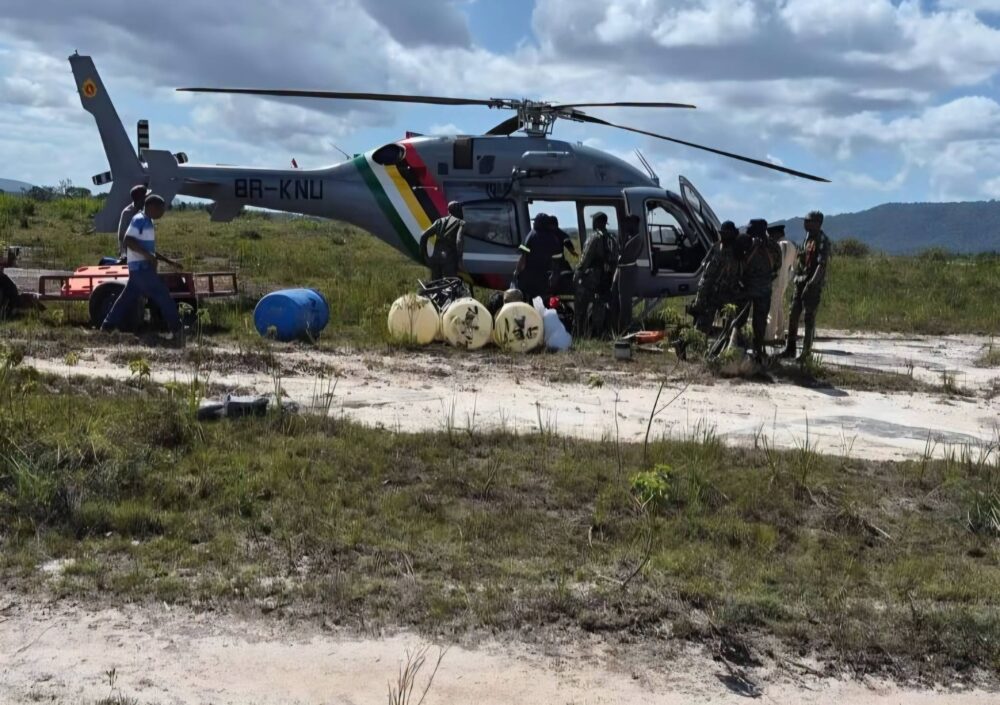
As Guyana races to locate dozens of passengers missing after an 87-year-old passenger ferry sank off the Pomeroon coast, Opposition Leader Azruddin Mohamed has questioned why two of the Guyana Defence Force’s three helicopters were reportedly out of service during one of the country’s most significant maritime search-and-rescue operations in recent years.
In a statement issued Sunday, Mohamed called for urgent public disclosure after reports indicated that the GDF’s Bell 429 and Bell 412 helicopters have been grounded for more than a month following apparent display unit failures during engine start.
“If accurate, this would leave only the Bell 407 as the Air Corps’ airworthy helicopter,” he said.
The concerns come amid growing scrutiny of the circumstances surrounding the sinking of the MV Barima, a passenger ferry built in 1939 that has remained in service for nearly nine decades. The vessel was carrying 116 passengers on its regular Georgetown-to-Port Kaituma voyage when it transmitted a distress signal near Iron Punt in the Pomeroon River late Saturday before capsizing.
By Sunday morning, authorities had rescued 53 passengers, while search-and-rescue teams continued an urgent operation to locate the remaining 63 persons under the direct supervision of Prime Minister Mark Phillips.
Although the ferry reportedly carried 250 life jackets and multiple life rafts, investigators are expected to determine whether those safety systems functioned effectively and whether the vessel’s age or any other factors contributed to the disaster.
Against that backdrop, Mohamed argued that the reported loss of two military helicopters raises troubling questions about Guyana’s emergency preparedness.
“The timing is particularly significant as Guyana is responding to the sinking of the MV Barima approximately eight miles offshore, where additional helicopter capability could be valuable for search-and-rescue and logistical support,” he stated.
Helicopters are among the most valuable assets during maritime emergencies, capable of rapidly locating survivors, deploying rescue teams, coordinating search patterns and evacuating the injured. Mohamed suggested that any reduction in that capability warrants public explanation.
He noted that under standard aviation practice, significant equipment failures are expected to undergo technical investigations to determine the root cause and prevent recurrence.
“If such an investigation has been completed, the findings have not been made public,” he said.
Mohamed also cited industry estimates indicating that replacing a modern integrated cockpit display system could cost between GY$45 million and GY$50 million per aircraft, meaning repairs to both helicopters could approach GY$100 million.
He called on the Government to disclose the cause of the reported failures, whether a technical investigation has been completed, and when the aircraft are expected to return to service.
“Greater transparency regarding the cause of the reported failures, the status of any technical investigation, and the expected timeline for returning these aircraft to service would help reassure the public and strengthen confidence in the country’s emergency response capability,” Mohamed said.
The Government has not publicly confirmed that the Bell 429 and Bell 412 helicopters are unserviceable or responded to the reported equipment failures.
The tragedy has now placed two issues squarely in the national spotlight: the continued operation of an 87-year-old ferry on a major passenger route and the readiness of Guyana’s emergency response assets when lives hang in the balance.