by Staff Writer
ExxonMobil, the U.S. oil giant operating in Guyana, is facing sharp criticism from diaspora leaders who accuse the company of using its financial resources to support the ruling People’s Progressive Party (PPP) while excluding groups representing African Guyanese.
Rickford Burke, President of the Caribbean Guyana Institute for Democracy (CGID), has led the charge, alleging that ExxonMobil’s sponsorship practices are not only partisan but are also racially motivated.
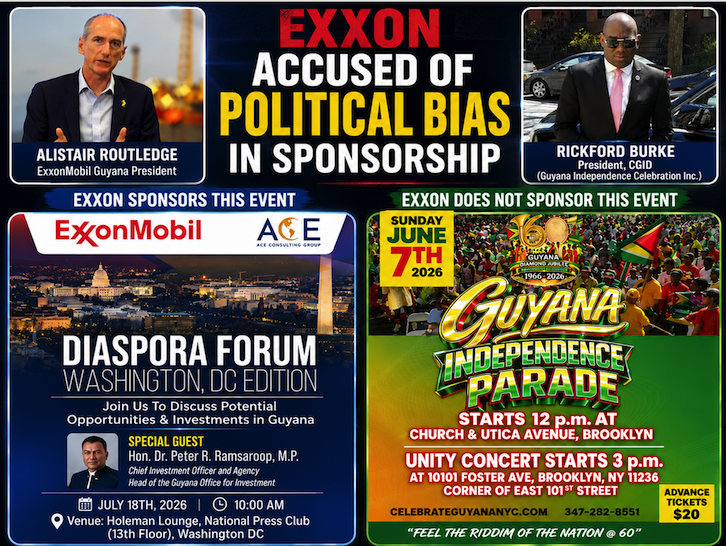
ExxonMobil Is Sponsoring This PPP Event
In a statement, Burke directly accused the company of favoritism, asserting that “ExxonMobil is sponsoring this PPP event.” He further claimed that “ExxonMobil has sponsored only PPP events in the Diaspora,” pointing to a clear pattern of selective financial backing.
The controversy centers on claims that when diaspora groups—particularly those supported by African Guyanese—previously requested sponsorship, they were turned away. According to Burke, Nakisha Burns, the Public and Government Affairs Country Manager for ExxonMobil Guyana Limited, “advised that ExxonMobil only sponsors or focuses on sponsorship opportunities in Guyana, not the diaspora.”
Burke dismissed this explanation outright, stating: “That assertion obviously lacks credibility!” The CGID president argued that this dismissive attitude reveals a double standard in how the company engages with different segments of the Guyanese community.
Burke went further, alleging that ExxonMobil’s conduct is not merely partisan but deliberately benefits one ethnic constituency over another. “Clearly ExxonMobil is playing partisan PPP politics in Guyana and appears to be operating in a manner that benefits the PPP and its supporters,” he stated.
NGOs Echo Concerns Over ExxonMobil’s Funding Patterns
Backing up Burke’s claims, this publication spoke to a local NGO manager who stated that ExxonMobil’s giving “seems politically directed by the PPP” and that its funding entities “have frequently decided not to sponsor our organization and we do not know why. Perhaps we are perceived to be too independent or not outwardly supportive of the PPP. I often wonder if ExxonMobil representatives have decided to weaponize giving”
Another NGO offered a more pointed observation regarding the ethnic dimension of the company’s giving, stating: “Observe which NGOs get big funding from Exxon, it’s usually the East Indian led organizations.”
These statements from local civil society groups lend weight to Burke’s broader allegation that ExxonMobil’s corporate social spending is being channeled in ways that align with the ruling party’s political interests and ethnic support base.
Burke issued a direct warning to the company’s leadership, declaring: “The management of ExxonMobil Guyana Limited should be put on notice that we in the diaspora would not allow them to play PPP race based politics in Guyana.”
The allegations come amid broader concerns about foreign corporate influence in Guyana’s rapidly developing oil sector. Critics have previously raised questions about the terms of Guyana’s oil agreements and the outsized role foreign companies play in the country’s political and economic affairs.
Burke is now calling on U.S. lawmakers to examine the company’s operations. He asserted that “Members of Congress should examine ExxonMobil’s operations in Guyana.” He further urged that they “should also seek to determine whether ExxonMobil is using its resources to benefit the ruling party in Guyana.”
The CGID president framed the issue as one of democratic integrity, suggesting that corporate influence over political events could undermine fair political competition in the country.
ExxonMobil has not yet responded to the specific allegations raised regarding the denial of diaspora sponsorship requests or the claims of ethnic bias in its funding decisions.
ExxonMobil has previously framed its presence in Guyana as a non-partisan economic contributor supporting the development of the nation’s energy sector. The company maintains a stated policy of refraining from political contributions in nations outside the United States.