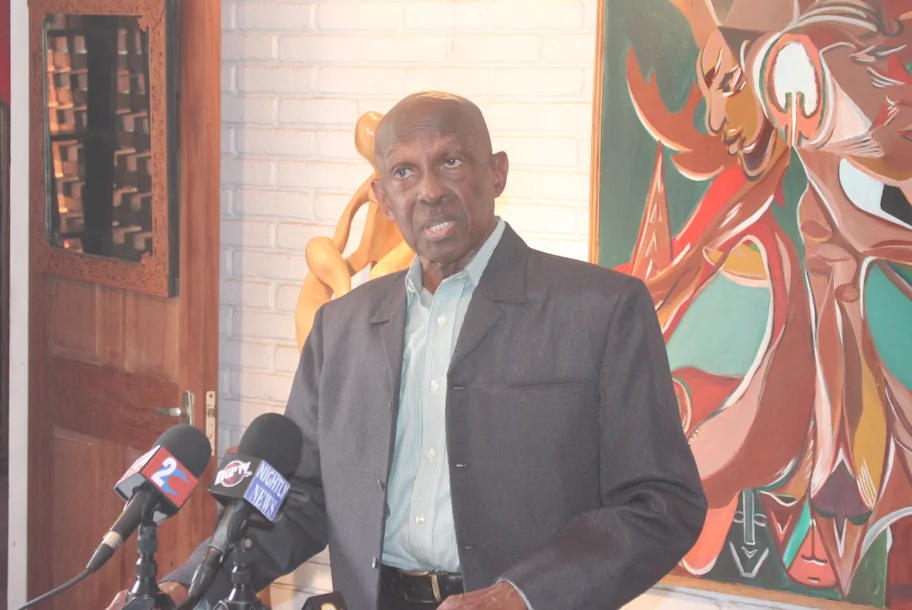
As Guyana marks the 62nd anniversary of one of the darkest episodes in its pre-independence history, former Prime Minister Hamilton Green is urging the nation not only to remember the victims of the Abraham family tragedy but to reflect on the dangers of political division, racial hostility and inflammatory rhetoric.
In a letter published in today’s Village Voice News, Green called for renewed national reflection on the June 12, 1964 firebombing of the Hadfield Street, Georgetown, home of senior public servant Arthur Alexander Abraham, a horrific attack that claimed the lives of Abraham and seven children during one of the most turbulent periods in Guyana’s political history.
“The coincidence of the Abraham family fire taking place on a Friday, the 12th June 1964, and that this Friday marks the 62nd anniversary of that tragic event allows me to ask the media to reprint, unchanged, a letter published in 2020,” Green wrote.
“It must serve to remind those who were not yet born or were toddlers, that we must work together to avoid this type of tragedy taking place again. Next, we must be strong and wise enough to forgive, but not be weak and foolish enough to forget.”
Green, who served as Prime Minister under the People’s National Congress (PNC) administration and remains the lone surviving member of the British Guiana delegation that attended the 1965 Independence Conference in London, which paved the way for Guyana’s independence on May 26, 1966, has long advocated for preserving the historical memory of the country’s political struggles.
He also served as Georgetown’s longest-serving mayor and remains one of the last living political figures with direct involvement in many of the events that shaped Guyana’s transition from colonial rule to independence.
A Nation on the Brink
The Abraham family tragedy unfolded against the backdrop of one of the most volatile periods in British Guiana’s history.
The early 1960s were marked by intense political rivalry among the People’s Progressive Party (PPP), the People’s National Congress (PNC), and the United Force (UF), as well as escalating racial tensions between Afro-Guyanese and Indo-Guyanese communities.
The political instability was further amplified by Cold War geopolitics, labour agitation, bombings, assassinations, riots and communal violence that left the colony deeply divided.
In his letter, Green sought to place the tragedy within that wider context, recalling efforts by then Trinidad and Tobago Prime Minister Dr. Eric Williams to broker peace among Guyana’s political leaders.
Quoting from his book From Pain to Peace (1953-1964), Green recalled that in May 1964, Williams invited delegations from the PNC, PPP and UF to Port-of-Spain in an attempt to resolve the political deadlock that had gripped the colony.
The talks ultimately failed.
“In spite of his efforts, he failed to break the deadlock existing between the three political parties,” Green wrote.
The political environment deteriorated further upon the delegations’ return.
Green recounted incidents including the killing of Joslyn John at De Kinderen, the murder of a young man from Buxton, and the racial violence that erupted at Wismar, where Indo-Guyanese residents were attacked and hundreds of homes and businesses were destroyed.
He also referenced the circulation of an inflammatory publication entitled Attention Indians, which resulted in criminal charges against several individuals.
“The language of the publication was inflammatory and tended to worsen an already racially divided nation,” Green noted.
The Abraham Family Fire
It was against this backdrop that tragedy struck in the early hours of June 12, 1964.
According to Green’s account, an incendiary device was thrown into the Hadfield Street residence of Arthur Alexander Abraham, then Permanent Secretary in the Ministry of Works and Hydraulics and a former Permanent Secretary in the Office of the Premier.
“June 12, 1964: In the early hours of the morning, an incendiary device was thrown into the Hadfield Street home of Mr. A.A. Abraham, former Permanent Secretary to Dr. Jagan and Permanent Secretary, Works,” Green wrote.
“Mr. Abraham and seven children perished in the fire, which engulfed his home. Mrs. Abraham and his daughter, Ann, jumped through a window and escaped. The only survivors of a beautiful family.”
The attack shocked the nation and remains one of the most haunting symbols of the political and racial violence that plagued British Guiana in the years leading up to independence.
Green described Abraham as “a dedicated son of Guyana” and “a man of unquestionable integrity and a public servant of competence, highly respected by one and all.”
He noted that Abraham, a graduate of St. Stanislaus College, had risen to one of the highest positions in the public service and had been involved in public education efforts ahead of the 1964 elections.
Green also referenced allegations that circulated at the time suggesting Abraham had been sharing information with UF leader Peter D’Aguiar, though he stopped short of drawing any conclusions about those claims.
Call for National Recognition
More than six decades later, Green argues that the tragedy has not received the level of national recognition it deserves.
“There is no Monument for the Abraham Family and I offer for consideration that a plaque or marker be placed at the spot on Hadfield Street to remember their martyrdom,” he wrote.
He also proposed special prayers at the Brickdam Cathedral and suggested that June 12 be formally recognised in the national calendar as “another Black Friday.”
“Further, this date be placed in our National Calendar as another Black Friday,” Green stated.
Throughout the letter, Green repeatedly returned to what he sees as the broader lesson of the Abraham tragedy: the dangers of political extremism and societal division.
“Let us use this anniversary of the Abraham martyrdom to call upon our political and business leadership to avoid the beating of war-drums,” he urged.
The former Prime Minister also reflected on historical examples ranging from the Trojan War to World War II and Cold War politics, arguing that leaders often fail to recognise warning signs until it is too late.
“On this Day, we hope that all of our leaders recognise that the challenge of democracy requires maturity, integrity and a passion to ensure that the welfare of Guyanese must be of primary importance,” Green wrote.
Sixty-two years after the Abraham family was consumed by flames and two generations after Guyana achieved Independence, Green’s message is clear: a nation that forgets the consequences of political hatred risks repeating them.
The tragedy remains a stark reminder that beneath every political conflict are real lives, real families and irreversible losses. For Green, remembering the Abraham family is not simply an act of historical reflection—it is a warning to present and future generations about the devastating cost of division.