The Guyana Trades Union Congress (GTUC) on Monday wrote Minister of Labour and Manpower Planning Keoma Griffith demanding an urgent and independent investigation into the death of an Indian national at the EKAA HRIM Earth Resources quarry operation in Batavia, Region Seven, amidst growing concerns over labour standards, migrant worker protections, and workplace safety in Guyana’s expanding extractive sector.
The union body said it is “deeply alarmed” by reports surrounding the worker’s death last week while on the job at the quarry site. Although the company reportedly stated the employee died from a heart attack, the GTUC argued that such a claim does not remove the legal and moral obligation for a full investigation.
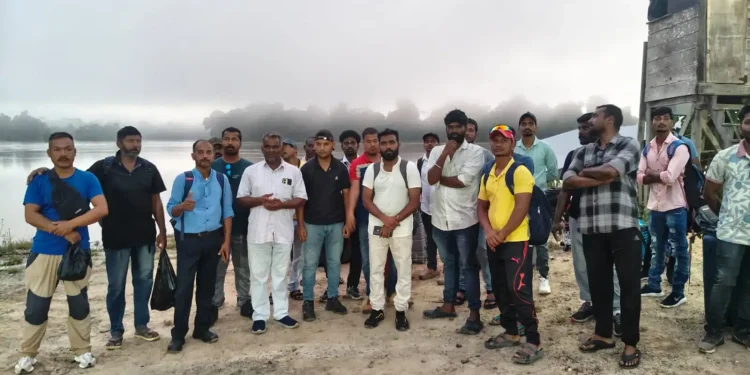
The incident has drawn wider public attention following reports by Indian workers at the quarry alleging poor working and living conditions, withheld wages, confiscated passports, and limited access to transportation and medical care in the remote hinterland location. Reports identified the deceased worker as Sekhar Chhetri. The company has maintained that medical findings and a post-mortem examination indicated the worker died from a heart attack, but the death has since triggered calls for closer scrutiny of labour practices at the operation.
“A worker died at a workplace. That fact alone demands scrutiny under occupational safety and health laws and internationally accepted labour standards,” the GTUC stated.

General Secretary Lincoln Lewis said the incident raises troubling questions about labour practices, occupational safety, the treatment of migrant workers, and what he described as the unchecked movement of labour into Guyana under potentially exploitative conditions.
“The time has come for the authorities to stop treating these matters casually. Guyana cannot boast about economic growth and investment while workers—particularly foreign workers brought into this country—are potentially being placed in unsafe and exploitative conditions,” Lewis stated.
The issue emerges amidst heightened scrutiny over whether Guyana’s labour oversight systems are keeping pace with the country’s rapid economic expansion since the 2015 discovery of commercially viable offshore oil reserves by ExxonMobil. The oil boom has transformed Guyana into one of the world’s fastest-growing economies and triggered a surge in foreign investment and imported labour across the mining, construction, oil and gas, and infrastructure sectors.
Labour advocates and opposition voices have increasingly questioned whether state agencies possess the capacity to effectively monitor workplace conditions, particularly in remote hinterland regions where mining and quarry operations are often located.
The GTUC reminded the Government that Guyana is a signatory to the International Labour Organisation’s core labour standards, including conventions relating to safe and healthy working conditions, non-discrimination, freedom from exploitation, and protections for migrant workers.
The Congress said it is particularly concerned about apparent deficiencies in the State’s oversight of labour mobility and foreign worker arrangements.
“The importation and deployment of labour must never occur in a manner that undermines the rights, dignity, safety, or protections afforded to workers under national law, CARICOM obligations, international labour conventions, and universally accepted human rights principles,” the statement said.
Lewis warned that Guyana must not allow economic growth to come at the expense of worker protections.
“We are part of CARICOM and the wider international community. Guyana must not become a territory where labour is abused, exploited, or subjected to unsafe conditions by private operators while State agencies look the other way,” he declared.
According to the GTUC, the matter extends beyond a single workplace death and raises wider concerns about labour relations, occupational safety enforcement, and the management of foreign labour within Guyana’s booming economy.
“The issue extends beyond one death at one quarry. It touches fundamentally on the future of labour relations in Guyana, the management of foreign labour, workplace inspections, occupational health and safety enforcement, and whether economic expansion is being pursued at the expense of workers’ rights and human dignity,” the Congress stated.
The GTUC is calling for:
- An immediate and independent investigation into the death at the EKAA HRIM Earth Resources quarry;
- A comprehensive review of labour practices involving foreign workers in Guyana;
- Full disclosure of employment, immigration, and occupational safety arrangements governing these workers;
- Stronger enforcement of occupational health and safety standards across the mining and extractive sectors; and
- Parliamentary and public scrutiny of the State’s management of labour mobility and migrant worker protections.
The organisation also called on the Ministries responsible for Labour, Home Affairs, and Natural Resources to publicly account for systems currently in place to monitor the welfare, safety, movement, and legal protections of foreign workers operating in often dangerous and isolated hinterland locations.
“Economic development cannot and must not be built on weak labour oversight, silence, or indifference. The Government has an obligation to ensure that every worker in this country—Guyanese or foreign—is protected under the law and treated with dignity,” Lewis declared.