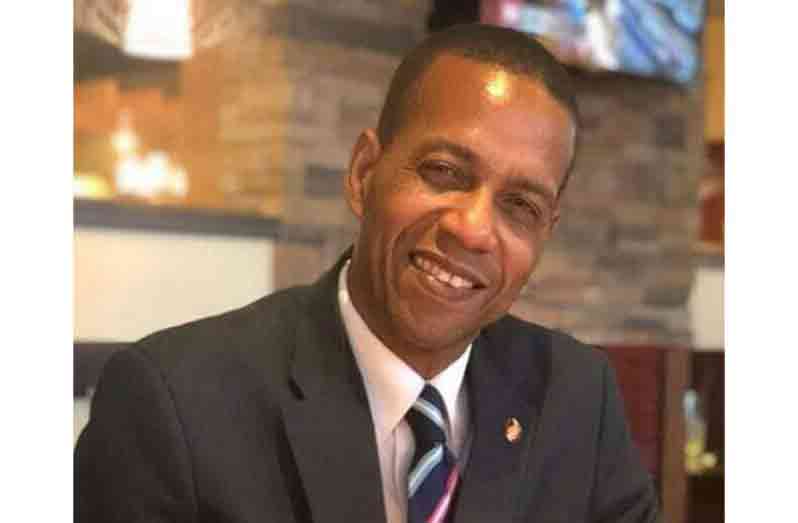
Social activist and host of Straight Up with Mark Benschop on 107.1 FM, Mark Benschop, has launched a blistering criticism of the prolonged non-sitting of Guyana’s Parliament, declaring that democracy in Guyana is effectively “dead under the PPP” as pressure intensifies for the National Assembly to reconvene after more than three months without a sitting.
Benschop’s comments come amidst growing public concern over the inactivity of the 13th Parliament and mounting demands from civil society and political groups for the restoration of regular parliamentary oversight at a time when Guyana is managing billions of dollars in oil revenues and unprecedented state spending.
Today, the Forward Guyana Movement (FGM) submitted a citizen-backed petition to Clerk of the National Assembly Sherlock Isaacs calling for Parliament to convene immediately and for key oversight bodies, including the Public Accounts Committee (PAC) and sectoral committees, to be constituted without further delay.
The petition argued that the prolonged dormancy of Parliament undermines constitutional governance and weakens democratic accountability.
As of today, Guyana’s Parliament has not sat for 95 days and counting.
The issue has become increasingly contentious as Guyana undergoes one of the most dramatic economic shifts in the world following the 2015 offshore oil discovery by ExxonMobil. Trillions of dollars in projected oil wealth have transformed the country into a major petroleum-producing nation, fueling massive public spending, large-scale infrastructure expansion, and multi-billion-dollar state projects. Yet, as oil revenues continue to flow, growing sections of society are questioning whether the mechanisms responsible for parliamentary oversight, transparency, and accountability are functioning effectively enough to safeguard the nation’s resources and democratic institutions.
The prolonged absence of Parliament also means reduced legislative scrutiny of government spending, borrowing, contracts, natural resource management, and public policy decisions. The failure to constitute oversight bodies such as the Public Accounts Committee — traditionally one of Parliament’s most important accountability mechanisms responsible for examining state expenditure and Auditor General reports — has further intensified concerns over transparency and democratic governance.
Speaking with Village Voice News, Benschop said the role and integrity of Parliament have deteriorated significantly under the People’s Progressive Party/Civic (PPP/C) administration.
“Parliament is not what it used to be. And when we look at the objective of Parliament, under the People’s Progressive Party (PPP) regime, they obviously have no respect for the House. They have no respect for the Laws of Guyana. They have no respect for the Constitution. They have no respect for the three branches of government and their functions. They have no respect for democracy,” Benschop stated.
He argued that parliamentary sittings are now determined primarily by political convenience rather than constitutional responsibility or public interest.
“They call Parliament only when it’s convenient for them, when it suits their agenda, and when they want to thief more money from the taxpayers of Guyana,” he said.
Benschop contended that Parliament no longer functions as a forum for substantive debate on issues affecting ordinary Guyanese.
“And so going into Parliament and argue on policies, real issues that are affecting the Guyanese people, is no longer the case. That has long gone out of the door under the PPP regime.”
The social activist went further, characterising the current political environment as authoritarian.
“So what we have there in Guyana is what is considered a barefaced dictatorship.”
The concerns raised by Benschop mirror broader criticisms from governance advocates, opposition figures, and civil society organisations who argue that the continued absence of Parliament weakens one of the Constitution’s core democratic safeguards — legislative oversight of the Executive.
In its petition, the Forward Guyana Movement stated: “The Constitution is clear: sovereignty belongs to the people of Guyana, and it is exercised through Parliament. When Parliament does not function, when it fails to sit regularly, when its oversight committees remain unconstituted, and when citizens cannot follow or engage with the parliamentary process, that sovereignty is denied.”
FGM representative and parliamentarian Amanza Walton-Desir has also written members of the international community raising concerns about the constitutional implications of the prolonged parliamentary shutdown and the broader state of democratic governance in Guyana.
The movement is calling for Parliament to reconvene immediately, for a structured parliamentary calendar to be published, and for all standing and sectoral committees to be constituted so that government policy, spending, and administration can be properly scrutinised.